














Virtual Reality Training That Prepares Teams for the Real World
Create VR training simulations that allow employees to learn through realistic scenarios, practice decision-making, and gain job-ready skills without entering complex or high-risk situations.
What is Virtual Reality Training?
Virtual reality training provides simulated, authentic work environments in which employees can safely practice tasks, procedures, and decision-making. VR training solutions enable learners to practice scenarios, acquire new skills, and prepare for workplace conditions without disrupting operations or risking unnecessary injuries or safety incidents.
Why Virtual Reality Training Works Better for Modern Teams
Safer Practice
Employees can practice hazardous, technical, or high-pressure situations without endangering actual people, equipment, or live operations.
Lower Training Costs
The costs of repeated travel, instructors, equipment, facilities, and scenario setup are all saved for larger workforce training programs using VR.
Freedom to Make Mistakes
Learners gain the opportunity to practice, make errors, attempt again, and refine decisions in a safe environment before they get real-world consequences for their mistakes on the job.
Higher Engagement
Immersive training allows learners to remain engaged in the scenario being presented, taking away the passivity of classroom training or watching videos.
Consistent Training Delivery
Organizations can provide uniform scenarios, processes, guidelines, and performance standards among various teams, facilities, and locations.
Flexible Workforce Training
VR employee training can be implemented for distributed employee teams and repeated training without all employees traveling to a single training site.
Why Choose Euphoria XR for Immersive Workforce Training?
Euphoria XR’s custom VR training solutions are based on actual workplace scenarios, operational risks, and business objectives. Our team handles everything from scenario planning to interaction design, generating 3D content, building the simulation, integrating the hardware, deploying it, and providing technical support.
Our immersive training solutions support organizations in training their employees in realistic environments while minimizing disruption to live operations and unnecessary risk to teams. These experiences can enhance consistent and scalable learning in areas such as safety, equipment handling, onboarding, compliance, technical abilities, and leadership growth.
Enterprise VR training can integrate real-life situations with company-specific content, learning analysis, performance monitoring, and decision-making based on scenarios. This transition enables businesses to progress from traditional teaching methods to standardized, measurable training programs that are more aligned with actual job performance.
Hire VR Developer
★ ★ ★ ★ ★
Train Smarter. Scale Faster. Perform Better.
Enhance enterprise VR with immersive scenarios around your workspace so teams can master the necessary skills, bolster readiness, and acquire the knowledge at all locations.
Use Cases of Virtual Reality (VR) Corporate Training

Train Smarter. Scale Faster. Perform Better.
VR sales training immerses employees in genuine buyer conversations, allowing them to practice their pitches, address objections, enhance their messaging, and boost their confidence. This is achieved through repeatable scenarios aimed at improving communication, persuasive skills, and preparedness for authentic customer engagements.

Customer Service VR Role Play Training
Customer service VR role play simulates difficult interactions and helps staff practice being empathetic, de-escalating, solving problems, and communicating. Repeatable scenarios enable teams to increase response quality, confidence, consistency, and preparedness to address complex customer scenarios successfully.

Compliance Training With VR Scenarios
VR compliance training allows employees to practice policies, procedures, and regulated responses safely in realistic scenarios. Interactive simulations help reinforce correct actions and highlight errors, teaching without the need for manuals, classroom sessions, or instructions.

VR-Based Technical Skills Practice
VR technical skills training allows staff to simulate equipment, maintenance, or assembly and repair procedures, troubleshooting, and operations workflows. Learners have the opportunity to repeat system processes safely and reinforce accuracy, as well as develop practical competence, before attempting systems work.

VR Equipment Operation Training
Virtual reality (VR) equipment training simulates machinery, control systems, operating methods, and safety protocols within engaging environments. Workers can repeatedly practice using the equipment, enhance their understanding of procedures, and gain confidence before handling actual systems in real workplace settings.

Conflict Resolution Training Simulations
Conflict resolution simulations are realistic scenarios of workplace conflicts to practice listening, communicating, negotiating, and de-escalating in conflict situations. The teams develop positive responses and enhance their judgment and confidence in successful meetings through repeated scenarios.

Scenario-Based VR Training
Scenario-based VR training puts employees in as realistic situations as possible where decisions made have consequences. Judgment, communication, procedures, and problem-solving can be practiced a number of times, which enables teams to become more confident, consistent, and ready to manage more complex scenarios, without risk of real-world implications.

VR Simulation Training
VR simulation training creates realistic environments, equipment, tasks, and hazards, providing employees with a safe environment to practice what they are meant to. Learners practice, receive feedback, and improve their skills in scenarios before replicating that in operation.

Virtual Reality soft skills / behavioural training
VR soft skills training is a role-play immersive training that reinforces communication, empathy, teamwork, leadership, decision-making, and emotional intelligence. Realistic simulations allow employees to respond, to give feedback, and to gain confidence in scenarios that replicate real-life challenges.

Virtual Reality Fire Safety Training
Virtual reality fire safety training involves employees in simulations of real fire emergencies to enable them to practice fire scene assessment, fire hazard recognition and identification, extinguisher operation, and decision-making. Multiple simulations increase preparedness, confidence in responding, and safety awareness without putting the learners at risk.

VR Onboarding & Orientation Training
VR onboarding training involves immersive environments that help introduce new employees to the workplace, procedures, equipment, workplace safety expectations, and company processes. This helps new hires become more comfortable with real-life scenarios and basic tasks, and gain confidence before they move on to live operations or a customer-facing position.

VR Cybersecurity Awareness Training
VR cybersecurity awareness training puts staff in realistic scenarios that involve phishing, social engineering, access control, and data security. This helps employees learn to identify risks and practice safer decision-making with interactive simulations before encountering real-world threats to security.
Virtual Reality Training Market Trends
- Workforce training and development
- HealthCare
- Education
- Manufacturing
- Automotive
The VR corporate training market is estimated to reach $16.64 billion in 2026 and $41.10 billion by 2031, reflecting increased investment among enterprises in immersive workforce training. Safety, compliance, technical training, and soft skills continue to be key applications in manufacturing, healthcare, retail, and other industries.
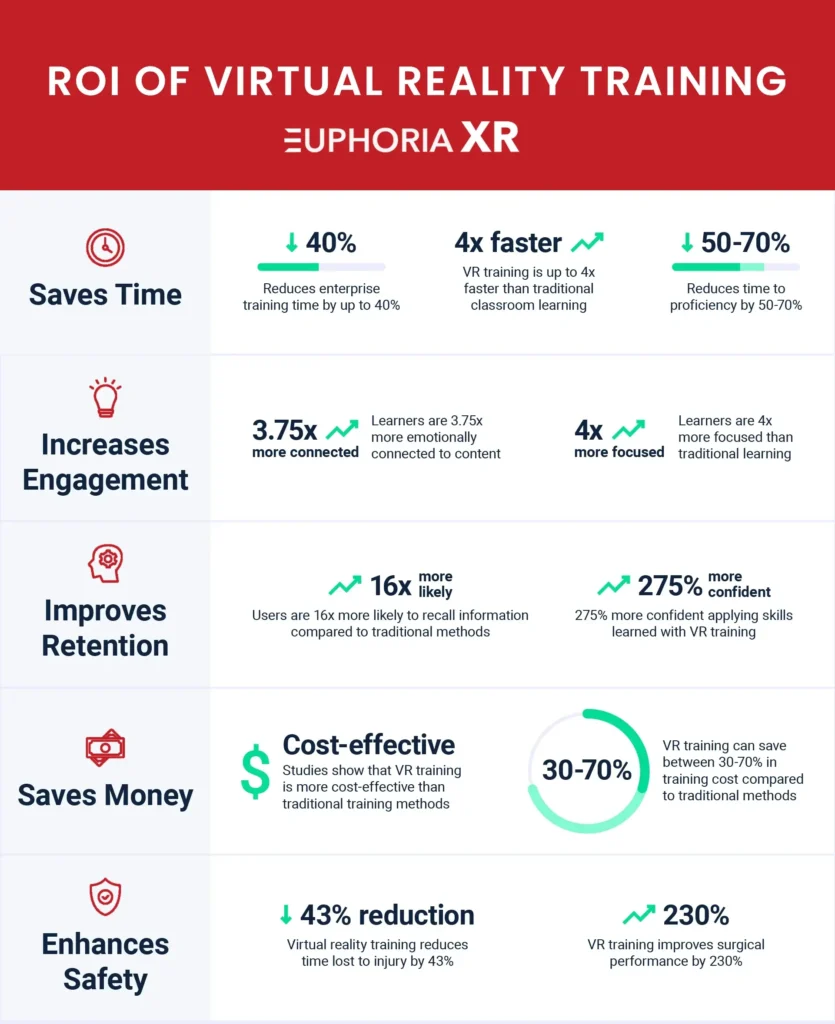
PwC research also revealed in its study on soft skills that people who have experienced VR training completed the training four times faster than those in the classroom, supporting the methodology’s ability to scale employee development.
How Industries Use VR Training to Build Real-World Skills
VR in Retail
VR in Retail
VR in Education
VR in Education
VR in Sales & Marketing
VR in Sales & Marketing
VR in Entertainment
VR in Entertainment
VR in Real Estate
VR in Real Estate
VR in Machinery
VR in Machinery
VR in Manufacturing
VR in Manufacturing
VR in Media
VR in Media
VR in Aerospace
VR in Aerospace
VR in Industrial Design
VR in Industrial Design
VR in Healthcare
VR in Healthcare
VR in Automotive
VR in Automotive
Train for Real Risks Before They Become Real Consequences
The VR safety training simulations make decisions, identify hazards, and develop better responses to traffic, workplace, or emergencies without the real-world risks or hazards.
VR Projects Built for Real-World Training and Engagement
Delve into the world’s most immersive VR experiences, designed for use in aviation field skills training, road safety awareness, and interactive brand engagement in any real-world environment.
Frequently Asked Questions (FAQs)?
What is virtual Reality Training?
Virtual reality training is a simulated environment that depicts realistic workplace situations where individuals can practice tasks, procedures, and decisions safely before they happen in real-world settings.
What are the benefits of virtual reality training?
They offer advantages such as practicing in a safer environment, simulated scenarios, improved engagement, the ability to deliver training in the same way repeatedly, the ability to map out performance, and minimal disruption to live operations.
What is the downside of virtual reality training?
Some disadvantages include hardware cost, discomfort from movement, restriction of the device, time-consuming production of the content, and requirements for correct technical setup and learner support.
What are three disadvantages of VR training?
Maintenance of compatible hardware and software, ability to cause motion sickness for some users, and initial equipment setup are three common disadvantages.
What companies are using VR training?
VR training is used by businesses in manufacturing, retail, aviation, healthcare, automotive, logistics, and public safety for safety, onboarding, technical, and scenario-based training.
What is the difference between AR and VR training?
VR places learners inside a fully simulated environment, while AR overlays digital guidance or information onto the learner’s real-world surroundings.
Is virtual reality learning effective?
Yes. VR can be used effectively in learning, as it can create realistic situations, repetition, active engagement, and real-time feedback for the learner, especially in terms of procedural, technical, and scenario-based skills.
How long does it take to learn VR?
Learning time depends on the task and training complexity. Basic experiences can take minutes to grasp, and advanced technical skills can take repeated sessions and practice.
What are examples of virtual reality?
These include flight training, medical training, material and product demonstrations, product testing, positioning displays, customer-service role play, emergency response, safety drills, and virtual classrooms.
What professions use VR?
VR is applied to professions that demand practical experience, such as healthcare professionals, manufacturing workers, sales teams, teachers, firefighters, designers, engineers, technicians, and pilots.
How much does virtual reality training cost?
The costs depend on the complexity of the simulations, 3D content, hardware, integration, analysis, number of users, and deployment needs. Custom enterprise VR training is typically priced on a project basis.
Insights Shaping the Future of VR Training
Company's Stats
Successful Projects
Success Rate
Pro Team Members
Years of Experience






Let's talk about your project
We are here to turn your ideas into reality