














Museums

AR VR in Immersive Museums

AR VR in Media & Marketing - EuphoriaXR
Media & Marketing

AR VR Media and Marketing

AR VR in Fashion & Retail - EuphoriaXR
Fashion & Retail

AR VR in Fashion and Retail

redExperience-Design
Training & Education

AR VR Training and Education

Medical & Healthcare

AR VR Medical and Healthcare

Extended Reality
Game & Entertainment

AR VR Gaming & Entertainment

Are You Spending Too Much Time Training Employees Here’s What You’re Missing - Euphoria XR

Are You Spending Too Much Time Training Employees? Here’s What You’re Missing

Share Article:
Are You Spending Too Much Time Training Employees Here’s What You’re Missing - Euphoria XR
Picture of Amelia Rose Content Strategist & Copywriter
Amelia Rose Content Strategist & Copywriter
Content Strategist & Copywriter
Summarize with:
Table of Contents
Table of Contents
Share Article:

TL;DR

VR employee training means virtual training with actual scenes and situations, as opposed to the traditional teaching or learning method. It supports workers to perform complex tasks without the risk of personnel or equipment issues or stopping work.

Immersive learning allows businesses to normalize training in their various facilities, reduce the amount of training hours required from their teachers, enhance the onboarding process, and capture objective training performance metrics. It is particularly effective for manufacturing, construction, health care, energy, aviation, logistics, and safety training, as well as in high-risk areas, due to its versatility.

With a clear business need in mind, VR employee training can be used to meet training needs with less time, lower costs, greater consistency, and better preparation of employees for real workplace situations.

Businesses spend and invest heavily on employee training. It trains new employees, enhances safety proficiency, introduces new technology, and aids employees in performing their work with confidence.

But there are still a lot of organizations that have to contend with the same issue.

The length of the training is a problem.

Even basic activities require employees to spend hours in classrooms, attend lengthy presentations, wait for equipment, travel to training sites, or work alongside experienced employees. During training, productivity declines, trainers deliver the same training, and production of products is disrupted.

Collectively, the issue of too much training is not the problem.

The issue is that many are adopting methods of training that were developed decades ago for the modern version of the extremely fast-paced work environment.

VR employee training is redefining workforce development.

Rather than reading through manuals and watching demonstrations, workers and agents immerse themselves in a realistic virtual environment where they have the freedom to perform, make decisions, solve problems, and receive instant feedback without risk to production or the risk of putting people, materials, and equipment at risk.

A survey by PwC revealed that employees who took VR-based “soft skills” training finished up to 4 times quicker than classroom-based training and had increased in terms of confidence and engagement following VR training. These results illustrate the growing relevance of “immersive learning” as a viable tool for educational purposes and not an experimental one in the world of business.

From cutting down onboarding times to boosting safety to decreasing training expenses to getting employees ready before they go from the classroom to real-life environments, virtual reality (VR) training solutions are an even more scalable investment in advancing organisations’ training personnel. 


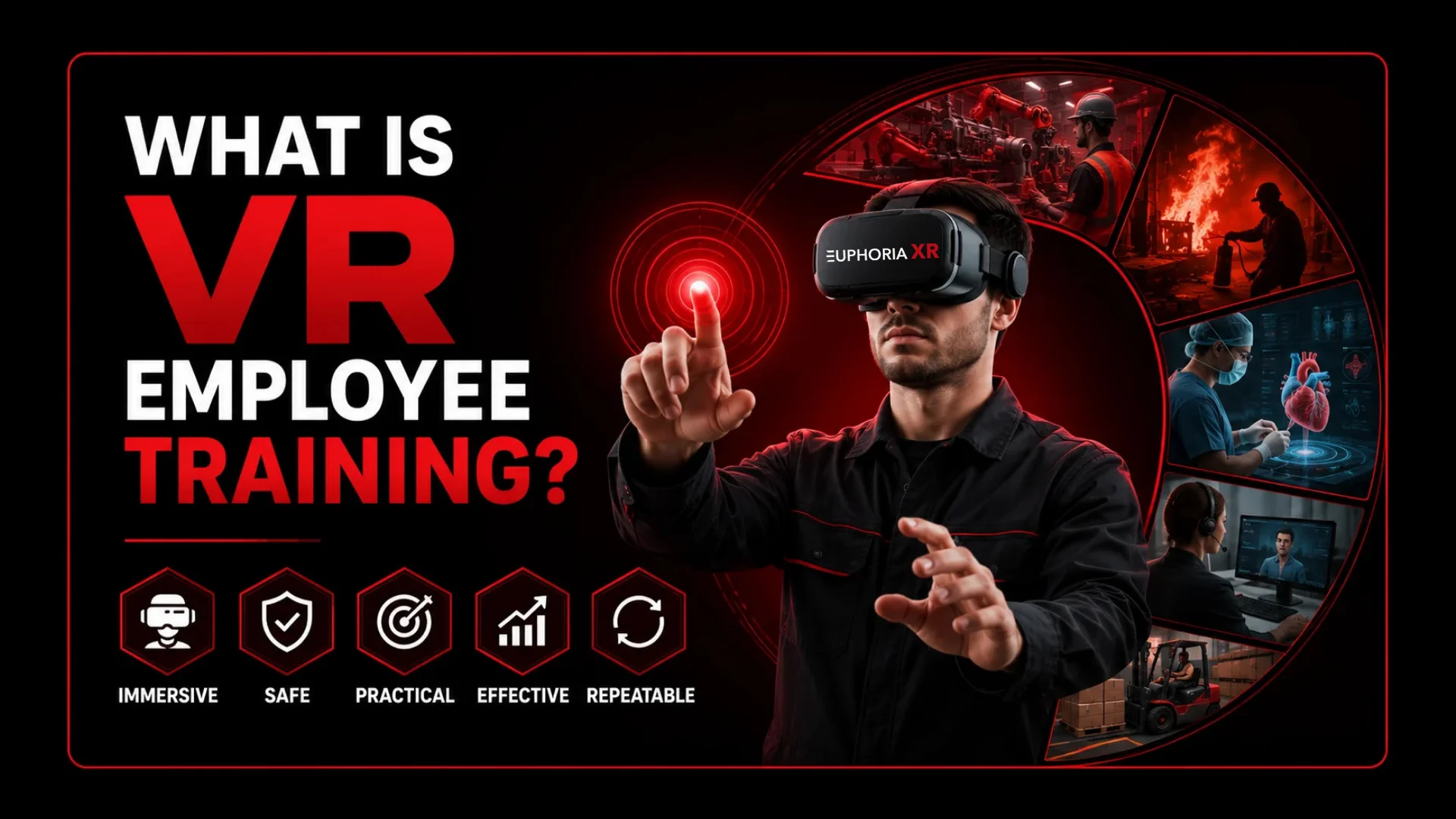
What is VR Employee Training?

VR employee training is a way of learning that involves a VR headset and interactive simulations to simulate an actual job-related task. Staff can practice procedures, learn to run equipment, react to risks, and make decisions within a secure digital landscape.
What is VR Employee Training - Euphoria XR

It is different from videos or classroom lessons in that the person can learn by doing. The learner is actively engaged in the task, gets feedback, and retries the task in difficult steps before going to the real environment.

It is used for onboarding, safety, manufacturing, equipment operation, customer service, healthcare, emergency response, and soft skills development in companies. 

Make the most time-consuming and risky training activity a focused VR Pilot experience. 

How Can VR Improve Employee Training?

VR offers employee training that increases workforce development through increased practicality, uniformity, safety, and measurable outcomes. 

Immersive and Experiential Learning

Instead of individuals relying upon reading instructions or watching demonstrations, they learn in realistic scenarios set in the workplace. This enables them to learn how to complete the activity when it is done in reality. 

Consistent Training Across the Workforce

All staff members are given the same instructions, scenarios, and expectations of performance. This minimizes variation between trainers, venues, and timetables. 

Higher Knowledge Retention and Recall

People tend to remember how to do a procedure more strongly if they do it themselves. VR is a connection between information, environment, and action and consequence. 

Safer Practice Environments

Workers can perform dangerous or high-risk work without injury to themselves, other workers, equipment, or operations. 

Repeatable Training Without Additional Resources

Simulations can be replicated by employees without needing new materials, live animals, traveling, and permanent supervision. 

Measurable Employee Performance

VR systems allow for the monitoring of completion time, errors, missing steps, accuracy of decision-making, attempts, and assessment scores. Managers can observe if members are ready for subsequent real jobs. 


Why Does VR Employee Training Work Faster Than Traditional Training?

Traditional Training Challenge How Does VR Employee Training Save Time?
Employees Wait for Trainers Simulations Can Be Started When the Learner Is Ready
Equipment Is Not Always Available Employees Practice with Virtual Equipment
Long Lectures Delay Practical Learning Learners Begin Performing Tasks Immediately
Mistakes May Go Unnoticed VR Provides Instant Feedback
Training Must Be Repeated by Instructors The Same Digital Module Can Be Reused
Employees Travel to Training Facilities Training Can Be Delivered at Different Locations
Full Courses Are Repeated for One Weak Area Employees Can Repeat Only the Steps They Struggle With
Live Training May Stop Operations Virtual Practice Does Not Require Production Downtime

How to Reduce Employee Training Time With VR?

VR can cut employee training time by solving the need for repeated explanations, access to equipment, risk, and instructor supervision during training.

Start With a Repetitive or Time-Consuming Procedure

Use a task in which trainers have to repetitively provide explanations or one that requires employees a long time to learn. Equipment inspection, safety protocols, facility, and emergency response are good examples. 

Break Training Into Short Practice Modules

Implement one longer course into shorter simulations on a particular task. Short modules can be easily repeated, easier to achieve, and easier to measure. 

Train Employees Before They Use Live Equipment

Let staff first be trained in VR to know controls, processes, and safety procedures before entering real machinery. This will save the time to teach basic training in real time. 

Identify Training Gaps Through Performance Data

Get the details of employees’ steps missed and misperformed with VR analytics. Managers can choose to give focused practice rather than a repetition of the course. 

Use Instructor Time for Coaching

Allow standard instructions and repeated demonstrations to be performed by the VR simulation. Trainers will have more time to focus on correcting performance, answering questions, and advanced skills. 

What Companies Save With VR Employee Training?

The cost of VR is lower than the cost of classroom sessions and also provides training that can save more. It can also save time, equipment, travel, and operational resources needed to train employees using conventional training techniques.

There are ways in which companies can save money and time in multiple aspects:

Employee training hours: Workers can focus on simulations without lengthy classroom training or waiting for equipment.

Instructor hours: Trainers are not required to show the same fundamental practices to all employees or at all locations.

Operational downtime: Employees can learn on virtual machines without interfering with running machines or production lines.

Travel expenses: Teams can receive the same training at different sites, without the need for the team to relocate to a central training point.

Training facility expenses: Businesses will have the ability to cut on the necessity for specialized rooms, actual simulators, or setups to perform training.

Equipment and material costs: With virtual practice, there are no fuel or raw materials, no replacement parts or disposable materials.

Retraining Costs: The manager uses performance data to determine weak points and determine which portions of the course or drills are required and which are not.

Safety-related costs: Mistakes can be made in a safe simulation setting prior to working in a setting where such errors may result in injuries or damage to equipment.

Employee onboarding costs: New hires can become familiar with their role, workplace, and procedures before they start working live. 

The total value will vary from person to person based on the number of employees, the current training practice, and the frequency of the training. If you have a big workforce, you can save some time on each one of the staff members and end up with tons of savings for the whole organization.

Collaborate with a reputable VR development company to create a highly engaging VR employee training solution to minimize downtime, boost preparedness, and expand to teams. 

How Do Companies Use VR for Employee Training and Onboarding?

VR employee training turns ill-feasible, unsafe, or difficult tasks into reality at a lower cost and in a shorter amount of time.

Staff can have procedures carried out, look at real workplaces, learn new technology, and get ready for real work before entering the workplace.


Walmart

Reducing New Technology Training Time by 96%

Walmart took advantage of VR to train people on its Pickup Tower technology.

The old way involved online training, guidance from the instructors, and demonstrations. This process took about 8 hours.

In the VR training, employees were taken in front of the virtual Pickup Tower. They were able to use the system, familiarise themselves with the key process, and to practise using the technology in a realistic environment.

The virtual program shaved off about 15 minutes of training, compared to the eight hours that took place before.

This was a 96% decrease in training duration.

The program demonstrated the benefits of VR training for employees across thousands of sites in one large organization without the need for repeat on-site presentations.


Nationwide Insurance

Reducing Three-Hour Adjuster Training to 25 Minutes

Nationwide Insurance employed VR to educate claims adjusters on water damage.

The former training had to take place in trapped water in basement training facilities. The entire session lasted about 3 hours and involved a trip to a specific training site.

The flooded basement was recreated digitally using the VR simulation process. Adjusters could look into the space, damage, and conduct an assessment without travelling or reconstructing the physical scenario.

There was a great success with the virtual training, taking the three-hour session down to around 25 minutes.

Staff had the opportunity to practise inspection without travel, set up, and lengthy training sessions.

An example here is how virtual reality training simulation can simulate challenging and costly environments that are not easily reproduced. 


United Rentals

Reducing New-Hire Training Time by 40%

VR helped United Rentals enhance its “new hire induction” process for new outside sales reps.

These methods of teaching used to be used by new employees: classroom study and visits to active construction sites. These visits were co-ordinated, involved travelling, needed to be supervised, and undertaken in an appropriate place.

The company developed virtual construction site experiences for employees, which enabled them to visit all equipment, jobsite conditions, and the usual hazards and risks of construction sites.

New hires might find out about the work environment without going to an actual place of employment.

The program cut new hire training time in half.

It also made it easier for United Rentals to onboard people more consistently throughout their extensive network of rental studios.

The case effectively illustrates how VR training can help their employees get up to speed with environments that might be challenging in the initial days at work. 


Where VR Training Solutions Deliver the Most Value?

VR training solutions are best when employees require real-world experiences but training cannot be done live due to risk, expense, availability, or other factors.

It can come in particularly handy for situations in which employees are required to conduct intricate processes, run expensive machinery, or be prepared for scenarios that are unlikely to occur on the job.

There are many practical use cases for VR training solutions, such as:

  • Manufacturing: Train employees in machine operation, maintenance, assembly, inspection, and shutdown without disassembling machines and putting them out of service.

  • Industrial operations: Operators can acquire both technical processes and knowledge about hazards and familiarize themselves with complex machinery in the offline setting before heading into the live environment.

  • Safety and emergency response: Teams can rehearse fires, evacuations, equipment failure, spills, and other emergencies without risk.

  • Construction: Work crews can recognize hazards on job sites, understand proper machine and equipment procedures, and practice working heights, tools, and moving equipment.

  • Oil, gas & energy: Students can train for remote locations, dangerous working environments, heavy machinery & adherence to safety measures.

  • Aviation and aerospace: Workers can safely build, maintain, inspect, and ground a plane and prepare for emergencies without using a real plane.

  • Knowledge: Students have the opportunity to engage in simulations of medical procedures, technology, practitioner-patient relationships, and emergency responses within a safe environment.

  • Warehousing and logistics: Picking and packing, running vehicles, and handling stock, plus safety in the warehouse.

  • Customer service: The staff has the opportunity to practice the skills of handling complaints, difficult conversations, sales, and conflict resolution.

  • Leadership and soft skills: Managers can practice feedback, communication, inclusion, interviewing, and decision-making situations.

  • Employee onboarding: New employees get a chance to explore the facilities, understand their roles, learn about safety requirements, and have realistic experiences at the workplace before they come into contact with the workplace.

  • Compliance training: Consistent, organized instruction and measurable assessment of compliance for teams and locations. 


Virtual Reality Solutions for Workforce Training

Your training requirements, workforce size, and business needs should ultimately dictate the virtual reality training solution that is right for you. Some will require a few basic off-the-shelf modules, but others will need the complete simulation experience that more faithfully models their workplace, their equipment, and their procedures. 

Solution Type Best For Key Benefits
Custom VR Training Simulations Company-Specific Procedures, Machinery, and Workflows Highly Realistic, Tailored to Business Processes, and Scalable Across Teams
Off-the-Shelf VR Training Content General Safety, Soft Skills, Compliance, and Leadership Faster Deployment, Lower Development Cost, and Ready to Use
Multiuser & Instructor-Led Simulations Team Exercises, Emergency Response, and Collaborative Training Enables Multiple Learners and Instructors to Train Together
VR Training Analytics & Assessment Measuring Learner Performance Tracks Completion Time, Errors, Scores, Attempts, and Progress
Learning Management System (LMS) Integration Enterprise Learning Programs Syncs Learner Data, Certifications, and Training Records
Device Management Platforms Large-Scale Enterprise Deployments Simplifies Headset Updates, User Management, Security, and Content Distribution

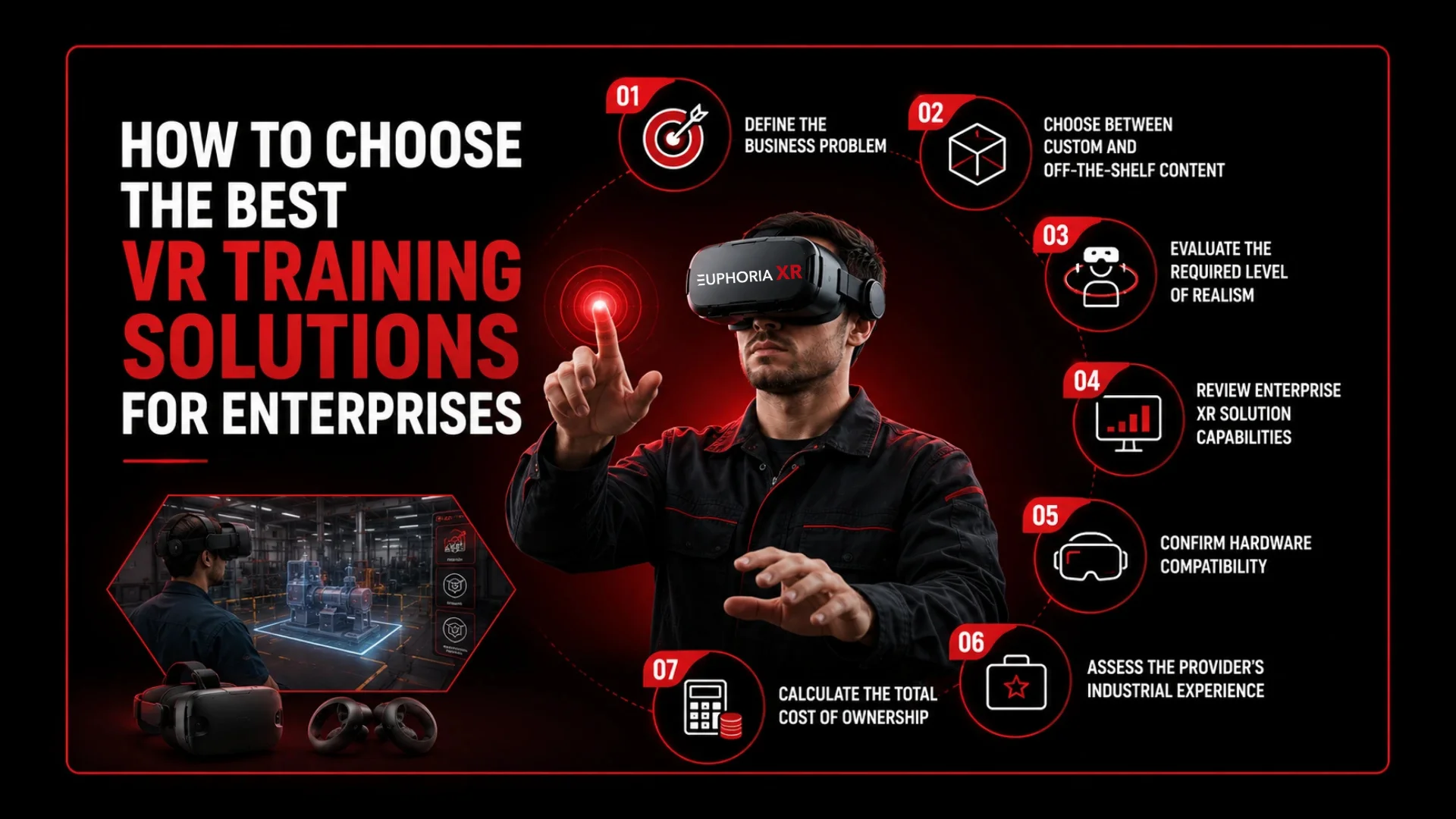
How to Choose the Best VR Training Solutions for Enterprises?

Getting the right VR training solution begins by knowing what you desire to attain in your business, and not only technology. Solutions should address a measurable training problem or need and benefit the advancement of the workforce.
How to Choose the Best VR Training Solutions for Enterprises - Euphoria XR

Define the Business Problem

Determine what problem you are trying to solve, like cutting down a training period, making training safer, saving on training costs, or using a standardized training program for the employees. 

Choose Between Custom and Off-the-Shelf Content

Apply custom simulations for company-specific processes and equipment. Select content that’s ready when it comes to compliance, communication, and workplace safety topics. 

Evaluate the Required Level of Realism

Ensure any simulation matches the objectives of the training. Technical procedure, for instance, may require a high level of realism and soft skills training, a realistic environment, and conversation. 

Review Enterprise XR Solution Capabilities

Check out things like user management, analytics, LMS integration, remote deployment, content updates, security, and multi-location support. 

Confirm Hardware Compatibility

Check that the headset fits your training environment and interaction needs, your comfort, its battery life, and deployment size. 

Assess the Provider’s Industrial Experience

Select a provider with technology and industry experience in instructional design, simulation development, enterprise deployment, and your own industry. 

Calculate the Total Cost of Ownership

Calculate and compare the cost of development, maintenance, original hardware, licensing, support, updates, and administration costs with the long-term savings from the training programme. 

Hire VR Developer expertise to create custom simulations for onboarding, equipment training, safety procedures, and enterprise learning. 

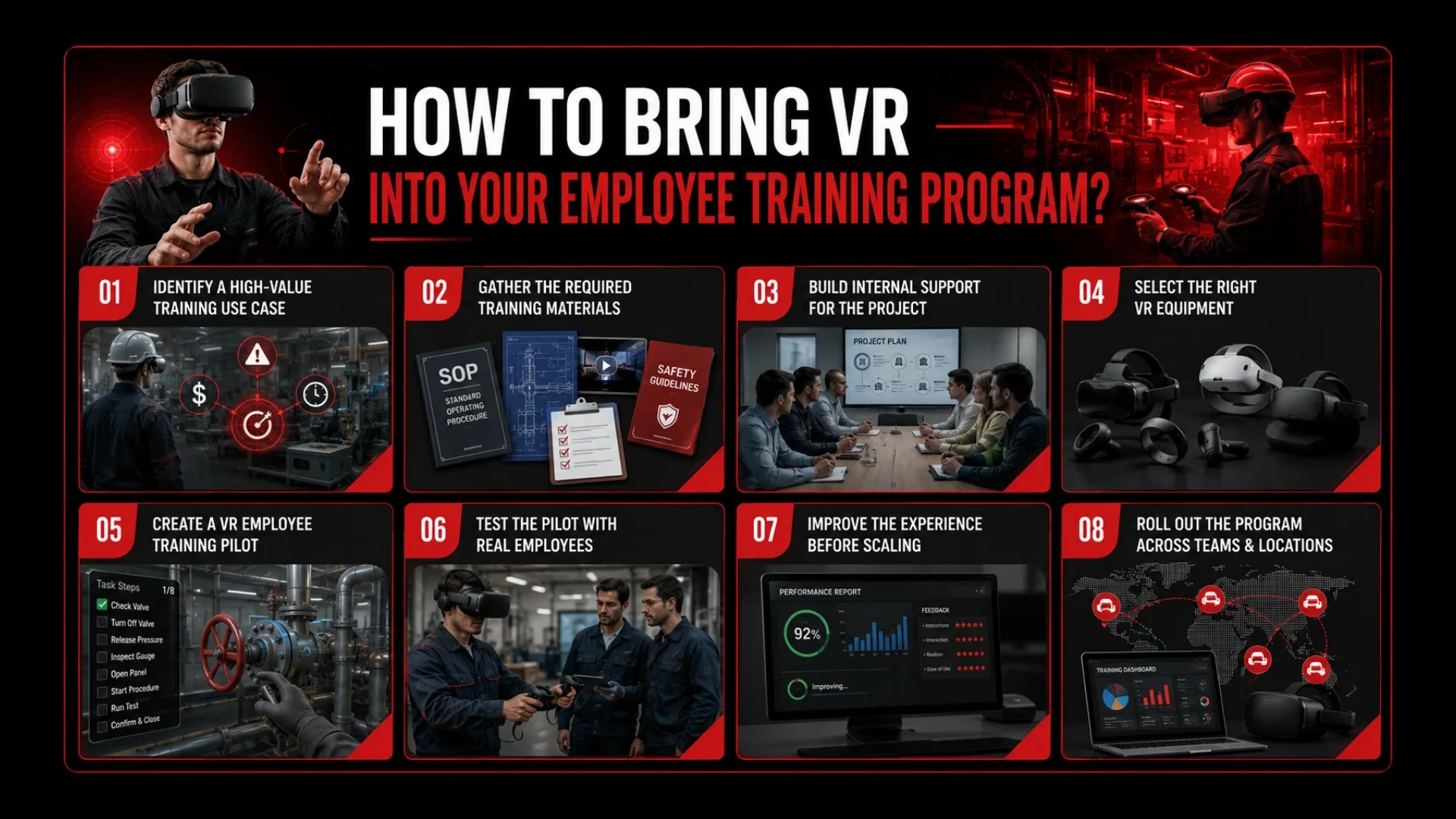
How to Bring VR Into Your Employee Training Program?

When implementing VR, it is important to start with a small-scale pilot instead of replacing all training programs as a whole. Start small, measure outcomes, and grow to a larger scale as the outcomes are positive. 
How to Bring VR Into Your Employee Training Program - Euphoria XR

Identify a High-Value Training Use Case

Choose a procedure that is either repeated, high-risk, costly, or time-consuming and will gain the most from immersive training. 

Gather the Required Training Materials

Gather SOP, CAD models, manuals, videos, safety documents, assessment criteria, and industry subject matter experts’ input. 

Build Internal Support for the Project

Engage operations, learning and development, safety teams, IT, managers, and frontline employees before development. 

Select the Right VR Equipment

Select equipment based on your training setting, motion use, desired visual quality, and deployment requirements. 

Create a VR Employee Training Pilot

Create an entire training simulation that should be built on a well-defined learning objective and have measurable criteria for success. 

Test the Pilot With Real Employees

Watch employees utilize the simulation and provide feedback on its ease of use, realism, comfort, controls, and how well it was used for learning. 

Improve the Experience Before Scaling

Improve instructions, interactions, scoring, visuals, and scenarios based on the pilot feedback and performance data. 

Roll Out the Program Across Teams and Locations

Implement the training in a planned manner, such as within a well-defined headset management, user onboarding, technical support, content, and reporting plan. 


How to Evaluate VR Employee Training Effectiveness?

A successful VR employee training should be judged by measuring outcomes of work carried out, and not just whether or not it has been completed. If this is not done, compare results with previous training to see that the training investment has measurable value.

Measure Training Hours Saved

After implementation, interview the employees and instructors to get a sense of how much time they spent before vs. after using VR for training. 

Measure Employee Performance

Monitor the time taken to complete the track, the assessment results, the accuracy of decisions made, the steps missed, safety compliance results, and competency level.

Measure Workplace Outcomes

Track productivity, safety, quality, employee preparedness, turnaround time, and operational efficiency improvements. 

Compare VR With the Previous Training Method

Compare and contrast both strategies with the same learning outcomes, assessment criteria, employee populations, and expected employee performance.

Calculate the Return on Investment

Assess financial gains, taking into account any reduction in training hours, travel expenses, downtime, overall productivity boost, or the number of errors made through training that are not reduced.


Barriers to Adopting VR Employee Training

VR employee training has the potential to be effective, but it isn’t going to solve the problem if you only purchase the headsets. The company needs to get ready for content quality, the comfort of the user, technical support, and long-term management.

Common barriers include:

  • Development Costs: Investments in discovery, development (three-dimensional), testing, and hardware may be needed for custom simulations.

  • Lack of appropriate content: The procedures, equipment, and work environment used might not be the same as the company’s procedures, equipment, and workplace conditions.

  • Comfort of employees: If VR is new technology for some or if they are to stay in VR for longer, there may be a need to buy larger devices or go through a learning curve.

  • Technical deployment: For large programs settings up the devices, deployment of software, account management, storage, and support.

  • Internal resistance: If trainers and/or employees do not understand the purpose of a new learning method for it, they may refuse to use it.

  • Limited technical skills: There might be a need for support of the internal teams to operate, update, and manage the training system.

  • Data and security issues: Companies need to look at practices regarding the collection, storage, and sharing of learner data.

  • Challenges in value proving: If there are no baseline measures, it could be hard to demonstrate whether the VR decreased training time, improved performance, or reduced costs.

  • Poorly Designed Simulations: Effective training cannot be created with good graphics. The experience should be true, usable, and linked to well-defined learning goals

Such hurdles can be mitigated by first a focused pilot, engaging employees early, getting the right provider, and measuring clear business outcomes. 


The Future of Employee Training With Virtual Reality

VR employee training’s future will be centered on smarter simulations, improving performance data, and making it more intuitive to incorporate into current work systems.

AI-Powered Adaptive Training

AI can adapt to the level, feedback, and learning process to match the individual employee’s performance. 

Digital Twins of Workplaces and Equipment

Virtual reproductions of facilities, machines, and processes can be employed to train employees in advance before they enter the real situation. 

Collaborative Immersive Learning

Workers, trainers, and professionals can even work in the same virtual environment, learning how to cooperate, communicate, and perform complex tasks. 

Real-Time Performance Coaching

Future systems can recognize errors while training and give on-the-fly assistance required for a particular task. 

Integration With Enterprise Learning Systems

VR training data can be seamlessly integrated with learning management systems, employee records, certifications, and performance dashboards. 

Wider Adoption of Enterprise XR Solutions

The increased capability of more easily deployed and lower development hurdles will enable more industries and workforce numbers to make enterprise XR feasible. 


Is VR Employee Training Right for Your Organization?

If your business experiences frequent delays in employee training or safety-related issues, limited equipment, or training inconsistencies, VR employee training might be a good solution.

Consider VR when:

  • Too much time waiting for trainers or equipment.

  • Live practices have safety concerns.

  • Training needs to be repeated in numerous training facilities.

  • Equipment is costly and/or hard to obtain.

  • Sourcing employees who are not job-ready soon.

  • Each trainer performs the same demonstrations.

  • It’s challenging to practise activities that are only occasionally necessary.

  • Some performance evaluation of the workers is required.

  • The longer the downtime, the more expensive the training.

VR may not be necessary for every topic. Even the simplest of lessons can be best conveyed via videos, documentation, or class teaching.

Where active practice adds value, the best approach is the use of VR. 


Build a Virtual Reality Training Solution With EuphoriaXR

EuphoriaXR creates customized virtual reality training solutions for companies looking for training solutions that are faster, safer, and easier to measure. Both solutions can be customized to meet your equipment, process, workflow, safety, personnel, learning, and assessment needs. It provides solutions for industrial training, safety simulations, onboarding, equipment operation, soft skills training, and enterprise solutions. This need not start with an extremely large use case but can be initiated with a narrow pilot around a single use case to assess usability, performance, and business impact before being rolled out more broadly. 


Key Takeaways

  • VR training for employees enables them to do real work in safe virtual environments.

  • Immersion learning can save time for training, repetition by instructors, travel, and equipment downtime. 

  • VR training solutions are beneficial in complex environments such as construction, aviation, healthcare, manufacturing, safety, and onboarding.

  • The best use cases are when the training is risky, repetitive, limited, or cost-prohibitive to arrange.

  • Businesses must start with a quantitative business issue and not the technology.

  • A pilot with a specific focus on determining the value of training before the roll-out of a larger number of students.

  • The effectiveness of training should be assessed by saving time, improvement in employee performance, workplace outcomes, and return on investment.

  • To enable enterprise XR solutions, a robust enterprise content, device, and analytics solution, along with support and device management.

Train employees for actual work in their actual equipment, actual hazards, and actual customers. Create a safer, quicker VR training application with EuphoriaXR.

Wrapping Up

VR employee training can be used to shorten the process of employee training, ensure the safety of employees, minimize the impact on daily operations, and simulate employee training. Provided they are based on a well-defined business need and can be evaluated by test/performance results, time saved, and ROI, virtual reality training solutions can become a regular part of the workforce development process. 

Get Started With Euphoria XR
• Award-Winning AR/VR/AI Development & Consulting Services
• Flexible Business Models – Project Based or Dedicated Hiring
• 10+ Years of Industry Experience with Global Clientele
• Globally Recognized by Clutch, GoodFirms & DesignRush

Recent Posts

10 Real-World Examples of Spatial Computing - Euphoria XR

10 Real-World Examples of Spatial Computing

TL;DR Spatial computing immerses digital content within physical environments and enables individuals to interact with them via their movement, gestures, voice, or eye-tracking. Some practical

Company's Stats

Successful Projects
0 +
Success Rate
0 %
Pro Team Members
0 +
Years of Experience
0 +

Let's talk about your project

We are here to turn your ideas into reality