












What if current work practices are already out of date?
Everyone is still clicking around in apps, windows, and tabs. This slows everything down. And crucial information is lost. Tasks feel scattered. No matter how fast the laptop or smartphone, there’s only so much work that can get done.
One day, it could be like this.
A system with screens that don’t stay in place.
An assistant who knows what you’re looking at.
A computer that responds to voice commands.
Here’s where the Samsung Galaxy XR comes into the picture. It is a new platform that enables you to work, create, and interact with others using AI and spatial computing.
What is Samsung Galaxy XR?
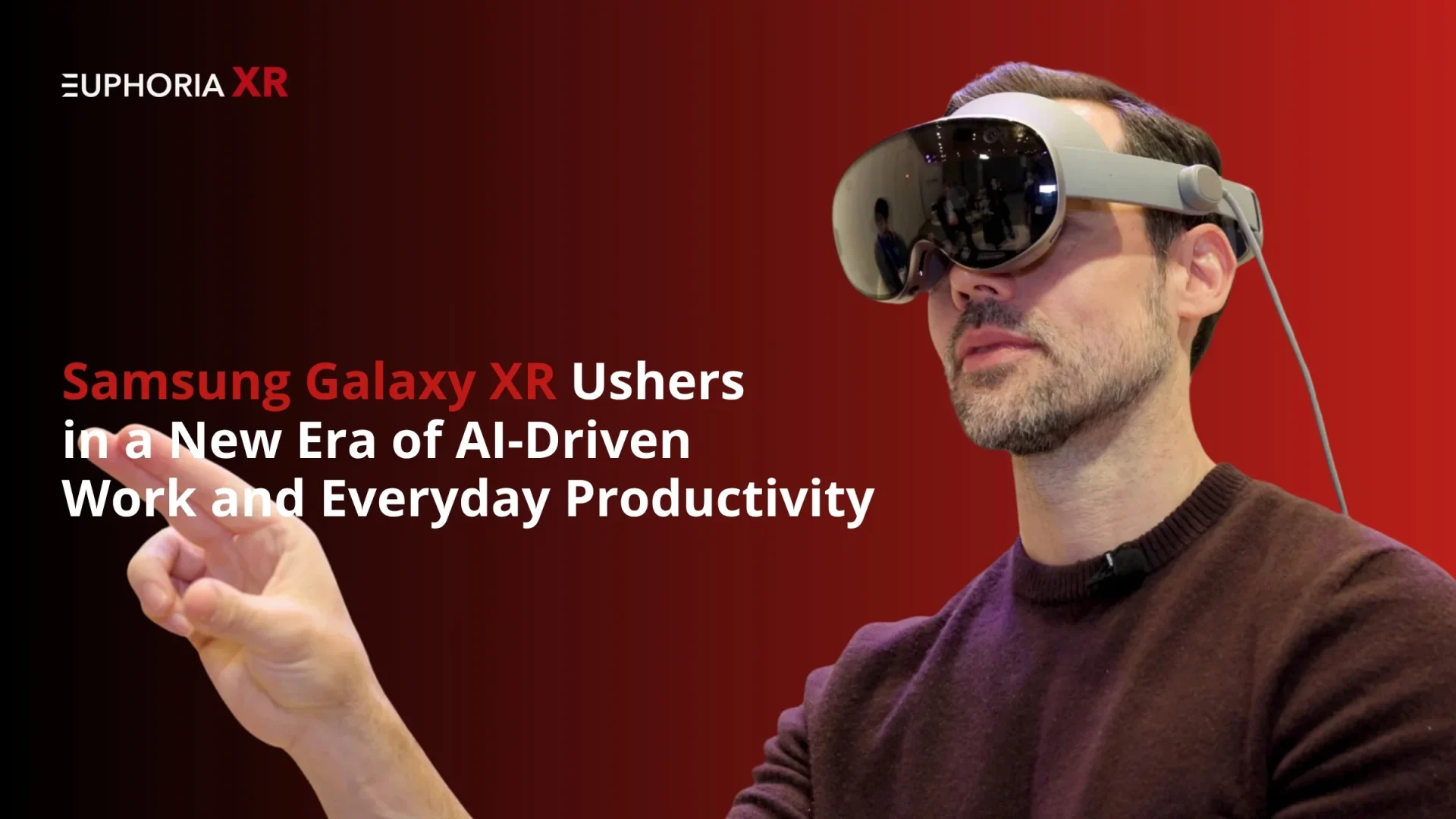
Samsung Galaxy XR is an AI-driven XR headset that combines spatial computing and natural interaction (voice, vision, and gestures) to enhance productivity, work collaboration, and digital life.
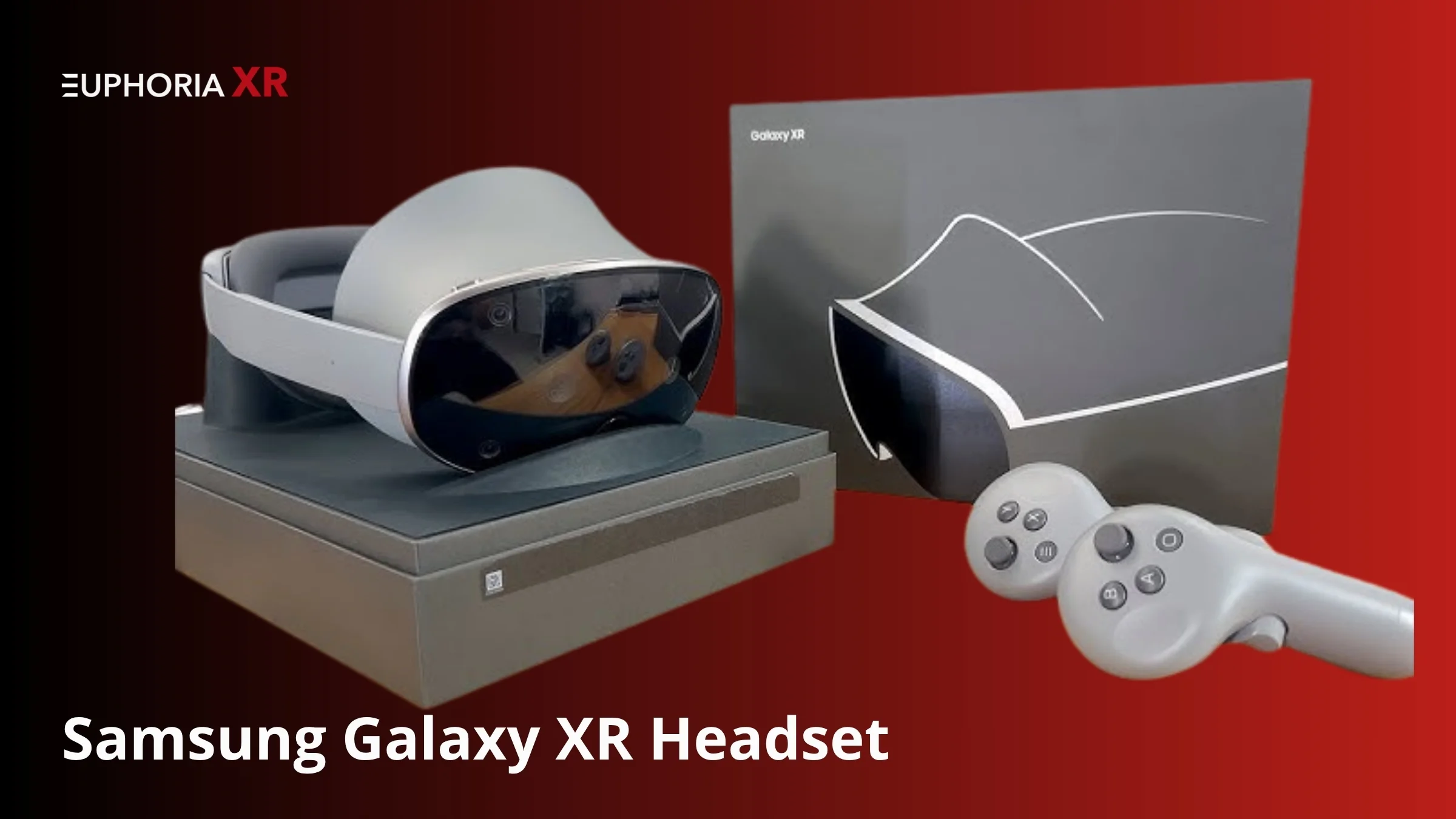
Rather than the keyboard, touchscreen, or apps, it offers the user interaction through:
Voice
Eye movement
Hand gestures
This makes using and interacting with technology more intuitive.
Ready to discuss AI-powered XR solutions for your business?
How Samsung Galaxy XR Combines AI and Spatial Computing?
Samsung Galaxy XR uses two innovative technologies: artificial intelligence (AI) and spatial computing. These create a new approach to engaging with digital content.
AI deciphers what you want from voice, visual, and context
Spatial computing brings content into the world, rather than onto screens
Together, this enables users to interact with an environment that displays information in a spatial context.
Multimodal AI Interface
Galaxy XR employs multimodal AI, which can process several pieces of information simultaneously.
It can understand:
Spoken commands
Visual surroundings
User behavior
For instance, the user can examine an object and pose a question. The system recognises the view and question, and replies immediately.
Human-computer interaction research indicates that multimodal systems are more efficient, less fatiguing, and make interactions quicker.
Spatial Computing and Infinite Screens
Spatial computing takes away the constraints of screens.
Galaxy XR allows people to:
Open multiple windows in the air
Move and resize them
Create a fully customizable workspace
| Traditional Setup | XR Workspace |
|---|---|
|
Fixed screen size
|
Unlimited space |
|
Limited multitasking |
Multiple floating apps |
|
Physical monitors required
|
No hardware limits |
This is sometimes referred to as the infinite screen, and the workspace grows as you need it.
AI as the Operating System
In Galaxy XR, AI is more than just an app. It’s the operating system.
Rather than open up apps, users can:
Ask for tasks to be completed
Get context-sensitive recommendations
Automate repetitive actions
This transforms computing from “operate” to “assist”.
Research demonstrates that AI systems can help speed up task performance in knowledge work by automating processes and speeding up decision-making.
In effect, it’s able to respond like an assistant.
Key Features of Samsung Galaxy XR
Samsung Galaxy XR packs advanced hardware with software powered by artificial intelligence (AI) to create a spatial computing device. All of these features enhance clarity, speed, interaction, and seamlessly integrate into everyday life.
Micro-OLED Display Technology
Galaxy XR features micro-OLED displays, which have high pixel density and contrast.
Key benefits:
Better text readability for reading and working
Better color accuracy
Less fatigue when working for extended periods
Micro-OLED screens are commonly found in high-end XR devices due to their almost-realistic visuals, which are critical for productivity purposes.
Snapdragon XR2+ Gen 2 Performance
The device features the Snapdragon XR2+ Gen 2 – an extended reality chipset.
It enables:
Fast processing of 3D environments
Real-time AI computation
Smooth multitasking
This chip combines graphics, AI, and tracking technologies and provides a responsive and seamless experience.
Eye Tracking and Hand Tracking
Galaxy XR offers natural input devices:
Eye tracking for focus-based interaction
Hand tracking for gestures
This allows users to:
Select items by looking
Navigate without controllers
Interact more intuitively
XR usability studies reveal that gesture-based interactions are less cumbersome and more engaging than using an input device.
Mixed Reality Passthrough
Passthrough enables seeing the real and digital world simultaneously.
Key advantages:
Safe travel in the real world
Time overlays of information
Real- and virtual-world interaction
This is crucial for mixed reality and the co-existence of both worlds.
AI Context Awareness
Galaxy XR features AI context awareness.
It can:
Recognise objects and scenes
Interpret user intent
Provide relevant suggestions
For instance, when looking at things, it can provide information without having to explicitly ask.
This saves time and effort and expedites decision-making.
Related: https://euphoriaxr.com/google-and-samsung-android-xr-headset/
Samsung Galaxy XR for Work and Productivity
Galaxy XR helps enhance productivity by removing some of the constraints and offering smart assistance.
Virtual Workspaces
Any number of virtual screens can be set up.
Features include:
Multiple floating screens
Adjustable layouts
All the screen you need, no hardware constraints
It aids in concentration and organization.
AI-Assisted Productivity
AI is an intelligent personal assistant.
It helps with:
Scheduling and reminders
Summarizing content
Managing workflows
Researchers have found that using AI tools can improve productivity and efficiency of knowledge tasks by taking over tedious tasks.
3D Collaboration Environments
Galaxy XR allows teams to work together in virtual environments.
Capabilities include:
Real-time interaction
Shared visual content
Collaborate with others virtually
This makes it a more immersive experience than video conferencing.
Spatial Data Visualization
Data is more intuitive to comprehend in 3D.
| Data Type | Traditional View | XR View |
|---|---|---|
|
Charts
|
Flat graphs |
Interactive 3D visuals |
|
Reports |
Text-heavy
|
Layered visual insights
|
|
Models |
Static |
Immersive and dynamic |
Visualizing data in 3D space allows users to process and interpret more data quickly.
This demonstrates how Samsung Galaxy XR is not only enhancing technology, but also how we work and are productive.
Enterprise XR Capabilities and Business Use Cases
Samsung Galaxy XR is an enterprise solution. Not only is it an individual device, but it can also be integrated into business systems, training programs, and processes.
Android Enterprise Integration
Galaxy XR is compatible with Android Enterprise, already in use for business smartphones. This means XR headsets can be integrated into an enterprise in a managed manner, similar to phones and tablets. Organizations can manage the apps, updates, and policies across devices. This ensures a seamless deployment and increases efficiency.
Device Management and Security
Security is important to enterprise adoption. Galaxy XR provides enterprise-level device management that enables corporations to track usage, enforce security settings, and secure data. Administrators can remotely update systems and enforce corporate policies. This is particularly important for industries where data security is a must.
Scalable XR Deployment
Scalability is one of Galaxy XR’s key features. Companies can initiate pilot programs and increase the use of XR throughout the organisation. This allows for experimentation with use cases, assessment of the impact, and then for XR to be seamlessly integrated into the workflow.
Industry Applications
Galaxy XR is versatile, making it a fit in various industries. It can be used to train and guide procedures in medicine. It can be used for product visualization and marketing in retail. It can assist manufacturers in training and streamlining processes. Educators can build interactive learning experiences to enhance learning and retention.
These use cases demonstrate how XR goes from theory to practice.
Everyday Use Cases of Samsung Galaxy XR
Galaxy XR also enhances digital life in other ways. It offers more versatility and immersion with content and tasks.
Immersive Entertainment
Galaxy XR reforms content consumption. It is possible to experience video content on large virtual screens as if in a movie theater. Playing games is a more immersive experience because they’re played in a 3D space. This makes it a more immersive experience.
Real-World Navigation
Galaxy XR makes navigating easier. Rather than having to look down, instructions can be projected onto the user’s field of view. The system can also identify objects and provide information. This helps to avoid distractions and helps people navigate physical environments.
Personal Productivity
Galaxy XR enhances productivity by making task management easier. Galaxy XR users have access to apps in space, can quickly browse through information, and use AI to summarise or remind them of tasks. This eliminates the need to navigate between devices and keeps users on track.
These scenarios show how Galaxy XR isn’t just for the office. It seamlessly integrates into our day-to-day activities, enhancing work and personal productivity.
Samsung Galaxy XR vs Apple Vision Pro vs Meta Quest
When it comes to XR headsets, Samsung Galaxy XR, Apple Vision Pro, and Meta Quest are the front-runners. All are in the extended reality (XR) family, but each caters to a different user.
At a high level:
Samsung is all about: AI + productivity + open ecosystem
Apple focuses on superior performance + control
Meta focuses on affordable VR + gaming experiences
| Feature | Samsung Galaxy XR | Apple Vision Pro | Meta Quest |
|---|---|---|---|
| Platform | Android XR | visionOS | Meta Horizon OS |
| Primary Focus | Work, productivity, AI workflows | Premium mixed reality computing | Gaming and entertainment |
| AI Integration | Deep, system-level AI (Gemini) | Advanced AI with strong sensor fusion | Limited AI features |
| Display | Micro-OLED | Ultra high-res Micro-OLED | LCD / Pancake lenses |
| Performance Chip | Snapdragon XR2+ Gen 2 | M2 + R1 | Snapdragon XR2 |
| Interaction | Voice, eye tracking, gestures | Eye + hand + voice | Controllers + hands |
| Mixed Reality | Strong passthrough | Industry-leading | Moderate |
| App Ecosystem | Open (Android) | Closed Apple ecosystem | Meta Store |
| Price | $1,799 | $3,500 | $300–$500 |
| Best For | Professionals | Premium users | Gamers |
Market Sentiment Around Samsung Galaxy XR
The market sentiment for Samsung Galaxy XR is both positive and negative. Users are fascinated by the technology, but are cautious about adopting it. So, the blend of technological innovation and practical uncertainty is the market’s view on XR.
Strengths
Samsung Galaxy XR is perceived to be a good XR device. The key strengths of the device are the combination of high-tech features and lower cost compared to high-end devices.
It is impressive due to the powerful screen, fast performance, and integration of AI. Early reviews have been positive about the natural interaction using voice, eye tracking, and gestures. The Android platform is another key feature, enabling more app support and flexibility than other platforms.
The fact that it is designed for productivity is also a key consideration. Unlike most XR devices that are geared towards gaming, Galaxy XR is a productivity device.
Concerns
Though the features are impressive, there are concerns impacting use.
First, XR devices are not as ubiquitous as other devices. Users don’t want to wear the headset for too long. Weight, battery duration, and form factor are still in need of improvement.
The other issue is the ecosystem. The technology is in place, but there are still more apps and use cases to be explored. Without such widespread use, the technology may not be widely adopted.
There is also an overall reluctance to pay for XR as it is still seen as a luxury item.
Adoption Trends
The use of XR technology is growing, but it remains in its infancy.
Adoption by businesses is growing, particularly for training, simulation, and collaboration. Users are more hesitant and wait until the technology is more valuable and easier to use.
A trend is becoming apparent:
Hardware is no longer the main problem
It’s the apps and patterns that matter
With AI improving and devices getting thinner, the adoption of foldable devices is likely to increase over the coming years.
Learn how EuphoriaXR uses AI-powered XR technologies to improve immersive business experiences, training, and productivity.
Market Sentiment Around Samsung Galaxy XR
The market sentiment for Samsung Galaxy XR is both positive and negative. Users are fascinated by the technology, but are cautious about adopting it. So, the blend of technological innovation and practical uncertainty is the market’s view on XR.
Strengths
Samsung Galaxy XR is perceived to be a good XR device. The key strengths of the device are the combination of high-tech features and lower cost compared to high-end devices.
It is impressive due to the powerful screen, fast performance, and integration of AI. Early reviews have been positive about the natural interaction using voice, eye tracking, and gestures. The Android platform is another key feature, enabling more app support and flexibility than other platforms.
The fact that it is designed for productivity is also a key consideration. Unlike most XR devices that are geared towards gaming, Galaxy XR is a productivity device.
Concerns
Though the features are impressive, there are concerns impacting use.
First, XR devices are not as ubiquitous as other devices. Users don’t want to wear the headset for too long. Weight, battery duration, and form factor are still in need of improvement.
The other issue is the ecosystem. The technology is in place, but there are still more apps and use cases to be explored. Without such widespread use, the technology may not be widely adopted.
There is also an overall reluctance to pay for XR as it is still seen as a luxury item.
Adoption Trends
The use of XR technology is growing, but it remains in its infancy.
Adoption by businesses is growing, particularly for training, simulation, and collaboration. Users are more hesitant and wait until the technology is more valuable and easier to use.
A trend is becoming apparent:
Hardware is no longer the main problem
It’s the apps and patterns that matter
With AI improving and devices getting thinner, the adoption of foldable devices is likely to increase over the coming years.
Why Samsung Galaxy XR Signals a Shift in Computing?
Samsung Galaxy XR is more than a device. It’s part of a new era of user interaction.
Traditionally, computing has revolved around screens, applications, and user input. People launch apps, enter commands, and move windows around. This is good, but not good enough.
Galaxy XR will change this.
Rather than work on a screen, users work in an environment. Rather than manage apps, they manage AI. Rather than jump between apps, everything is interconnected.
This changes three fundamental aspects of computing:
People use natural modes of interaction via voice and gesture
Computing becomes spatial rather than planar
The user interface is AI, not apps
This is comparable to the transition from desktops to mobile phones, making it easier to interact.
Limitations of Samsung Galaxy XR
The Samsung Galaxy XR is powerful, but it has limitations in real-world applications. The tech is impressive, but it isn’t ready to completely replace other devices yet.
Key limitations include:
Battery life: XR headsets need a lot of power to run displays, sensors, and processing, making long battery life difficult
Comfort: Even with better ergonomics, continued use can be uncomfortable and fatiguing
App ecosystem: Not many apps are XR-compatible, which takes time to build
Learning curve: There’s a learning curve associated with gestures, eye tracking, and spatial computing
These limitations demonstrate that Galaxy XR is a big step in the right direction, but that there is more to come until XR becomes mainstream.
Future of AI-Powered XR and Spatial Computing
The next steps for XR are to merge artificial intelligence with spatial computing. This makes for more intelligent, responsive, and practical systems.
With advances in AI, XR devices will get smarter. They will be more aware of context and user needs and will be able to automate more tasks. Meanwhile, spatial computing will grow in its use with digital content.
This will lead to a more immersive computing experience.
XR and Smart Glasses Evolution
XR is set to progress from headsets to smart glasses.
The progression is clear:
Now: Full headsets with high power
Next stage: Light and miniaturised devices
Future stage: Glasses that can be worn every day
The more compact, light, and comfortable the devices, the greater the uptake. This is the time for XR to become mainstream.
AI Agents in XR
AI Agents will be a significant part of XR.
Rather than launching apps, customers will interact with smart assistants that will:
Complete tasks
Provide real-time insights
Manage workflows
The agents will be in the user’s workspace. They will act according to what they see, hear, and need to do.
This will make computers quicker and easier to use.
Next Computing Platform Shift
The world is in a transition of technology:
Desktop computing
Mobile computing
AI-driven spatial computing
XR is the next step. It alters the way we interact with technology and eliminates the need for screens and input devices.
In this new model:
Interfaces become invisible
AI handles complexity
Users concentrate on what instead of how
This can change the way users work and how they interact with digital devices.
Learn how EuphoriaXR can help you create immersive AI and XR experiences.
Final Thoughts!
Samsung Galaxy XR is a step in a new direction. It uses spatial computing, natural interaction, and AI to provide a more seamless interaction.
There are still issues such as comfort and building the ecosystem, but it’s only the start. The future is about spaces and spaces that are smart.
Galaxy XR demonstrates a new way of working and being productive using AI and space.