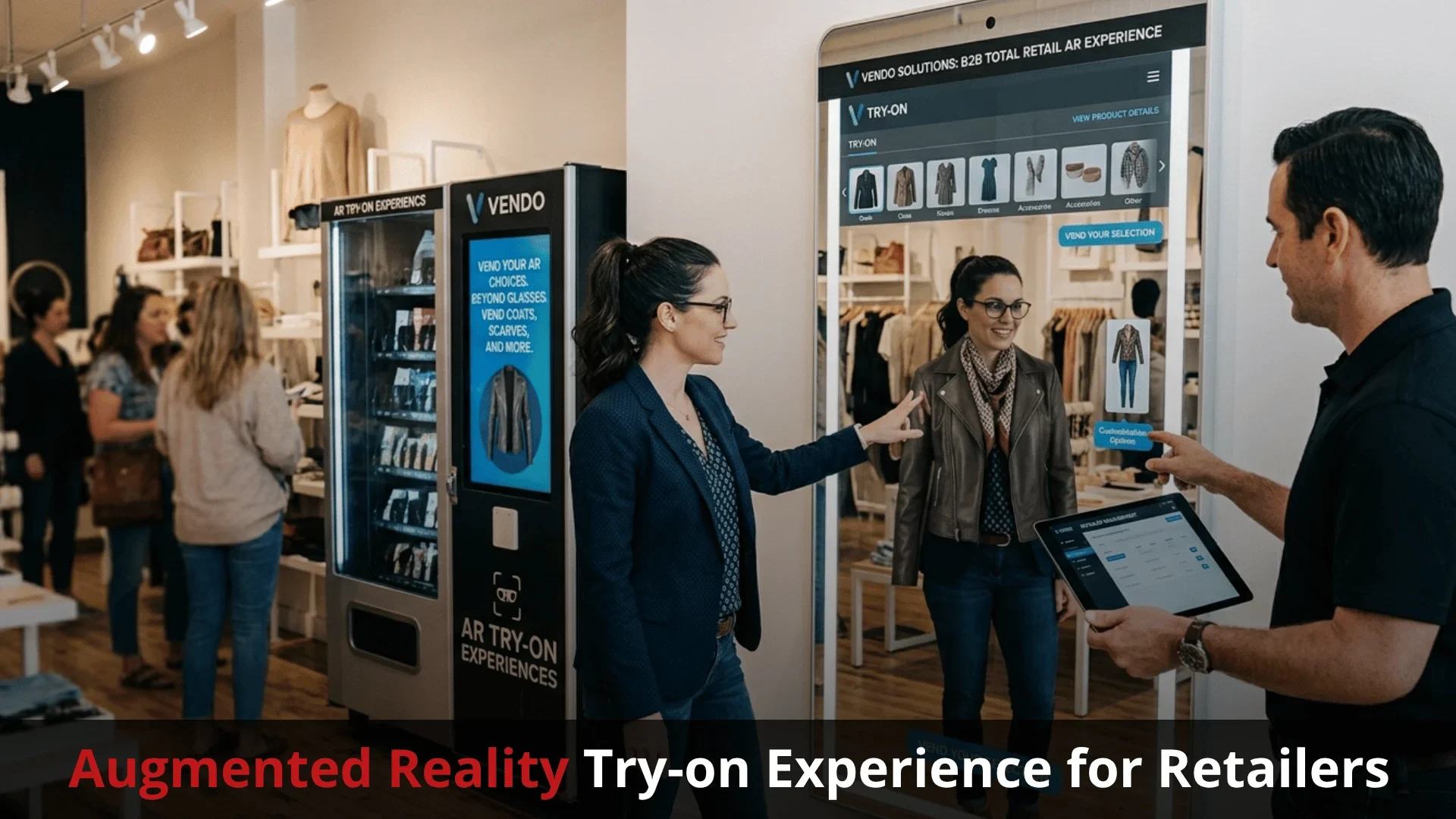
A B2B vending company’s AR try-on experience lets shoppers preview a product before purchasing it from a vending machine. It can be used for eyewear, cosmetics, jewellery and accessories, as well as electronics and other retail products
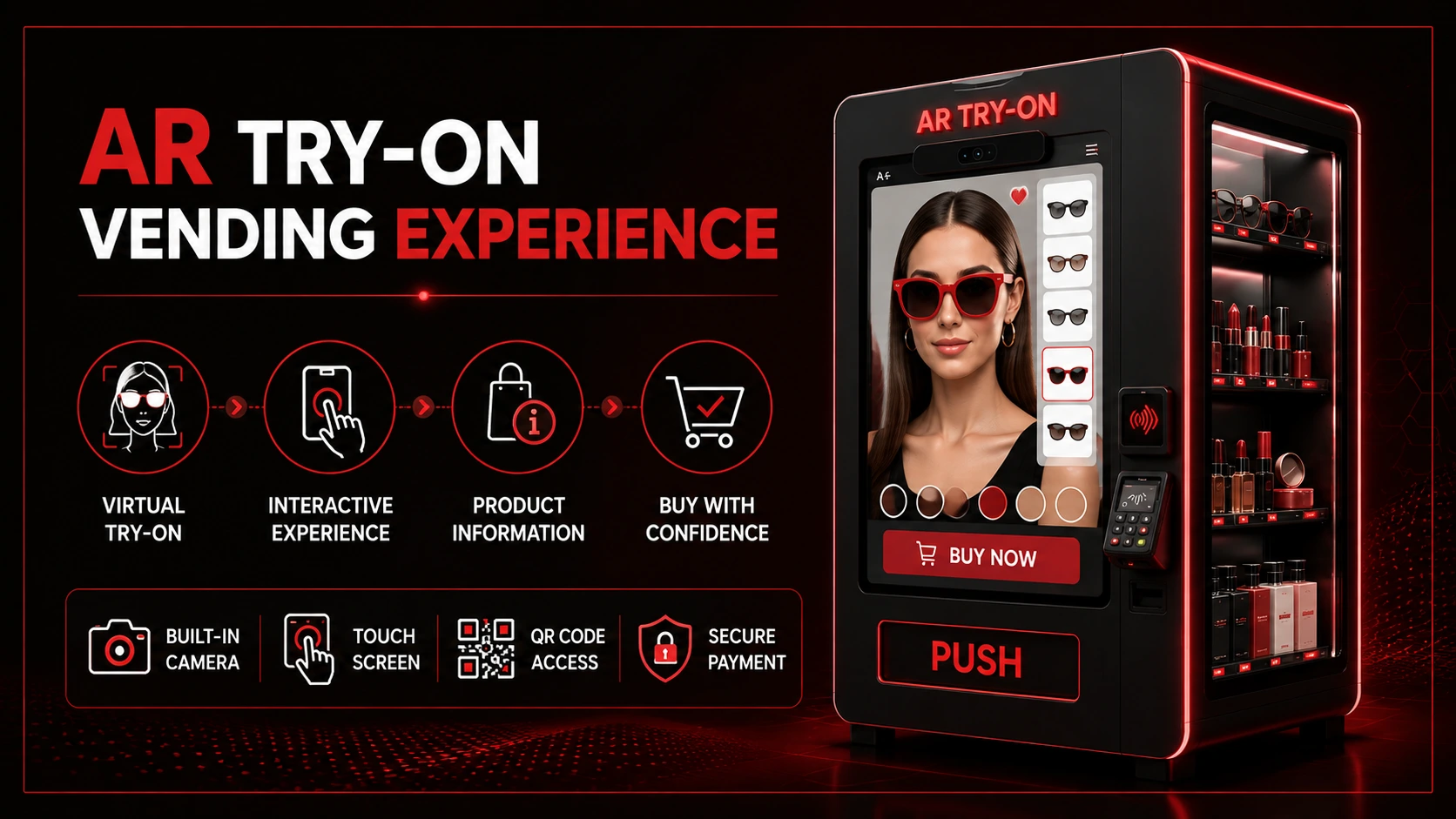
This experience can take place via a camera-equipped machine, touchscreen, mobile app, or WebAR link scanned via a QR code. Users can view products, compare different types of products, access product data, pay for the product, and receive the purchased product.
A positive AR try-on experience is beneficial to retailers because it can help to lower the risk of indecision, boost product engagement, help with promotions, and provide information on customer interests. The key to its success is providing accurate product visuals, reliable tracking, appropriate hardware, streamlined design, privacy protection, and appropriate integration of the vending system.
Suppose you are in front of a vending machine that sells sunglasses. You love one pair but can’t determine if it will look good on your face. Take the chance or get out.
This small hassle can be a sale on its own.
A B2B Vending Company AR solution does that. Allows the customer to view the virtual product, compare products, view details, and make a purchase all from a single machine.
It can be done via a built-in camera, touch screen, mobile app, or QR code. A customer may wear a pair of glasses, try the perfect color for her makeup, try a hat or watch, or add a product to her environment.
That will be more than a screen interaction for retailers. It enables product discovery and enhances consumer confidence, and it also gathers valuable engagement metrics. It also allows retailers to transform a conventional vending machine into an interactive selling point.
What is a B2B Vending Company Augmented Reality Try-on Experience?
A B2B vending company augmented reality try-on experience is a retail solution that integrates vending machines and augmented reality (AR) experience. It provides users a way to virtually try, preview, or explore products before buying. The experience may use a built-in camera, the touch screen, or a mobile app or QR code to show digital products in real time, depending on the setup.
The vending machine technology is a new AR-based vending machine that is widely used and provides an interactive shopping experience, while the traditional vending machine type dispenses products. Customers would be in a better position to view products on themselves and be able to compare colours or styles, read product information, and be able to make a more confident purchase. Retailers also have the benefit of learning more about customer interactions and how they improve merchandising and marketing strategies.
Have an AR vending concept in mind? Explore the optimal setup, features, and customer journey.
Why Are Retailers Adding Augmented Reality to Vending Machines?
Retailers are searching for new and interactive approaches to make the shopping experience more engaging for customers and make their buying decisions with enhanced confidence. Augmented reality is a new layer that’s added to the vending experience that enables customers to look at a product first and learn more before buying it. This magnifies client engagement and encourages vending machines to go beyond being just a gadget for product conveyance.
AR vending experiences are gaining traction in the retail vertical because it enables retailers to:
Create more interaction with customers in shopping.
Allow virtual testing of products for customers before purchase.
Enhance purchase confidence and lower purchase uncertainty.
Show additional product details without an additional shelf.
Encourage other colours, shapes, and varieties.
Make memorable in-store experiences.
Help run loyalty programs and promotions.
Gather customer interaction and customer preference data.
To stand out from the competition for retail locations.
Encourage more product exploration and impulse purchases.
How Does an Augmented Reality Try-on Vending Experience Work?
The customer journey to experience augmented reality try-on vending is very straightforward. The shopper uses the machine, sees the products through AR, pays for the item, and gets it.
Customer Approaches the Vending Machine
The customer observes the vending machine and is prompted to interact by the instructions on screen or graphics advertising the product.
The Experience Opens Through a Screen or QR Code
An AR experience begins on a machine’s touch screen or by accessing the machine’s QR code, which launches a WebAR experience on a customer’s smartphone.
The Camera Detects the Customer or Environment
The camera reads the face, the body, or the space around the shopper, assuring perfect positioning of the digital product.
The Customer Virtually Tries or Previews the Product
When shopping, a customer sees products in real time to see what they will look like and fit like before buying them.
Product Details and Available Options Appear
Product descriptions, available colours, sizes, promotions, product specifications, and price are shown on the interface.
The Customer Selects and Purchases the Product
The customer compares products and selects one product, and then they fill out the order and make the payment by providing a payment method.
The Machine Dispenses the Selected Item
After confirming payment, the vending machine dispenses the product of the customer’s choice, thus concluding the shopping journey.
Types of Augmented Reality Try-on Experiences for Retailers
Retail products have different requirements for AR experiences. The most appropriate method will depend on the types of products that the retailer sells, the types of customers they cater to, and the way they would like the shopping experience to be. Whether it’s a virtual try-on or interactive product education, every experience makes for an informed buying decision for the customer.
AR Experience
How It Helps Retailers
Virtual Eyewear Try-On
Lets Customers See How Different Glasses or Sunglasses Look on Their Face Using Real-Time Facial Tracking, Making It Easier to Compare Frames and Styles Before Purchasing.
Cosmetic and Makeup Try-On
Allows Shoppers to Preview Lipstick, Foundation, Eyeshadow, Blush, and Other Beauty Products on Their Face Without Physically Applying Them, Helping Them Choose the Right Shade with Confidence.
Fashion Accessory Try-On
Enables Customers to Virtually Wear Jewellery, Watches, Hats, Scarves, or Other Accessories to See How They Match Their Appearance Before Buying.
Product Colour and Style Preview
Displays Different Colours, Finishes, Patterns, and Design Variations Instantly, Allowing Customers to Compare Multiple Options Without Stocking Every Physical Version.
3D Product Visualization
Presents Interactive 3D Models That Customers Can Rotate, Zoom, and Inspect from Every Angle to Better Understand Product Design, Size, and Features.
Product Placement in the Customer's Environment
Uses Mobile AR to Place Virtual Products Inside the Customer's Real Surroundings, Helping Them Visualise How Décor Items, Electronics, or Other Products Will Look Before Purchasing.
Interactive Product Education
Shows Digital Overlays with Ingredients, Specifications, Usage Instructions, Compatibility, Demonstrations, and Key Product Benefits, Giving Customers More Information at the Point of Sale.
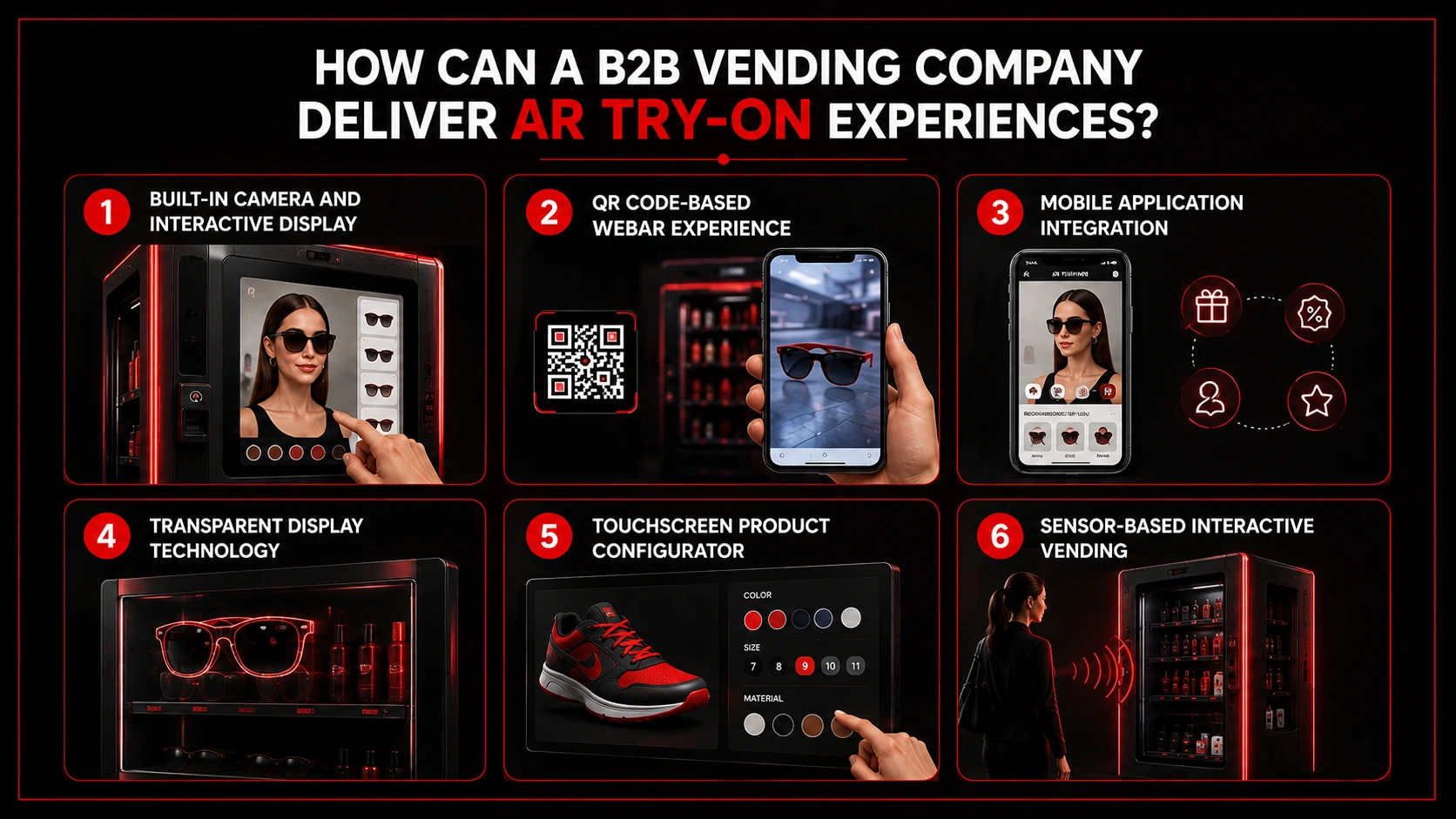
How Can a B2B Vending Company Deliver AR Try-on Experiences?
Based on the retailer’s objective, budget, level of in-store technology, and customer journey, a B2B vending company can bring AR experiences to life with various solutions. Whereas some solutions are set up inside the vending machine, others make use of customers’ smartphones to bring the experience.
Built-in Camera and Interactive Display
The vending machine is equipped with an embedded camera and touchscreen, enabling AR interaction with the customer. All takes place on the machine, which provides a simple and guided shopping experience.
QR Code-Based WebAR Experience
The QR code takes the user to an AR experience in a browser installed on their mobile device. The ability to add AR functionality to existing vending machines requires minimal hardware changes, as no app is required for the solution.
Mobile Application Integration
Advanced AR features, personalized suggestions, customer loyalty programs, saved preferences, and exclusive promotions or offers for repeat customers can be enabled via a dedicated mobile application.
Transparent Display Technology
Transparent displays project digital elements over products in the vending machine. Product info, animation, or virtual effects can be shown to customers without unfocusing the 3D items behind the screen.
Touchscreen Product Configurator
Customers use an interactive touchscreen to customize colours, sizes, materials, or other product options before completing their purchase. This is effective for products offered in many different varieties.
Sensor-Based Interactive Vending
When someone approaches the machine, it automatically responds to opening motion, depth, or proximity sensors. The AR experience can be initiated without the user clicking a button, making the experience more engaging and hands-free.
Collaborate with an experienced AR development companyto design and develop a retail try-on experience based on your products and sales goals.
Main Features of an AR Try-on Vending Machine
The AR try-on vending machine is a retail-technology mixed, interactive shopping machine that lets customers experience the products prior to purchasing them. These are the key features for most solutions, but it will depend on the machine and software.
Real-time virtual product try-on
Motion-sensitive face and body tracking
Interactive 3D product viewing
Rotate and zoom the product.
Colour and style choice
Product information overlays
Multiple product comparisons
QR code and WebAR support
Featured with inbuilt camera and touchscreen.
Integrate a secure digital payment system
Product recommendations
Promotional offers and loyalty rewards.
Customer interaction analytics
Integrated inventory and vending solution systems.
Remote content and product updates
Benefits of an Augmented Reality Try-on Experience for Retailers
A unique augmented reality vending machine experience brings far more than a contemporary shopping tool for retailers. It enables customers to make informed buying choices and makes retail more interesting. Meanwhile, retailers also have access to customer intelligence that can help enhance future campaigns and product offerings.
Improves customer engagement
Increases buying confidence
Reduces purchase uncertainty
Encourages product exploration
Supports impulse purchases
Promotes product variations
Delivers more product information
Creates memorable shopping experiences
Provides loyalty schemes and promotions
Gathers Customer Contact Information
Differentiates retail locations
Enhances the customer experience
Retail Products Suitable for AR Try-on Vending
It is best to use AR try-on technology on products the customers typically look at, compare, and visualise before making a purchase. It can be implemented in various retail sectors without large setup costs.
Eyewear
Sunglasses
Cosmetics
Makeup products
Jewellery
Watches
Hats and caps
Fashion accessories
Handbags
Footwear
Electronics
Home décor items
Collectibles
Beauty samples
Promotional merchandise
Where Can Retailers Use AR Try-on Vending Machines?
Many retail venues where quick, interactive, and convenient shopping is desired have websites suitable for AR vending machines. They can be used for any permanent stores or temporary promotional parties.
Shopping centres
Department stores
Airports
Railway stations
Hotels
Beauty stores
Fashion retail stores
Electronics stores
Universities and campuses
Sports venues
Entertainment centres
Trade shows and exhibitions
Pop-up stores
Brand activation events
AR Try-on Vending Machine Customer Journey
The AR vending experience should bring the customer close to the product through a simple customer journey, until they find the product and purchase it. Every step is taken seamlessly to diminish uncertainty and simplify the buying process.
Customer notices the vending machine.
Customer starts the AR experience.
Camera detects the customer or surroundings.
Customer tries virtual previews of products.
Product information and options appear.
Customer makes a selection that meets their need.
Customer chooses the desired component.
Customer makes a safe payment.
The product is dispensed from a vending machine.
Customer receives loyalty rewards or promotions, if applicable.
Hardware Required for an AR Vending Experience
A smooth and interactive vending machine experience depends on the following hardware components for an AR vending machine. The specific hardware varies, which is built into the machines or delivered via the customer’s cell phone.
Hardware Component
Purpose
Vending Machine
Stores and Dispenses Products
Digital Display
Displays Product Information and AR Interface
Touchscreen
Allows Customers to Interact with the Experience
HD Camera
Detects Faces, Products, or Surroundings
Processing Unit
Runs AR Software and Machine Operations
Motion or Proximity Sensors
Detects Customer Presence
QR Code Display
Launches WebAR Experiences on Smartphones
Internet Connection
Connects Cloud Services and Updates
Payment Terminal
Processes Digital Payments
Speakers
Plays Audio Guidance and Promotional Content
LED Lighting
Improves Camera Accuracy and Product Visibility
Software Required for AR Try-on Vending
Software links the AR experience to the vending machine, payment system, inventory, and analytics platform. They can be integrated to provide a full retail solution.
Software Component
Purpose
AR Engine
Renders Augmented Reality Experiences
Face or Body Tracking Software
Tracks Customer Movements Accurately
3D Product Viewer
Displays Interactive 3D Product Models
Product Catalogue System
Manages Products and Product Information
User Interface Software
Controls Customer Interactions
WebAR Platform
Delivers Browser-Based AR Experiences
Mobile Application
Provides Advanced AR Features and Loyalty Functions
Vending Machine Control Software
Communicates with Vending Hardware
Payment Integration
Processes Secure Customer Payments
Inventory Management System
Tracks Stock Availability
Analytics Dashboard
Measures Customer Engagement and Performance
Content Management System
Updates Products, Promotions, and Digital Content Remotely
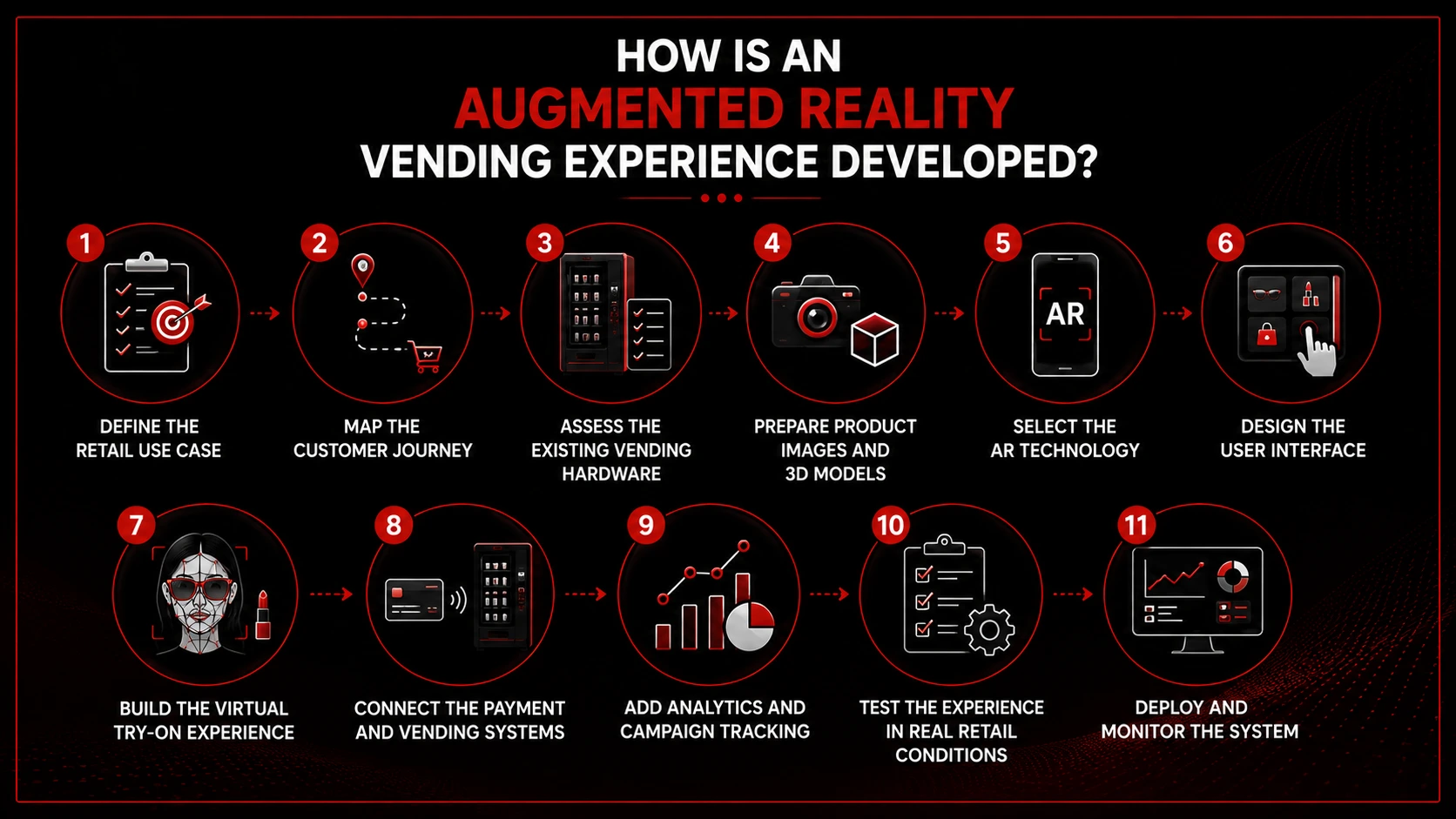
How Is an Augmented Reality Vending Experience Developed?
Setting up a new AR vending experience requires thoughtful planning and development, as well as reliable software integration and a vending machine that can handle it. Each phase helps customers have a seamless shopping experience, with correct information and a positive experience, whereas retailers can manage products, payments, and performance easily.
Define the Retail Use Case
Identify the products, target customers, business goals, and the type of AR experience the vending machine will provide.
Map the Customer Journey
Outline each interaction with customers, starting with discovering a vending machine and ending when customers receive the item they’ve purchased.
Assess the Existing Vending Hardware
Determine if the vending machine has cameras, touchscreens, sensors, internet access, and payment capabilities or if any upgrades are needed to these features.
Prepare Product Images and 3D Models
Gather great product shots and design accurate, quality-optimized 3D models with realistic previews without negatively impacting performance.
Select the AR Technology
Choose the most suitable solution, such as WebAR, mobile AR, or a built-in AR application, based on business requirements, hardware capabilities, and customer accessibility.
Design the User Interface
Design an intuitive shopping experience in which users can easily navigate the items, initiate AR visualization, compare products, and make their selection.
Build the Virtual Try-on Experience
Create some new features like face tracking, body tracking, 3D visualization, product comparison, and product information that might be interactive.
Connect the Payment and Vending Systems
Connect secure payment systems, stock management, and vending systems with accurate processing and automatic feed systems.
Add Analytics and Campaign Tracking
Use analytics to track activities of customers, popularity of products, conversion rates, campaign performance, and machine utilization.
Test the Experience in Real Retail Conditions
Test the full solution under different lighting, internet, customer, and hardware conditions to ensure reliability under various conditions.
Deploy and Monitor the System
From launch to continuous monitoring, remote content updates, rapid problem resolution, and enhancement of the experience according to user behaviour and analytics, it is all in hand.
Hire AR developer specialists to create accurate virtual try-on features, connect your vending systems, and prepare the experience for launch.
How Can Retailers Use Gamification With AR Vending?
Gamification adds an extra element of entertainment to AR vending machines, promoting user interaction with items beforehand. Making things easy for others to remember and repeat can get them more involved; more people will remember your brand name, and they’ll come back for more.
Gamification can be implemented in a retailer’s business as follows:
Virtual spin-the-wheel rewards
Scratch-and-win promotions
Product matching games
AR treasure hunts
Loyalty points and digital badges
Discount vouchers after completing an AR experience
Limited-time product challenges
Social media sharing rewards
Seasonal campaigns and interactive events
Product quizzes with instant rewards
How Can Retailers Measure AR Vending Performance?
Performance measurement gives retailers a deeper understanding of how customers engage with AR vending machines and whether they add value to business objectives. These learnings are used to help make improved product choices, marketing campaigns, and improvements in the future.
Some of the key performance parameters are:
Number of AR experiences activated
Average interaction time
Virtual try-on completion rate
Product comparison rate
Purchase conversion rate
Most viewed products and variants
Best-performing promotions
QR code scan rate
Repeat customer interactions
Revenue per vending machine
Loyalty programme participation
Customer satisfaction & feedback
How to Protect Customer Privacy in AR Vending Experiences?
Trustworthiness of customers is a critical part of any AR retail solution. Retailers need to make clear how customers’ cameras and customer data will be utilized and what they need to provide for the experience to be successful.
Best practices include:
Show clear privacy notices before starting the AR experience.
Collect only essential customer data
Do not take photos of the faces unless permission is given
Encrypt customer and payment information
Build trust among hardware and cloud-based services
Follow applicable data protection regulations
Allow customers to opt out of data collection where required
Keep software up to date to fill in security gaps.
How Much Does an AR Try-on Vending Experience Cost?
Different hardware and software capabilities, the number of products, and complexity of the project all impact the price of an AR vending solution. With a simple WebAR experience, the cost is lower than a fully integrated vending machine with built-in cameras and custom software.
Cost factors include:
Existing vending machine capabilities
Hardware upgrades
Overall camera and display quality.
Number of products and 3D models
AR technology selection
Custom software development
Payment gateway integration
Inventory management integration
Analytics and reporting features
Content management system
Testing and deployment
Ongoing maintenance and support
How Long Does It Take to Develop an AR Vending Experience?
The development time varies from project to project, product catalogue, hardware integration, and software complexity. While a basic WebAR solution can be realized in a few weeks, an AR vending machine solution that also integrates with hardware, transitions payments, offers in-depth analytics, and optimizes virtual try-on options can take several months. The overall timeline significantly contributes to proper planning, 3D assets accuracy, and thorough testing.
Is an AR Try-on Vending Experience Worth It for Retailers?
An AR try-on vending solution can help retailers make retail shopping more interesting. It allows customers to buy more confidently, helps users explore the products, helps with promotions, and provides customers with some valuable information. Retailers can reap the rewards of enhanced customer satisfaction, boosted brand loyalty, and utilizing vending machines as online retail opportunities, but it comes at a price in terms of investment that must be committed to implementation.
Challenges of Building an AR Try-on Vending Experience
Creating an AR try-on vending solution is not as simple as just putting AR on a vending machine. The developers must make sure every element of the hardware, software, 3D content, and customer experience reliably plays and works together in various retail environments on the market.
Hardware and Development Costs
Cameras, displays, sensors, software development, and 3D content will raise the initial investment, particularly where a custom solution is required.
Accurate Product Tracking
The AR system needs to be able to accurately identify faces, bodies, or environments to fit the virtual products in a natural and consistent fashion.
Quality of 3D Product Models
Badly-designed 3D models do not reflect reality and customer confidence. Models should depict the product and be optimized for smooth operation.
Internet Connectivity
Most AR applications use cloud-based services, remote and content updates, analytics, or payment processing, for which a stable internet connection is necessary.
Lighting and Camera Conditions
Bright or dim lighting conditions can impact camera tracking and affect the accuracy of virtual product placement.
Integration With Existing Vending Systems
The AR platform needs to integrate seamlessly with payment providers, stock management systems, product databases, and vending machine management systems.
Customer Privacy
Retailers have obligations under law to be clear about the use of the cameras and customer information and follow appropriate privacy and data protection guidelines.
Software Maintenance
Updates are necessary to enhance security, add product capabilities, fix bugs, and retain compatibility with evolving devices and OS versions.
Machine Performance
The hardware should be capable of rendering AR experiences quickly to avoid delays, lag, or interruptions during customer interactions.
User Adoption
The experience should be easy and natural. The process can be complex, which may cause customers to remain nonchalant about using the AR capabilities.
The Future of B2B Vending Company Augmented Reality
As retail technology matures, AR is likely to be a key part of an engaging and interactive experience within vending machines. The progress of faster processors, smarter retail software and WebAR platforms, and better cameras will render AR vending more accessible, affordable, and useful for businesses of any size.
Other features that are likely to develop include:
More realistic virtual try-on experiences
Faster browser-based WebAR solutions
Improved face and body tracking
Greater product personalisation
Multi-brand vending platforms
Better integration with loyalty programmes
Cloud-based content management
Real-time inventory synchronisation
Advanced customer analytics
Interactive promotional campaigns
Support for smart retail ecosystems
Greater acceptance at retail outlets worldwide
Looking forward to transitioning from ideas to action? Get an estimate for Your AR Try-on Project.
A B2B vending company’s augmented reality solution incorporates AR innovation into vending machines to create an interactive shopping experience.
Customers can virtually try, preview, and compare products before purchasing.
AR vending works with products like eyewear, cosmetics, jewellery, accessories, electronics, and home décor.
Retailers can provide AR experiences using built-in AR displays, mobile apps, or WebAR via QR codes.
Successful implementations require reliable hardware, accurate 3D models, and smooth software integration.
Analytics profile customer engagement, product interest, and conversion rates.
Gamification and loyalty programs can increase the duration of engagement and future sales.
Security of data and privacy issues should be taken care of from the start of the development.
AR vending machines can be used in retail stores, shopping centres, airports, hotels, and promotional events, etc.
With the evolution of AR, more and more companies will be offering interactive vending experiences in the future of retail.
Conclusion
A B2B vending company augmented reality solution provides a simple method for increasing the interaction, informativeness and engagement factors of vending machines for retail chains. Using a try on feature with secure transaction processing, product details and customer insights, retailers can build confidence in the buying process, and match those processes with distinctive customer experiences. The more AR technology advances, the more it will become involved in the future state of self-service retail.
Yes. Many existing vending machines can support AR by adding a QR code-based WebAR experience or upgrading the machine with compatible hardware such as a touchscreen and camera.
Not always. There are numerous AR vending experiences that take advantage of WebAR that link to a webpage without requiring an application installation.
The majority of AR vending machines are connected to the internet to support cloud services, analytics, content updates, and payment processing. Depending on the system design, some basic features could also be available in the offline mode as well.
Yes. Most AR vending platforms come with a content management system that lets vending companies update products, prices, promotion and digital content remotely.
Retailers can capture anonymised data like time spent on site, product views, most popular product variants, conversion rates, and campaign effectiveness depending on system set-up and privacy laws.
Yes. Many AR solutions don’t store customer images or facial information permanently and process the camera data in real time.
Get Started With Euphoria XR • Award-Winning AR/VR/AI Development & Consulting Services • Flexible Business Models – Project Based or Dedicated Hiring • 10+ Years of Industry Experience with Global Clientele • Globally Recognized by Clutch, GoodFirms & DesignRush
I’m M.A Malik, Co-Founder and AR/VR Mentor at Euphoria XR, with 10+ years of experience in immersive technology. Over the years, I’ve worked across augmented reality, virtual reality, and interactive digital experiences, helping businesses move from ideas to practical solutions. I also share insights on AR/VR development, implementation, emerging trends, and real-world applications based on hands-on industry experience.