












T-Shirt Augmented Reality How Interactive Apparel Works for Brands - Euphoria XR

T-Shirt Augmented Reality: How Interactive Apparel Works for Brands

Share Article:
T-Shirt Augmented Reality How Interactive Apparel Works for Brands - Euphoria XR
Picture of Amelia Rose / Content Strategist & Copywriter
Amelia Rose / Content Strategist & Copywriter
Summarize with:
Table of Contents
Table of Contents
Share Article:

TL;DR

An AR T-shirt is a printed piece that features an AR marker, or another recognizable pattern, that an app on your phone or similar device scans to activate the digital overlay. This experience can take the form of 3D models, animation, video, offers, product pages, or social content. Depending on how much tracking, interaction, and customization a brand needs, it can use WebAR, a mobile app, or an AR development tool

A basic T-shirt isn’t just for design printing. T-shirt augmented reality lets the same design cause animation, video, 3D objects, games, product links, or brand content to appear on a smartphone camera. For brands, it elevates regular clothing to dynamic engagement by letting them entertain customers, create a story, market products, or link physical items to digital promotions. 


What is an AR T-Shirt?

An Augmented Reality T-shirt is a normal shirt that becomes informative when viewed using an AR viewer app on a smartphone or other device, usually a dedicated viewer or smart frame. A printed design acts as a visual trigger, such as showing the user interactive elements like animation, 3D models, videos, games, product information, or any branded content overlaid on the physical garment.
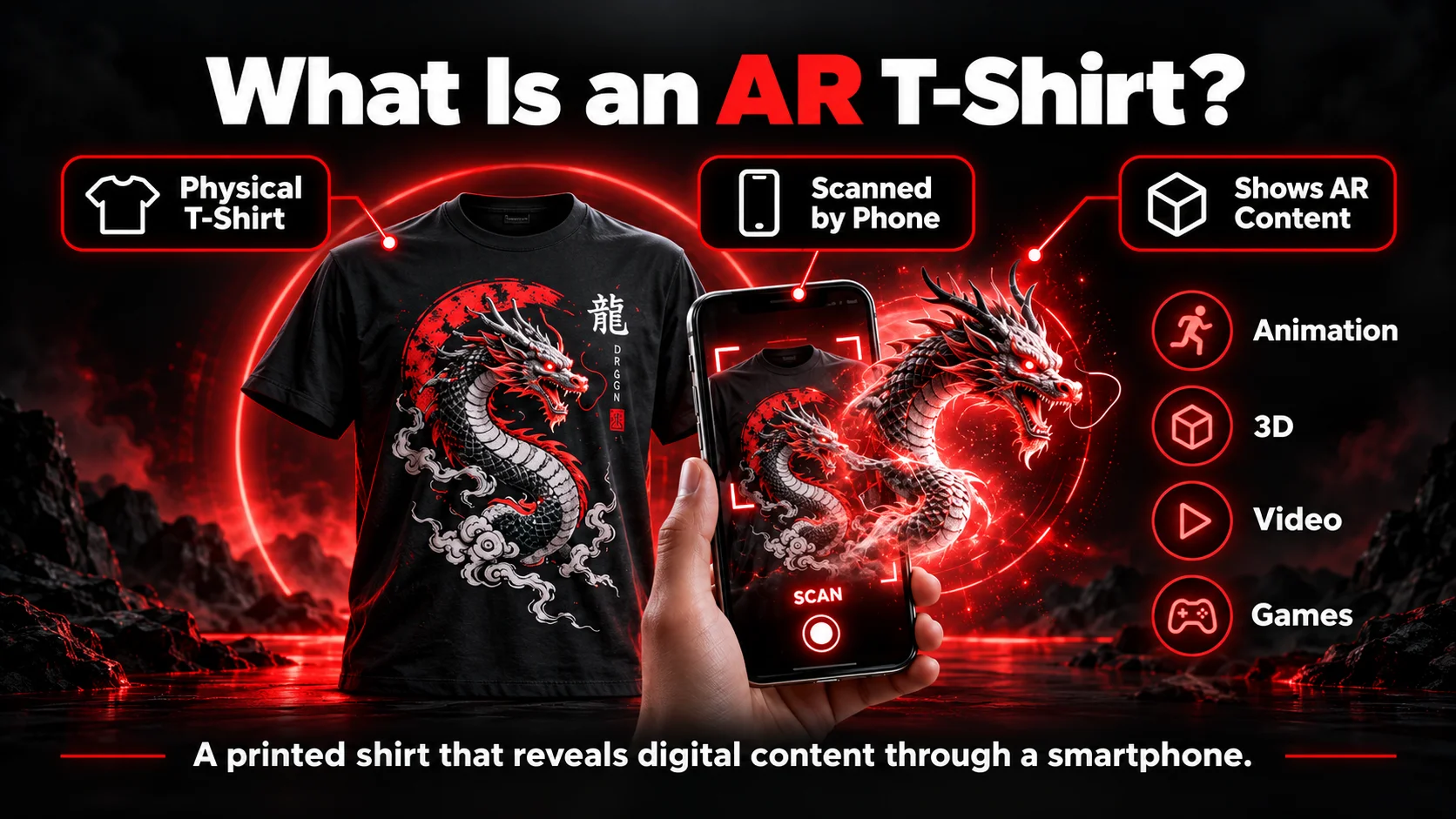
What is an AR T-shirt - EuphoriaXR

Unlike the virtual model that involves displaying a virtual shirt on the user, an AR T-shirt is based on a physical shirt and adds a digital layer to a physical shirt.

Let customers scan, explore, share, and learn about your clothing through the use of AR interaction. 

How Does an Augmented Reality T-Shirt Work?

An AR T-shirt connects printed graphics with digital content. Above all, the design is recognized and tracked, and then the AR layer remains coupled with the shirt, moving with the user or the camera.

A Visual Trigger Is Added to the Design

A logo, illustration, pattern, or custom graphic is chosen as an image target. The design should have distinctive and clear parts to allow easy identification by the AR system. 

The Camera Recognizes and Tracks It

The smartphone camera recognizes the design, learns about its location, and tracks its movement in real-time.

Digital Content Is Placed Over the Shirt

After the design is detected, the system overlays digital components on the design. They can be 2D animation, 3D animation, video, sounds, text, buttons, games, product information, or links. 

The User Interacts Through Their Phone

Users can view, tap, rotate, play, shop, record, or explore the content on the screen of their smartphone. The experience can appear on WebAR or through a mobile app, depending on the configuration. 


How to Make Augmented Reality T-Shirts

Requirements to create an Augmented Reality T-shirt include college-appropriate tracking artwork, digital assets, an AR platform or custom utility, as well as testing on the completed product. Both the physical design and experience should be developed concurrently at the beginning of the process. 
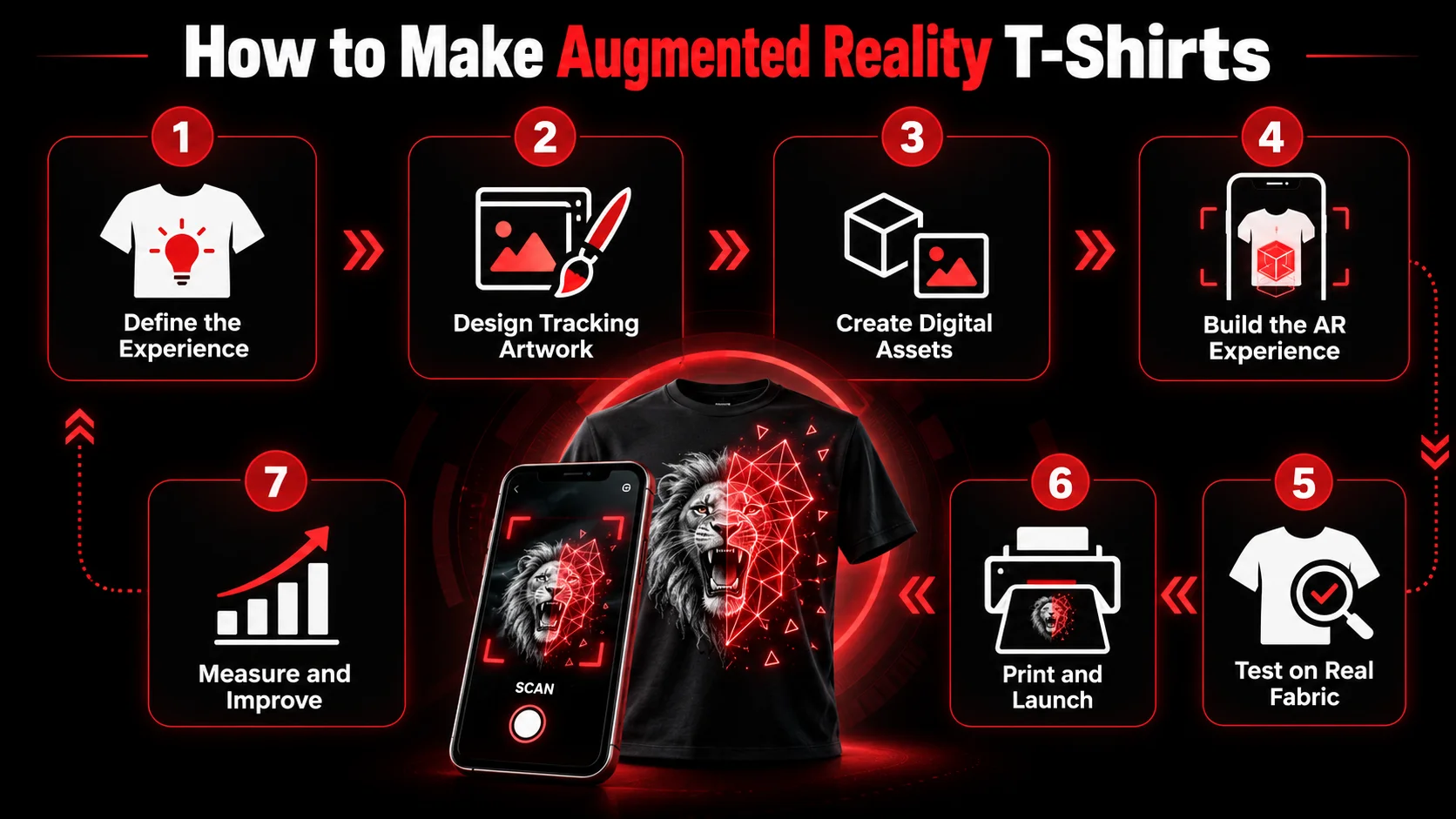
How to make Augmented Reality T-shirts-EuphoriaXR

Step 1: Define the Experience

Decide what will happen after the person scans the shirt. You can play an animation, a video, a game, show a 3D model, or direct users to a product page. 

Step 2: Design the Tracking Artwork

Make stylish, contrasty, and detailed work with distinctive, original elements. Be careful not to use too straightforward or repetitive patterns, which may be harder for the camera to pick up. 

Step 3: Produce the Digital Assets

Set up the information that will be displayed on the screen. It can be presented as a 2D graphic, 3D model, animation, video, audio, text, buttons, or any sort of interaction. 

Step 4: Build the Experience

Link the physical design to the digital content by connecting it to a WebAR platform, a mobile application, or custom AR development. Depending on the complexity and user requirements, the correct method can vary.

Step 5: Test Tracking on Real Fabric

Check the printed shirt at different distances, camera angles, lighting, running and stretching, on devices, and check loading speed. This can help in the identification of problems which might not be visible on a flat digital photograph. 

Step 6: Print and Launch

Once the artwork is approved, print it and make sure tracking still works well, and provide clear instructions for opening the tracking. Making WebAR easier to access can also be through a QR code. 

Step 7: Measure and Improve

Monitor clicks, shares, conversations, interactions, time spent, and track scans. Look at this data to understand your users’ journey and what works and doesn’t work. 


What Can You Add to an Interactive T-Shirt?

An interactive T-shirt can display much more than a moving image. Printed designs can be linked to functional, engaging, and even shoppable digital content.

You can add:

  • 2D and 3D animations

  • Product videos and brand stories

  • 3D characters or objects

  • Games and interactive challenges

  • Music, audio, and voice messages

  • Product information and tutorials

  • Buttons, offers, and ecommerce links

  • Exclusive or members-only content

  • Digital rewards and collectibles

  • Social effects and shareable experiences

The best feature depends on your goal. A certain fashion brand could use an animated shirt, and an event shirt can create offers, content, or interactive challenges. 


Where Augmented Reality Tees Create Real Value

AR tees are best when there is something in the digital layer that the printed shirt can’t do alone. They can work with marketing, education, entertainment, sales, and customer engagement

Common App uses include:

  • Fashion and streetwear: limited drops, animated designs, and digital collections

  • Branded merchandise: interactive promotional and corporate apparel

  • Music, entertainment: artists’ messages, fan content, characters, concealed entertainment

  • Gaming: digital characters, challenges, rewards & collectibles

  • Events: Interactive merchandise, activations, contests and campaign content

  • Sports: player content, team experiences, promotions and fan engagement

  • Education: 3D lessons, diagrams, demonstrations, and learning activities

  • Retail/ecommerce: product information, offers, collections, and shopping links

  • Marketing campaigns: connecting physical apparel with digital experiences 


Related: https://euphoriaxr.com/augmented-reality-in-clothing/


Why Brands Are Experimenting With Interactive Apparel

Using interactive apparel, brands can enhance physical products and make them more useful, memorable, and tie them into digital campaigns. 

Make Physical Products More Engaging

A regular shirt provides customers with something to wear. AR will provide them with something new to discover, view, play, or communicate with, which will make the product experience more vivid. 

Give Merchandise More Perceived Value

Adding animation, exclusive content, games, or digital rewards can make regular merchandise feel more valuable, particularly on limited releases, fan merchandise, at events, or premium collections. 

Extend Campaigns Beyond the Printed Design

The space available on a shirt is limited. AR can be used to open videos, stories, product pages, games, offers, or campaign content without adding more text or graphics to the garment. 

Encourage User-Generated Content

The interactive benefits provide customers with something that they can see, make notes on, and share with others. This can help to enable social posts, social reactions, social challenges, and other user-generated content regarding the product. 

Update Digital Experiences Without Reprinting

Depending on the type of AR experience, the brand can replace connected videos, offers, messages, links, or other digital material without significantly changing the physical shirt. 

Connect Offline Customers With Digital Channels

Functional apparel can transport shoppers from the physical product to the online store, loyalty program, product page, sign-up form, campaign, or even a unique virtual experience. 


Real Examples of AR-Enabled Shirts

The possibilities are endless when it comes to the real-world uses of AR shirts for education or fashion, entertainment, and fan engagement. The best examples clearly connect the purpose of the shirt with its digital layer. 
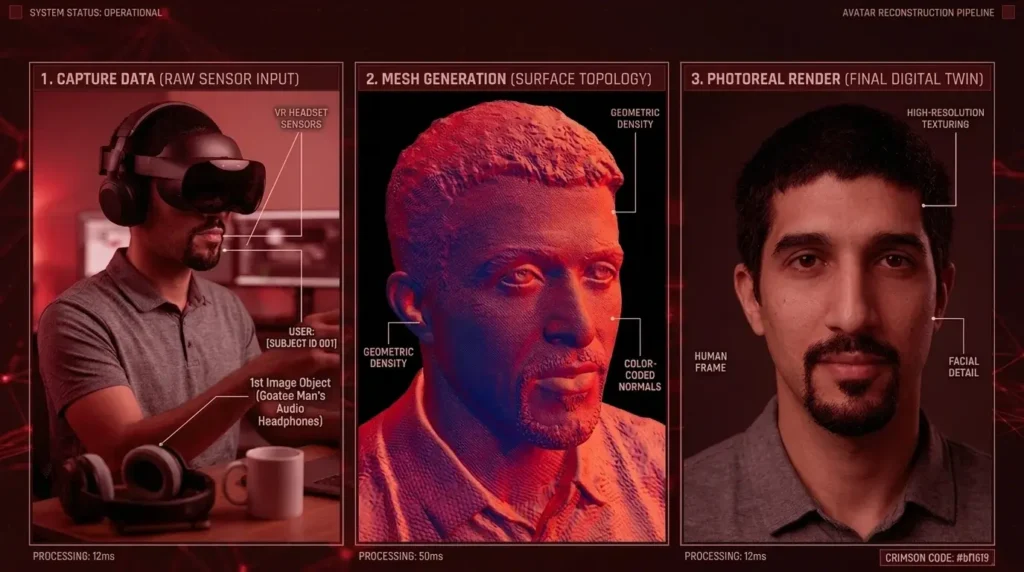
 

Virtuali-Tee

A printed shirt is transformed into an interactive anatomy lesson with the help of Curiscope’s Virtuali-Tee. Users take a photo of the shirt using the app, and they are able to see, in 3D, various organs and systems of the body contained within the shirt. 


Carlings’ The Last Statement

Carlings cleverly designed The Last Statement T-shirt as a single garment, which allows a variety of digital designs to be put on it. The point was tracked with a printed graphical logo, and the QR code was followed by animated statements using Instagram AR filters. 

The project demonstrated the ability to touch up a brand’s digital image of a shirt without having to make a new physical shirt for each design. 


What Makes a Shirt Design Easy to Track?

Attractive artwork is not enough to make a good AR shirt design. The camera should recognize the image quickly and continue tracking it as the garment moves. 

An effective tracking design will have:

  •  Clear and unique visual features

  •  Appropriate contrast among areas

  •  Enough fine detail for image recognition

  •  Limited repetitive patterns

  •  Sharp, high-quality printing

  •  An adequately sized tracking area 

  •  Key information removed from probable folds

Simple logos, designs, or graphics with small size can be more difficult to identify. Another requirement that Google recommends for reference images is that they have enough unique visual features and show clearly in the camera frame when they are first captured.

It is important to test the design on actual fabric before mass production. 


Suggested Read: https://euphoriaxr.com/augmented-reality-jewelry/


Common Challenges With AR Apparel

It will be difficult to track a design on a piece of clothing rather than a flat poster or a package. Fabric can have movement, bend, stretch, and change shapes, so there is a need for careful testing of all aspects of the artwork and digital experience. 

Wrinkles Can Affect Image Recognition

Substantial wrinkles can result in the tracking image being distorted or not being seen. This can cause a delay in detection or cause the digital content to misalign.

Do not obstruct or remove key visual elements in areas that remain relatively flat and visible. 

Poor Lighting Can Reduce Tracking Quality

The camera must be able to see the design. The environment may be darker than normal, with intense light or with shadows, or may be in motion, making the detection of important visual features difficult.

Try out the experience using the same light conditions as customers are likely to use. 

Weak Artwork May Be Difficult to Recognize

Artworks that lack uniqueness provide the tracking system with fewer clues.

Highly detailed images, with lots of unique details, tend to work best, rather than images containing only shapes, repetitive patterns, barcodes, or primitive line art. 

Large Digital Assets Can Slow Loading

The loading time is increased by the weight of heavy 3D models, as well as high-resolution textures, videos, and audio elements.

Access content that users are likely to access first and load the asset later whenever possible, particularly across mobile broadband. 

Requiring an App Can Increase Drop-Off

Downloadable applications can do more complicated things, but that’s an additional step.

For shorter-running campaigns, events, or promotional clothing or other items, the friction of having to download the WebAR app may not be such a significant issue, as customers can open supported WebAR experiences directly from their mobile browser. 

Experiences Need Testing Across Devices

Actions that are successful on one device may not be successful on another.

Test across:

  •  iOS and Android

  •  Different screen sizes

  •  Different camera qualities

  •  Major mobile browsers

  •  Older and newer devices

  •  Fast and slower internet connections

The ability of device testing to pick up on tracking, loading, layout, and compatibility issues before customers do. 


How Much Does an Interactive T-Shirt Experience Cost?

The price of an interactive shirt experience will vary depending on its complexity. Simple animation and video triggers are less expensive of custom experience with 3D, games, e-commerce, analytics, or backend systems.

The major contributing costs are:

  • Number of shirt designs and tracking images.

  • 2D or 3D asset creation

  • Animation and interaction complexity

  • WebAR or mobile app development

  • Games or custom features

  • E-commerce and API integrations

  • Analytics and user accounts

  • Device testing

  • Hosting and ongoing updates

One of the easiest campaigns could simply be a standard AR platform, but if the brand activation is bigger, it is likely to require custom development. Make sure to first determine what the experience will be and then estimate the technology and content. 

Looking for AR integration of your T-shirts, clothing, or projects?

Key Takeaways

  • AR T-shirts connect physical clothing with digital content.

  • Printed art can serve as the image tracking target.

  • Videos, animation, 3D models, games, offers, and product links can be unlocked.

  • WebAR can alleviate the need for users to install an app.

  • Clear, detailed artwork usually improves image tracking.

  • Fabric movement, wrinkles, and lighting can affect performance.

  • Real garments should be tested before mass production.

  • Brands can use interactive apparel for marketing, education, events, entertainment, and ecommerce.

  • Football activities can involve updating digital content that doesn’t require changes to the actual shirt.

  • The cost will largely be based on the complexity of the AR Experience. 


Closing Note

T-shirt augmented reality is a solution for brands seeking to bridge the gap between digital and physical experiences through clothing. With just a simple printed creation, these may turn into an animation, game, story, product guide, or direct map to an online campaign.

The best experiences begin with a definite aim. Before choosing the tracking method, the content, and the technology, consider what benefits scans over the shirt will provide to the users. 


Frequently Asked Questions (FAQs)

Yes. The image or graphic to be tracked does not require a QR code as a tracking target. If a QR code is included, it is usually just to facilitate easy access to an experience on the WebAR platform. 

Yes. The various designs of shirts can link to the same digital experience, provided each image is registered and set up appropriately. Another option is to project separate content to each design. Brands may also send various content to each design. 

Yes. Typical AR shirts are meant to function in wear. The artwork, however, must be at least visible to the camera so that it can be identified and tracked. 

The experience will be available while the hosting AR platform, the application, the digital experience assets, and other necessary services are all active. If you are doing long-term campaigns, you need to think of continual hosting and platform support. 

Yes. An AR can have buttons or links that direct a user to product pages, collections, offers, shopping carts, loyalty programs, or other ecommerce destinations. 

Yes. The digital artwork, badges, characters, rewards, or other collectibles can be unlocked with a shirt. Ownership, limited access, or availability typically requires an independent back end or account system. 

It depends on how the experience is built. Some projects use only simple analytics, e.g., visits, clicks, device type, etc., or session activity. Some people may gather additional information from users who create accounts or complete forms. Brands need to be explicit about data captured and why. 

Yes, printed designs are sometimes simpler to monitor because they can capture details of the image in finer detail. If the embroidered artwork has identifiable patterns and is tested before production, then it can also be utilized.

Get Started With Euphoria XR
• Award-Winning AR/VR/AI Development & Consulting Services
• Flexible Business Models – Project Based or Dedicated Hiring
• 10+ Years of Industry Experience with Global Clientele
• Globally Recognized by Clutch, GoodFirms & DesignRush

Picture of Amelia Rose / Content Strategist & Copywriter
Amelia Rose / Content Strategist & Copywriter
I’m Amelia Rose, a Content Writer and Copywriter with 7+ years of experience creating clear, engaging, and research-driven content. I specialize in technology, digital innovation, and SEO-focused writing, covering topics such as AR, VR, AI, software development, and emerging tech. My goal is to turn complex ideas into useful, easy-to-understand content that connects with readers and supports search visibility.

Recent Posts

10 Real-World Examples of Spatial Computing - Euphoria XR

10 Real-World Examples of Spatial Computing

TL;DR Spatial computing immerses digital content within physical environments and enables individuals to interact with them via their movement, gestures, voice, or eye-tracking. Some practical

Company's Stats

Successful Projects
0 +
Success Rate
0 %
Pro Team Members
0 +
Years of Experience
0 +

Let's talk about your project

We are here to turn your ideas into reality