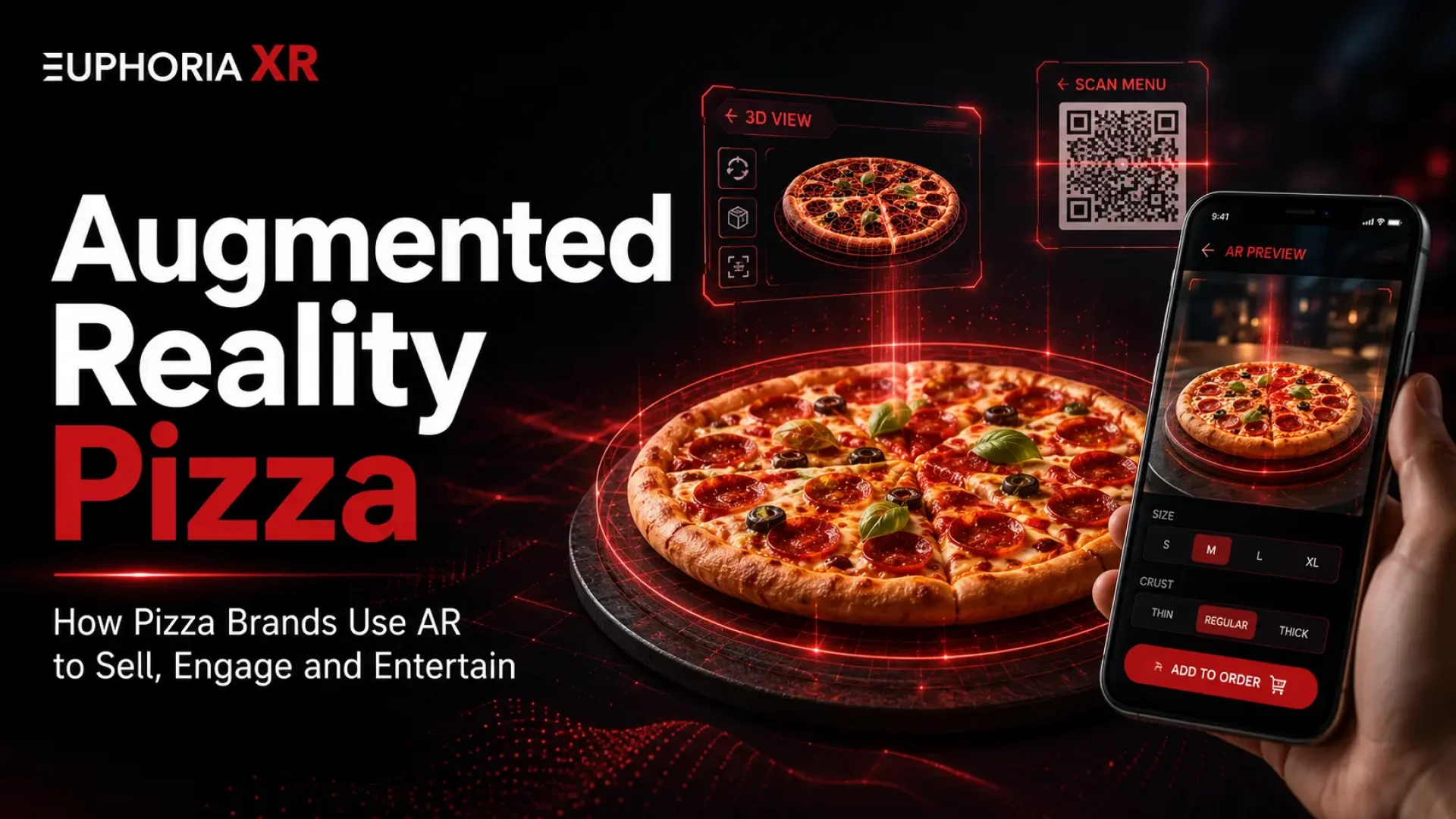
Augmented Reality pizza re-creates the pizza ordering, menus, packaging, and promotions in a more interactive manner using AR. Domino’s employed AR Pizza Chef to enable customers to create and view pizzas before they placed the order, and Pizza Hut utilized AR for the PAC-MAN pizza boxes, on-the-spot encounters, and transportation games. Pizza brands can utilize AR for food visualization, customization, interactive packaging, games, promotions, and online ordering.
What if you could create a pizza on your table before ordering pizza?
Or even dine on pizza and use the box to create a PAC-MAN game.
It’s already possible with augmented reality pizza experiences. Pizza manufacturers are utilizing AR to enable users to see their food, change orders, enjoy games, interact with the packaging, and participate in brand campaigns
Domino’s invented a virtual Pizza Chef. Pizza Hut turned pizza boxes into playable AR games.
As these examples demonstrate, AR pizza isn’t just a concept. It can accompany the client in picking a dish and letting him or her engage with the brand after delivery.
What is Augmented Reality Pizza?
Augmented reality pizza is an AR experience built to bring digital pizza, menus, games, or other interactive content to the real world via phone, tablet, or screen. Customers can interact with it in a range of ways, from exploring products, ordering, playing games, or bringing a pizza to life for them to order.
AR is different from virtual reality because it doesn’t substitute the physical world. It overlays digital content over customers’ existing view.
For instance, a customer may place their cell phone on a table and see an actual pizza appear. They can even flip the pizza, inspect the toppings, alter ingredients, or explore the additional product information
Pizza brands can use augmented reality for:
This helps bring AR pizza into the entire customer journey, from selecting food to engaging in post-delivery engagement with the brand.
How Does Augmented Reality Pizza Work?
Augmented reality pizza works because the device’s camera can perceive the surroundings and overlay the pizza’s content onto the real world, as seen by the end user. This experience could begin via a mobile app, a website, a QR code, or a packaging printout.
A normal AR pizza session looks something like this:
Customer unseals the AR experience.
They can scan a QR code, open an app, or access a WebAR page.
The camera takes pictures of the environment.
It can find tables, floors, menus, pizza boxes, and printed pictures.
AR software will observe the surface or object.
This helps keep the digital content in the right position.
A 3D pizza or other digital item is projected.
Its screen is displayed on the customer’s tablet or smartphone.
The customer is engaged in an experience.
They may spin a pizza, throw toppings at it, look at the product info, or even play a game.
The experience can tie to the next action.
This can include opening a menu, using a coupon, or proceeding to order.
It is an AR experience that incorporates app-based AR technology, like ARKit, ARCore, and Unity. Others employ WebAR, which enables customers to open AR with a supported mobile browser without having to download any particular app.
The correct approach will vary depending on the objective. The detailed surface tracking capabilities of a 3D pizza builder may require a different type of AR technology than an AR pizza box game, which could simply use a QR code and image recognition.
Domino’s Pizza Augmented Reality: Build Your Pizza Before Ordering
Domino’s showed how augmented reality pizza could become part of choosing and ordering food with its New Pizza Chef with Augmented Reality.
The feature, which debuted in Australia in 2018, enabled customers to build a virtual pizza via the Domino’s current mobile application. In place of looking at a menu to order toppings, they could now see their pizza come into shape in front of them.
Users could choose the preferred toppings and drag them on the virtual pizza:
Crust
Sauce
Cheese
Toppings
Finishing Swirls
Then the pizza might be viewed from various perspectives in the actual environment of the customers.
To recognize the surrounding environment of the user, Domino’s utilized Google ARCore and Apple ARKit. The experience was created with the Unity 3D game engine add-unity-addon-experience.
The company paid close attention to visual accuracy. Domino’s said the ingredients were developed to mimic the weights of the ingredients in its pies. The idea was to have the pizza that customers would see in AR closer to the pizza that was presented to them.
The greatest benefit of Domino’s Pizza’s augmented reality experience was its embedding in the ordering process.
It was not an AR game that lasted a few minutes. Pizza Chef built the app inside the existing Domino’s app, enabling the ability to see the menu, offers, and order tracking.
This provided AR with a real job:
Take customers through ground-level illustrations and construction to create the pizza they desired before ordering it.
Domino’s eventually summarized their idea as a game where customers can virtually build mixing combinations of pizza ingredients on a table at their place or home.
The AR Pizza Chef was never a standalone website, but a component of Domino’s mobile app.
Pizza Hut Augmented Reality: From Pizza Boxes to AR Games
Pizza Hut AR campaigns have also incorporated AR technology into the pizza box, live events, and promotions, creating interactive experiences for visitors. Pizza Hut employed AR more for entertainment and engaging with customers, whereas Domino’s had mainly utilized AR for creating pizzas.
Its AR projects demonstrate the ability of pizza brands to use the technology in various stages of the customer journey. A pizza box can be a game when it reaches your door. A live event could be a shareable AR moment. Customers can be targeted to play and re-enter with a promotion.
Pizza Hut’s PAC-MAN Augmented Reality Pizza Box
Pizza Hut turned a simple pizza box into a playable PAC-MAN game using WebAR.
The company worked with GSD&M and creative studio Tool to create special-edition pizza boxes. The manual QR code located on the box was scanned with a customer’s cell phone. The experience was then opened with a mobile browser.
The customer directed the camera at the top of the pizza box. A PAC-MAN board was created and placed over the object, using image recognition. The surface on which they played was a physical box.
Players could:
Control PAC-MAN using an on-screen joystick
Choose from 3 difficulty levels
Play directly on the pizza box.
Enter their initials on a Pizza Hut x PAC-MAN leaderboard
The experience was created with the help of Three.js and A-Frame (3D graphics rendering) as well as 8th Wall (augmented reality). The position of the pizza box was tracked using image recognition, while the customer played the game.
Easy access was one of the greatest benefits. It’s constructed with WebAR, making it so that there was no need to install another app for consumers.
The campaign is a great example of how augmented reality Pizza Hut packaging products can bring the experience after delivery. Now that the meal is over, the box doesn’t simply disappear, but instead it allows customers to connect with the brand.
Pizza Hut’s Augmented Reality Delivery Game
Pizza Hut Hong Kong went another route and used AR to create a campaign around their delivery service.
The company wanted the experience of its delivery concept to be felt through an interactive game. The AR game was added to Pizza Hut’s Mini-Plate campaign, and it was meant to draw more customer interactions with the brand.
Lenovo PCCW Solutions has undertaken the development process, which comprises:
Game-flow Design
AR Development
3D Graphics
Quality Assurance
The entire AR game took two months for the developer to conceive, design, and develop, according to the developer.
Users were able to play the game and redeem their coupons for the next visit. Pizza Hut Hong Kong had hoped to roll this out to other outlets upon receiving a favourable market response.
This led to a definite next step for the AR campaign. Customers didn’t just simply come in, play, and leave. The promotion might entice them to go back to Pizza Hut and accept the promotion.
6 Ways Pizza Brands Can Use Augmented Reality
Pizza brands can be enhanced in three ways: before, during, and after the order. Here are some practical ideas for its use:
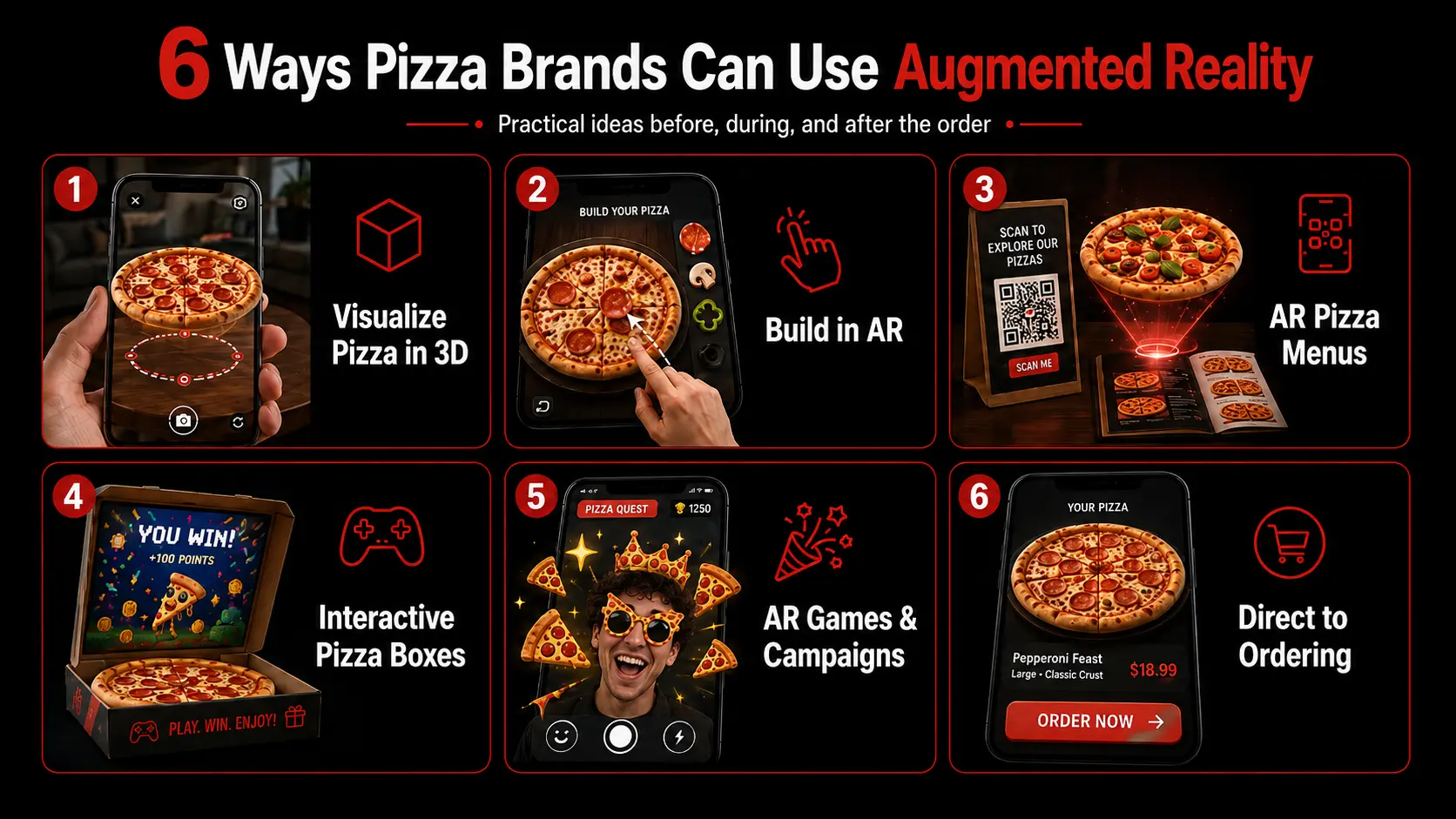
Visualize Pizza in 3D Before Ordering
AR can have a realistic 3D pizza image on the customer’s phone placed on the table. Customers can see the size, crust, toppings, and the general appearance of the pizza before purchasing it.
Build and Customize Pizza in AR
Customers can add and remove toppings and watch the pizza transform as they go. This allows for easier customization in a visual way than picking options from a text list.
Create Augmented Reality Pizza Menus
3D food models, ingredients, sizes, and other information can be seen on an AR pizza menu when customers scan a menu or QR code. It adds extra info into a regular menu without overloading it.
Turn Pizza Boxes Into Interactive Experiences
Pizza boxes can be used as AR triggers for games, offers, gameplay footage, or branding. PAC-MAN campaign was a Pizza Hut experiment that demonstrated the possibilities of packaging to keep connecting with customers after they have picked up the order.
Launch AR Games and Brand Campaigns
By harnessing AR games, filters, event experiences, and interactive promotions, pizza brands can drive customer participation, social engagement, and increased brand interaction time.
Connect AR Directly to Ordering
AR can be used to lead the customer from the display or customization to the purchase of the pizza. A prominent “Order Now” or “Add to Cart” call-to-action can speed up the conversion rate.
Why Pizza Brands Should Invest in AR Experiences?
Pizza brands can use augmented reality to make product discovery more interactive, allow for customization, create promotions, and engage customers post-purchase. Brands can use it beyond the novelty of AR and tie it to meaningful user behaviors, like exploring a pizza, choosing the toppings, unlocking an offer, or ordering a pizza.
The AR technology can help create pizza brands that:
Improve product visualization: Let customers view pizzas in 3D before ordering.
Make customization more interactive: Show toppings, crusts, and other changes in real time.
Design interactive packages: Make pizza boxes interactive with games, promotions, or loyalty programs.
Enhance product releases: AR to promote new, luxury, and limited edition pizza products.
Boost engagement with brands: Get consumers to interact with a brand rather than contemplate an ad.
Link campaigns to orders: Send customers to menus, coupons, products, or checkout from an AR experience.
Create extended engagement after purchase: Packaging to nurture the brand after the pizza is delivered.
The best AR experiences provide customers a good reason to interact and a useful next step as a result, making it easy for customers to see how to get closer to it.
How Can AR Support Pizza Sales and Customer Engagement?
With AR, pizza places can help customers better comprehend products, items on menus, and move toward purchasing amidst the hunt through the discovery process. It can also establish engaging touchpoints to keep customers involved before and after a sale.
AR can enable both sales and engagement with:
Decreasing uncertainty from ordering: Customers can check a pizza, toppings, crust, or size before ordering.
Promoting menu exploration: Interactive 3D helps customers to investigate the various products and menus.
Easy customization: Customers can visually observe how pizza changes when ingredients are added and removed.
Showcasing premium products: 3D visualization can give new or higher-value menu items more visual impact.
Turning promotions into experiences: Customers can unlock coupons, rewards, or offers through AR games and packaging.
Connecting directly to conversion: Buttons such as Order Now or Add to Cart can take customers from the AR experience to the ordering process.
Repeat visits: Pizza boxes and delivery materials can lead customers to loyalty offers, games or offers for their next order.
The engagement can then trigger a measurable action that is most likely to positively result in viewing a menu, claiming a promotion, signing up for a loyalty program, or ordering something.
Benefits of Augmented Reality for Pizza Brands
The applications of augmented reality are not limited to providing a campaign with interest. If done correctly, it can have a positive influence throughout the discovery, understanding, and interaction that a pizza brand has with the customer.
Show the Pizza Before Customers Order
Customers can get a 3D visual of what a pizza will look like before they purchase. This will make it easier to make menu selections, particularly when it comes to new products or custom pizzas.
Turn Pizza Packaging Into a Digital Experience
AR is an additional component in physical packaging. A pizza box can be programmed to communicate with a phone to open games, promotions, loyalty rewards, contests, or brand stores.
Increase Customer Engagement
Customers can converse with the brand as opposed to just looking at an advertisement. They can create pizzas, play games, look at products, or participate in AR campaigns.
Connect AR Campaigns With Ordering
If a customer clicks on an AR experience, they will be taken directly to a menu, coupon, product page, or checkout. This brings an interesting campaign to a very helpful business activity.
Give Customers More Product Information
AR can display ingredients, toppings, sizes, nutrition details, customization choices, and other information without adding more clutter to a printed menu or pizza box.
How to Create an Augmented Reality Pizza Experience?
The process for the creation of an AR Pizza experience begins with the customer goal and then progresses through experience design, 3D production, development, integration, and testing.
Define the Goal
Understand how customers can experience what they can do. It could be intended to preview a pizza, add toppings, engage in packing and packaging or play a game, sign up with a promotion or order a pizza.
Choose the AR Experience
Choose the format best suited to the aim. It could be anything from a 3D pizza visualization, a pizza-building AR app, interactive menus, pizza-box experiences, branded games, or any kind of promotional campaign.
Select WebAR or App-Based AR
Determine access to the experience for customers. QR codes can potentially be used with WebAR, packaging can be used, and quick-access campaigns can be successful with WebAR, although app-based AR might be better for deeper functionality or a restaurant app.
Create the 3D Assets
Create digital assets for use in the experience, including pizza bases, crusts, sauces, cheese, toppings, packaging, animations, or branded merchandise. Realistic textures, proportions, and presentation should be used in models of food.
Develop the AR Interactions
Create the functions for customers to utilize, including surface tracking, image recognition, object positioning, pizza rotation, item selection, animation, touch controls, or gamification.
Connect Business Systems
Integrate the AR experience with relevant systems such as online menus, shopping carts, ordering platforms, coupons, loyalty programs, landing pages, or analytics.
Test Across Devices
An extensive test of it across supported smartphones, operating systems, browsers, lighting, etc., and physical environments is done to provide reliable tracking and a usable experience.
Launch and Measure Performance
Monitor and trace customers’ experience after launch. Useful measures can include experience opens, time spent, coupon claims, and visits to the menu, add-to-cart, orders, and repeat engagement.
AR Pizza Menu vs Traditional Digital Menu
An AR pizza menu provides interactive 3D visualization, making ordering simple, and a traditional digital menu is simple and easy to use. The choice will vary on whether customers just need info provided or if they need to see and explore the pizza before ordering it.
How Much Does an Augmented Reality Pizza Experience Cost?
The price of an augmented reality pizza experience varies with complexity, platform, features, 3D assets, integrations, tracking needs, and device support. Generally, a basic WebAR visualization solution with one 3D pizza will involve less development than a full AR pizza kitchen with real-time customization, gamification, ordering integration, and several models of the pizza. The best cost estimate is getting a clear understanding of the parameters of site functionality, expected number of 3D assets, technical requirements, integrations, and supported devices before development.
Technologies Used in Augmented Reality Pizza Experiences
There are various types of augmented reality pizza experiences, depending on the purpose. Some emphasize 3D visualization, some require image tracking, accessing the browser, or interaction with the app.
Common technologies include:
WebAR: Use AR through a supported mobile browser, instead of installing an app.
ARKit: Apple’s AR capability (framework) for building AR experiences on compatible iPhones and iPads.
ARCore: Google’s platform for AR experiences on supported Android devices.
Unity: A game development platform and engine for developing real-time 3D and AR experiences.
8th Wall: A WebAR platform used for browser-based AR campaigns.
Vuforia: An AR platform commonly adopted for AR-related image recognition and tracking applications.
Three.js: A JavaScript library used to display 3D graphics on the web.
A-Frame: A web framework to build 3D and AR scenes.
QR codes: Give your customers easy access to an AR experience.
Image Recognition: Using the camera to detect a Pizza box, menu, or print piece.
3D modeling: Creates realistic digital pizzas, toppings, packaging, and other assets.
The choice of technology depends on the customer’s activities. Picture tracking may be necessary in a pizza-box game, whereas for a 3D pizza viewer, image tracking is not enough, and some surface tracking and realistic 3D models are necessary.
WebAR vs. App-Based AR for Pizza Brands
WebAR can be implemented as a supported mobile browser with pizza brands or as an app. Usually, WebAR applications are appropriate for short-term engagements such as packaging events and QR-code promotions, whereas app-based AR can prove more useful for a richer set of functionalities and tighter integration with pre-existing ordering and loyalty processes.
This is not to say that either option is the right one; it will vary by customer journey. Where access friction is the most important factor, WebAR is often more appropriate; when AR should become a more wholly integrated part of an existing ordering or customer application, app-based AR may prove more appropriate.
What Does the Future of Augmented Reality Pizza Look Like?
The next steps for augmented reality pizza are likely to involve not only increasing the accessibility of AR but also increasing the utility of AR in the buying experience. One thing is that AR can go beyond fun campaigns and be incorporated into menus, customization, ordering, and loyalty programmes.
Possible future uses:
Enhanced 3D food models: Realistic pizzas come with realistic textures, crust thickness, and toppings.
WebAR: More brands could take advantage of WebAR to begin without having to download an application.
Real-time customization: Customers may add toppings and see their pizza change instantly.
Direct ordering: AR experiences can be more closely linked to carts, offers, and checkout.
Interactive packaging: Pizza boxes may offer games, prizes, stories, or special offers available for a limited time.
Loyalty integration: Users can accumulate a certain number of rewards upon engaging with AR elements.
Personalized menus: AR can provide offer recommendations based on the selected products.
Social AR: Pizza brands can develop filters and experiences during launches and campaigns.
The most effective future uses will probably be those that facilitate choosing, ordering, or enjoying pizza, as opposed to using AR just for fun.
Key Takeaways
Augmented reality pizza overlays real-world food with digital pizza, games, and promotions.
Pizza companies can use AR for 3D visualization, customization, packaging, and ordering.
Domino’s utilized AR to allow customers to create and visualize pizzas before placing an order.
Pizza Hut introduced AR in pizza-box games, events, and customer campaigns.
WebAR can help to ease friction without requiring customers to download a separate app.
An AR pizza menu can be more descriptive than traditional digital menus.
QR codes and image recognition are ways to transform pizza boxes into interactive marketing channels.
Technologies such as ARKit, ARCore, Unity, 8th Wall, and Three.js can support different AR use cases.
The best AR experiences have a purpose to stimulate engagement from customers.
AR is most effective when it relates entertainment or visualization to a practical follow-up action.
Wrapping Up
Augmented reality pizza offers pizza manufacturers fresh opportunities to allow their consumers to view, customize, place orders, and engage with food. The technology can be used to enhance the customer experience as well as marketing, such as 3D visualization of pizza, AR menus, interactive pizza boxes, and even branded games. The thing to learn is the positive use of AR, and add to it when it helps customers choose a pizza, it provides them with useful information, or has added value for them to interact with.
Frequently Asked Questions (FAQs)