












How Does an Augmented Reality Cake Work?
The Augmented Reality cake is a cake that links the physical world item or visual cue to digital content.
This depends on the AR technology in use, but the guest experience is kept extremely easy.
Scan the QR Code or Image
A visitor first scans the QR code, clicks on an AR link, or focuses a device on a known image.
The trigger may be included on the cake topper or in other event supplies like a table card or invitation.
Recognize the AR Trigger
An AR system finds the visual target selected by the user for an image-tracked experience.
A good target should provide the tracking system with sufficient shape and markers to enable easy consistency recognition from various angles.
The experience is then recognized and knows where the related digital content should be presented.
Load the AR Experience
The AR content is loaded via a mobile app or a mobile browser.
This can involve interactive user elements such as visuals, sounds, and motion, as well as 3D forms and animation.
It’s important to keep these optimized, since visitors should not need to wait needlessly for the experience to load.
Display Digital Content Around the Cake
Virtual content may be placed above, beside, or around the physical cake once tracking has started.
The visitors would have been able to look upon:
-
Balloons floating above a birthday cake
-
Flowers growing around a wedding cake
-
A 3D cartoon character at the brand event
-
Photos emerging around the cake
-
A video message displayed on a virtual screen.
-
Tap-activated objects that react
The effective design of AR can make the digital content have a connection and feel more real to the real object or display an unrelated animation on the phone screen.
Interact, Record and Share
The experience doesn’t have to be limited to watching an animation.
You might have the opportunity to:
-
Tap digital objects
-
Progress through a story
-
Play a short game
-
Open additional content
-
Take an AR photo
-
Record a video
-
Visit a website
-
Access a promotional offer
-
Share their experience
The interactive layer lies at the heart of delivering an AR cake from a mere visual effect into a full event experience.
Does an AR Cake Need an App?
Not necessarily. The augmented reality cake can be sent in the form of WebAR or as a standalone AR application.
WebAR Cake
A WebAR cake enables the experience to be opened via an appropriate mobile internet browser.
The guest can scan a QR code, allow access to the camera, and access the AR experience without an app store visit.
This could prove very beneficial for the following:
-
Weddings
-
Birthdays
-
Exhibitions
-
Conferences
-
Product launches
-
Restaurants
-
Retail activations
-
Short-term marketing campaigns
Without the app-download step, it becomes easier for more guests to participate.
App-Based AR Cake
The cake experience might make sense in the larger digital product or in a continuous campaign.
A brand could, for instance, already have an application that features loyalty elements, games, product data, and other AR experiences.
Additionally, it might be suitable to use an app approach if the project has some of these integrations that are more easily managed in a custom mobile app.
The one to select depends on the viewers, functionality, and overall event strategy.
What Can You Do With an Augmented Reality Cake?
Creative applications are far from cakes featuring a single animation over the top.
With a well-planned augmented reality cake, storytelling, customization, fun, and interaction can all be accomplished.
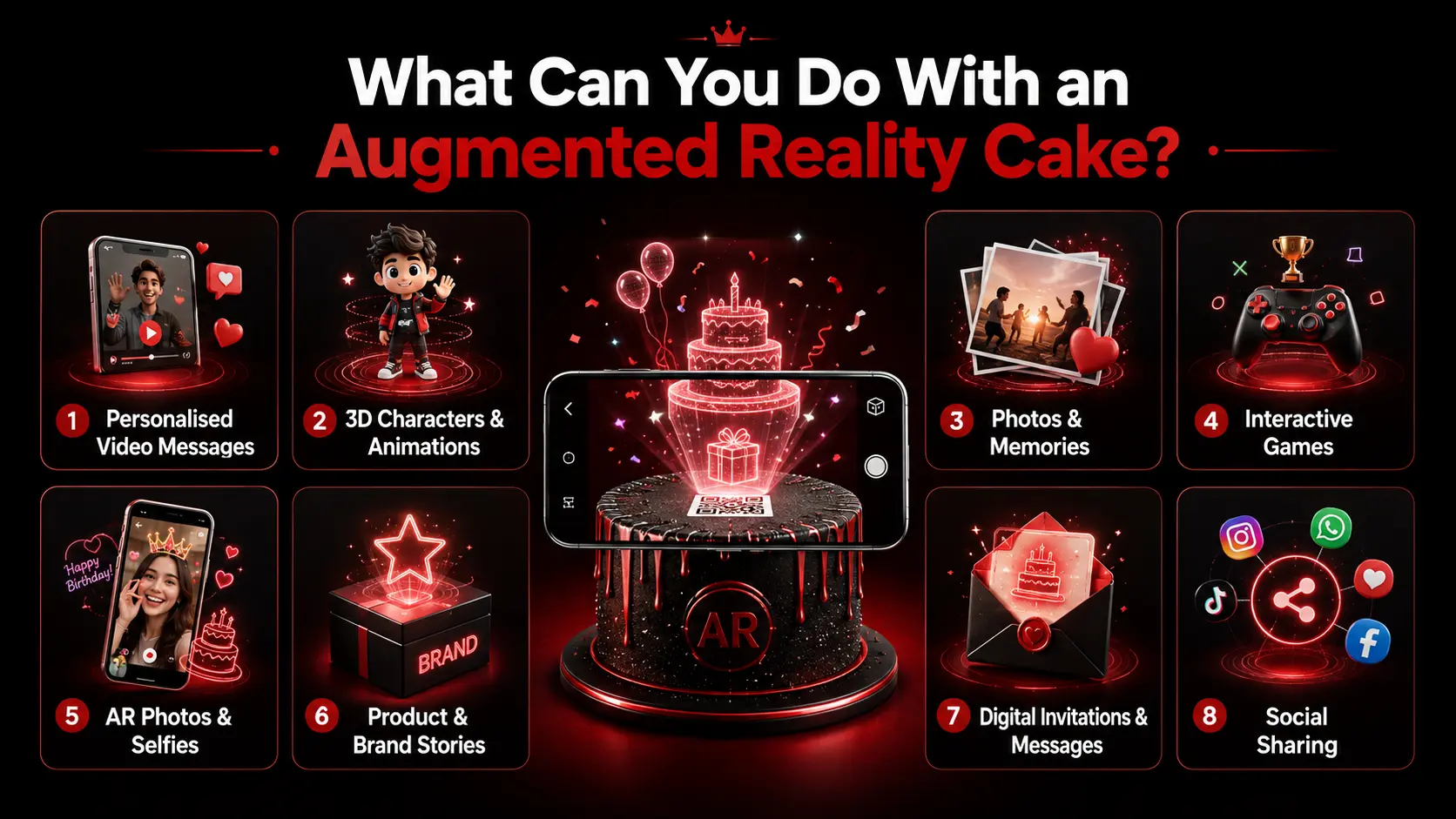
Personalized Video Messages
A family member might be playing a surprise video on a birthday cake, or a message could play on a wedding cake.
Pre-recorded messages can help to invite remote guests, relatives, or colleagues into the celebration.
3D Characters and Animations
3D content can make the physical cake appear to come alive.
There’s enough room to let a dinosaur wander around the circumference of a child’s birthday cake. The rocket could fly over the candles. Digital flowers and butterflies may be manifested on an arrangement around a wedding cake.
If the event is related to a brand, it can also be based on a product, mascot, character, or logo.
Photos and Memories
Using AR can transform the cake into an engaging or special remembrance display.
Visitors may find photographs and memories from their childhood, engagement pictures, photos from trips, or photos from previous company milestones or of earlier occasions.
Taking photos can be incorporated into the digital interactive environment, rather than having them physically located around the venue.
Interactive Games
The AR cake can also serve as the base of a quick game.
They may pick up a virtual object, answer questions, discover hidden objects, or solve a minimal issue concerning the person, occasion, or brand.
The interaction should be easily comprehensible to ensure that visitors can interact without lengthy instructions.
AR Photo and Selfie Experiences
Digital effects can be used outside of the cake.
The guests could switch on the themed frames, floating objects, characters, or other AR elements that were prepared for photos and videos.
This can make it more enjoyable to share and provide something for them to take away from the event.
Product and Brand Stories
An AR cake, for companies, can turn into a non-traditional storytelling surface.
You might discover when scanning the experience that:
-
A new product in 3D
-
A product demonstration
-
Campaign messaging
-
A brand mascot
-
A company milestone
-
An interactive product catalogue
-
A link to purchase or learn more
This makes the cake more than just decor but an integral part of the overall event activation.
Digital Invitations and Messages
An AR experience can even link several parts of an event.
For instance, by using the same brand for the cardboard invitation, guests will be directed in their arriving to a similar AR experience within the venue.
These messages can then vary based on the guest’s location in their journey.
Social Sharing
Visual content fits in perfectly with AR experiences.
If the devices can take photographs or videos, an event can go beyond the actual number of people attending.
The AR concept can be created from the ground up to support social sharing features for branded campaigns.
Augmented Reality Birthday Cake Ideas
Incorporating AR technology into a birthday cake can make ordinary birthday celebration routines more connected and customized.
The experience can be customized, depending on the individual’s age, their previous experiences, or their favourite themes.
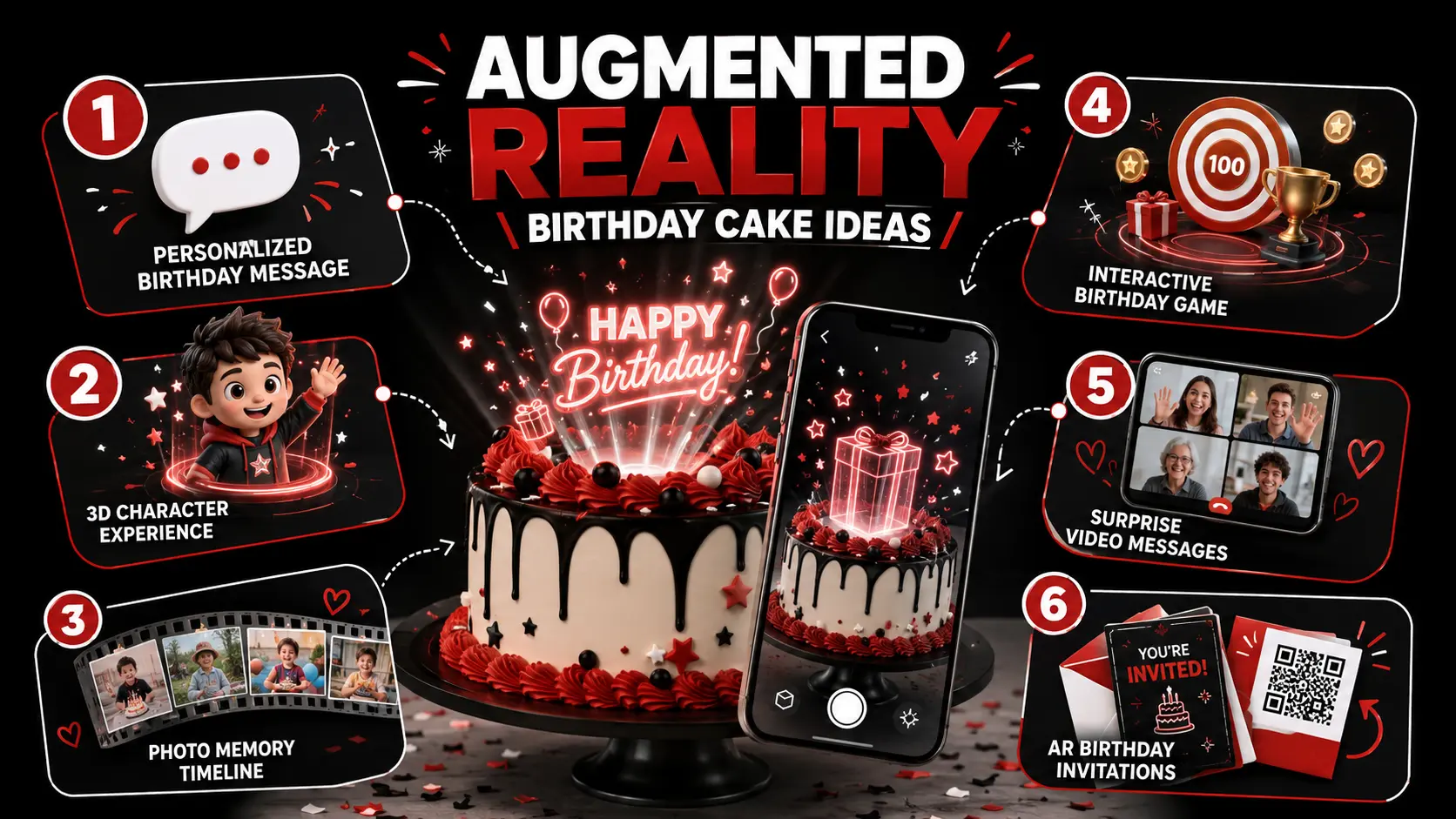
Personalized Birthday Message
The cake might reveal the individual’s name, age, and a happy birthday animation.
Memories from friends and family may also come out one by one, mimicking a real-life digital wonder during the cake-cutting moment.
3D Character Experience
A favourite type of character, animal, vehicle, or fantasy object could appear in 3D around the cake. This could be the primary attraction for younger guests. The 3D elements may be more nuanced and related to a favorite activity, curiosity, or recollection for adults.
Photo Memory Timeline
Within the walls of an AR birthday cake, photographs could be revealed from different phases of a person’s life. Visitors could browse through sections of childhood photographs, school memories, and travel photos until the final birthday message.
Interactive Birthday Game
You can start a mini AR challenge with the birthday cake. For guests, they may attempt to answer trivia about the birthday person, pick up virtual candles, or look for hidden digital items all around the cake.
Surprise Video Messages
Friends and family members who are not able to attend in person could make video messages in advance. These can then be interwoven into the cake experience, helping to make it more personal than playing a video on another screen.
AR Birthday Invitations
The AR journey can start before the party.
An invitation, either printed or displayed on a screen, may begin the picture or theme, and then the idea is carried on at the birthday cake.
This makes the overall experience of the event a stronger one, from the invite to celebration.
Augmented Reality Wedding Cake Experiences
An augmented reality wedding cake can be really helpful both before and during the wedding.
Using AR can show couples how they will look in this design, and as the cake is crafted, it can be integrated into an interactive story at the reception.
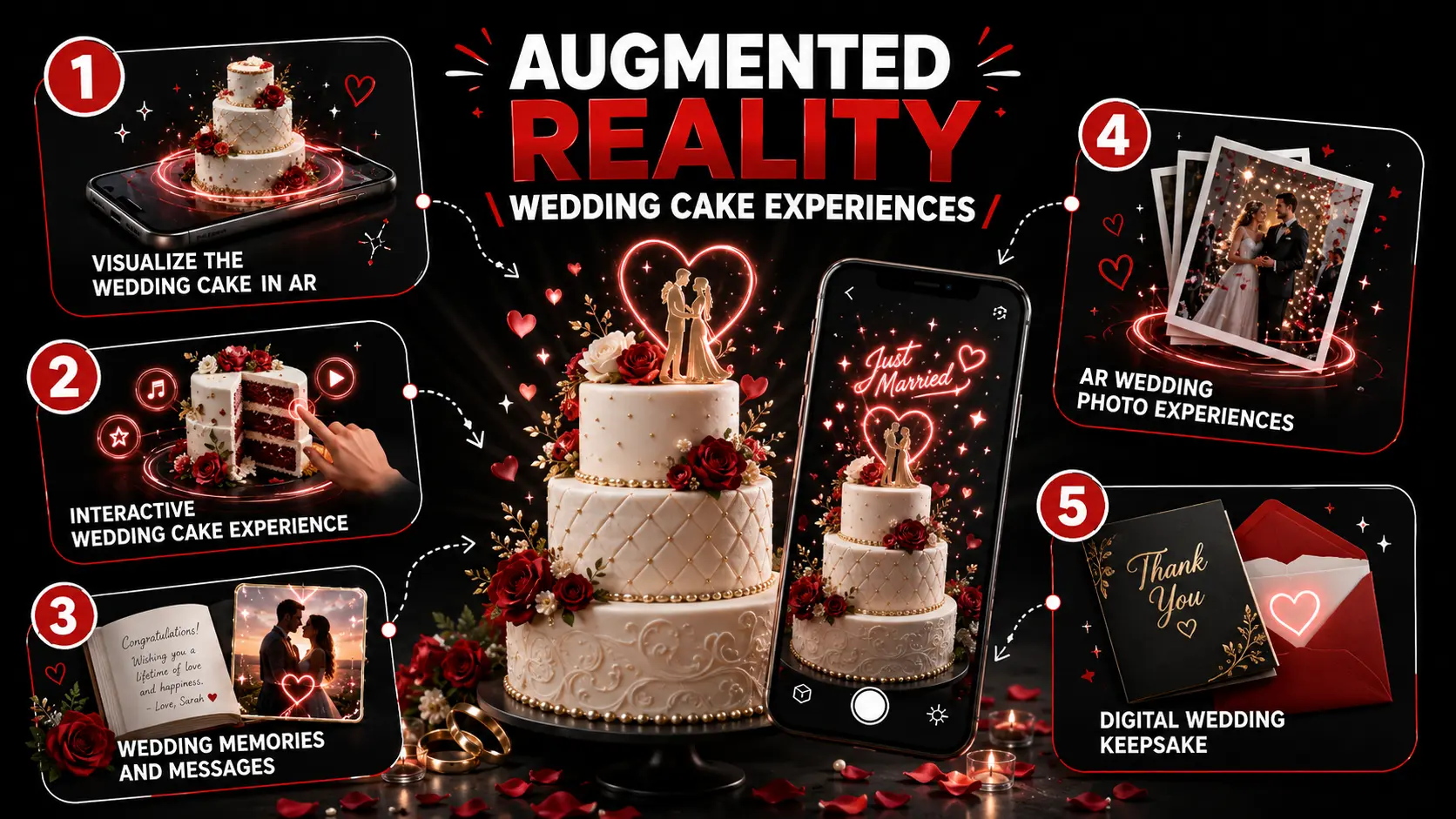
Visualize the Wedding Cake in AR
AR can assist to imagine a design in physical space before the production of a cake.
Couples could compare:
-
Cake sizes
-
Number of tiers
-
Decorative styles
-
Colours
-
Placement
-
Different design concepts
3D preview lets people assess a design in another way before a final decision.
Interactive Wedding Cake Experience
Attendees can scan a cake or one of the nearby triggers, which display a digitally created experience at the reception.
A digital flower may be arranged, the couple’s names may be written above the cake, and an animation could be used to guide guests through various components of the couple’s story.
Wedding Memories and Messages
The cake can be a catalyst for positive recollections.
They may experience:
-
First photographs together
-
Engagement pictures
-
Travel memories
-
Messages from family
-
Wedding dates
-
Thank-you messages
Subsequently, they can be served as a series of bites rather than all at once.
AR Wedding Photo Experiences
The cake can link to a larger AR photo experience as well.
Participants can have photos taken with digital variations such as virtual flowers, wedding initials, themed effects, or other digital content centered on the event.
Digital Wedding Keepsake
The physical wedding cake will be gone after the day, but the digital one doesn’t necessarily need to be.
After the wedding, a couple may have printed access to specific digital memories by having a card, photo, or similar retrieval item to open it.
It enables the AR concept to be part of the couple’s digital keepsake, rather than just existing during the reception.
Augmented Reality Cakes for Brands and Events
AR cakes aren’t confined to personal events.
An interactive cake can be used as a part of an AR event activation to capture attention, draw involvement, and deliver a message to the business.
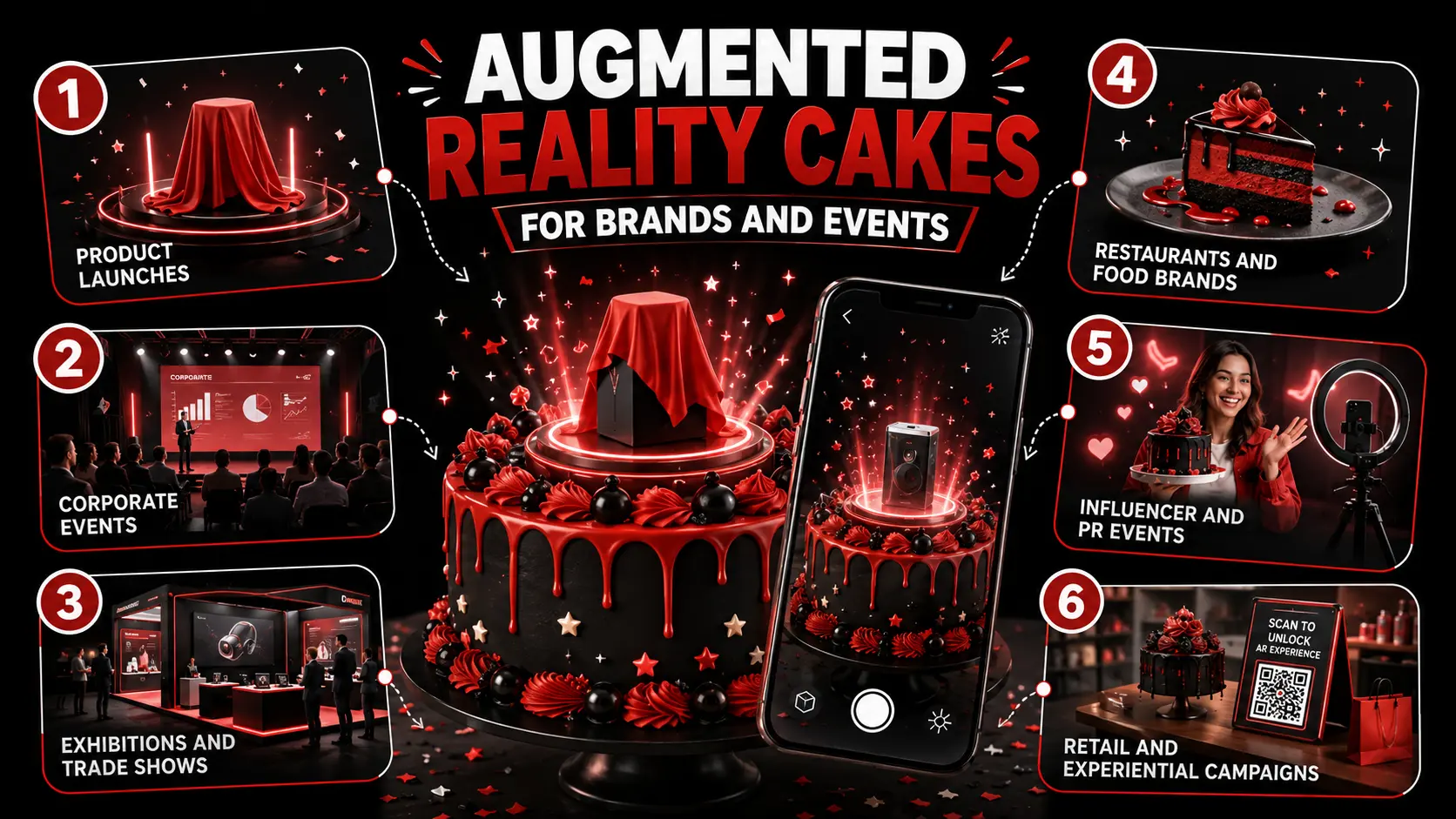
Product Launches
The new product could be unveiled as an interactive 3D model from a launch cake.
Visitors were able to swipe it side to side, or jump straight to product information from the AR experience.
Corporate Events
Events like company anniversaries, employee events, and milestone celebrations can use AR to showcase the company’s history, achievements, or messages from company leaders in an interactive way.
Exhibitions and Trade Shows
An unusual AR activation at an exhibition stand can be yet another reason why visitors will stop and interact with the brand.
This cake could serve as a portal for more product information, a game, a giveaway, or a deeper digital interaction.
Restaurants and Food Brands
Physical products made for restaurants, bakeries, and food brands can be linked with a digital story.
A dessert might help you to tell what’s in the dish, what the chef wants to say, the name of the brand, a promotion, or an interaction-based campaign.
Influencer and PR Events
An AR experience can be highly visual and serve as content creation.
This can be a branded cake created with 3D effects, animation, or a photo moment that is AR-related and allows for content to be photographable and recordable for attendees
Retail and Experiential Campaigns
AR cakes can also be part of a pop-up, retail launch, or experiential marketing campaign.
The whole activation does not need to be on the cake. Rather, it can be a singular physical point of contact that ties back into a larger campaign.
AR is more effective for engaging visitors personally. Projection mapping works better if everybody needs to see the same visual impact at the same time.
How to Create an Augmented Reality Cake?
Creating an augmented reality cake requires a clear concept, reliable tracking, optimized digital assets, and a smooth mobile experience.
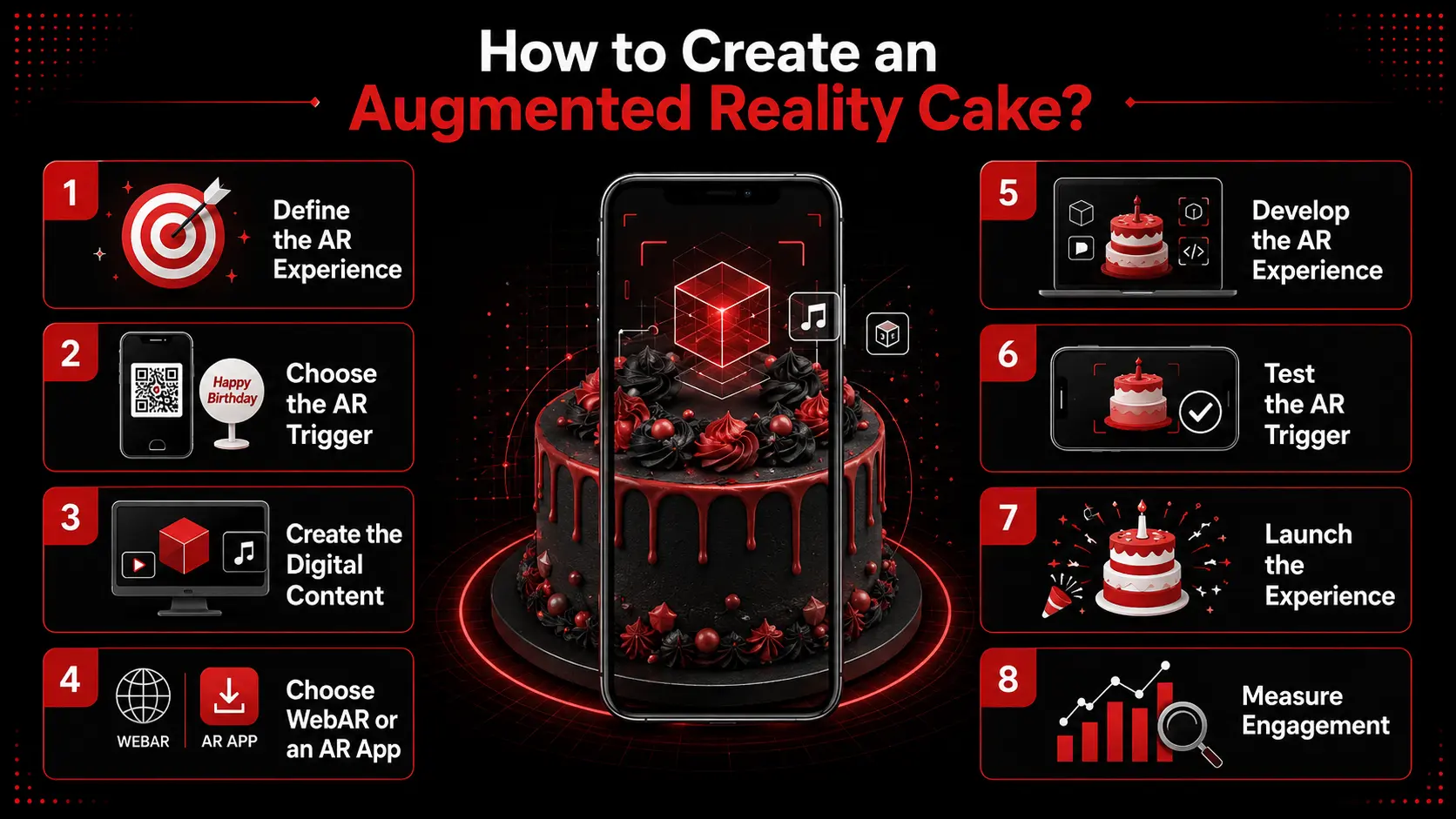
Step 1. Define the AR Experience
First, determine what guests need to do. It can show a personalized message, a 3D character, wedding memories, a branded interaction, or just a simple AR game.
Step 2. Choose the AR Trigger
Figure out opening modes or tracking methods for the experience. This could be a QR code, cake topper, print-out image, logo, invitation, or anything else that is recognizable to the viewer.
For image tracking, the trigger should be highly visible with sufficient contrast on the image observed under the real event conditions.
Step 3. Create the Digital Content
Create AR assets (3D models, animations, videos, photos, audio, or interactive content).
These assets need to be carefully optimized for use in mobile AR. Heavy 3D artifacts, huge textures, or big media files may cause delays and affect performance.
Step 4. Choose WebAR or an AR App
Events may also be appropriate for WebAR since they can be accessed via a mobile browser with a compatible application.
If the project involves high-end functionality, integrations, or is part of a current mobile application, it might be better to use a dedicated AR app.
Step 5. Develop the AR Experience
The development stage relates the physical trigger to the digital content.
It can entail image recognition, image tracking, 3D modeling, animation, video integration, user interactions, analytics, and external integrations.
Experience must consider screen size, camera permissions, browser compatibility, loading behaviour, etc. when considering mobile.
Step 6. Test the AR Trigger
Test on the types of devices involved and under conditions which replicate the event.
The performance can depend on lighting, viewing distance, camera angle, reflections, Internet bandwidth, object visibility, and loading times in 3D mode. The images should also not move around when users are navigating throughout the cake.
Step 7. Launch the Experience
Make the activation process as simple as possible.
With instructions like “Scan to see the cake come alive,” or “Point at the topper,” the reading level can be lower, enabling guests to understand the instructions right away.
Again, it should be verified at the site considering any changes in lighting, placement, or connectivity.
Step 8. Measure Engagement
In branded and commercial activations, analytics can help to measure launches, sessions, interactions, button clicks, content views, and conversions.
These insights will provide a clear lens on the AR experience and be used to enhance upcoming AR campaigns and event activations.