















Colour Blind Spectacles - EuphoriaXR

Colour Blind Spectacles: Expert-Reviewed Guide to Benefits, Uses, and Effectiveness

Picture of Aliza kelly
Aliza kelly

Content Writer

Colour Blind Spectacles - EuphoriaXR
Table of Contents
Table of Contents
Share Article:

Have you ever found yourself looking at a crossing light and unsure of its color?

Or looked at a fruit and said, Is this a ripe one or not?

For most people with colour vision deficiency, this is the normal way of life.

It is not just about seeing colours.

It shows up in school charts. Work dashboards. Clothes shopping. Cooking.

Stressful things concern even small things.

And when one mentions it, it is so obvious, then it makes them lonely.

That is the problem.

This is a place where there are signals in the form of colours.

Mistakes occur when similar signals occur.

Confidence drops. Time gets wasted. Some begin to shun colour-based activities.

Then it would be natural to suppose that colour blind spectacles should sound like the ideal solution.

Put them on, and the world seems clear.

However, that is not always the case with real life.

There are glasses that do some good for some folks.

Others see almost no change.

And some think the colours are not right or too dark.

This guide simplifies the interpretation into an easier language.

How blind the eyes of colour are.

Colorblind glasses are functioning.

Who do they help most?

What is the cost of color blind glasses in 2025?

And what can AR and VR do that spectacles cannot?


What Are Colour Blind Corrective Glasses?

Colour blind corrective glasses are special glasses used by persons with colour-deficient vision.

They are also referred to as colourblind spectacles or colour-correcting glasses.

  • Their cure is not colour-blindness.

  • They do not affect the genes of the eye.

  • They are not the givers of normal colour vision.

In their turn, they attempt to make certain colours appear more contrasting.

It does this by varying the level of light going through the eye.

The majority of the products are designed to address the deficiency of red-green colour vision, as it is the most prevalent.

There also exist some products that create an inability to see blue and yellow colours.

These are glasses worn daily, such as:

  • Reading colour charts

  • Picking ripe fruit

  • Choosing matching clothes

  • CVD Noticing coloured wires or labels.

  • Enjoying nature and sports


How Do Colorblind Glasses Work?
How Do Colorblind Glasses Work - Euphoria XR


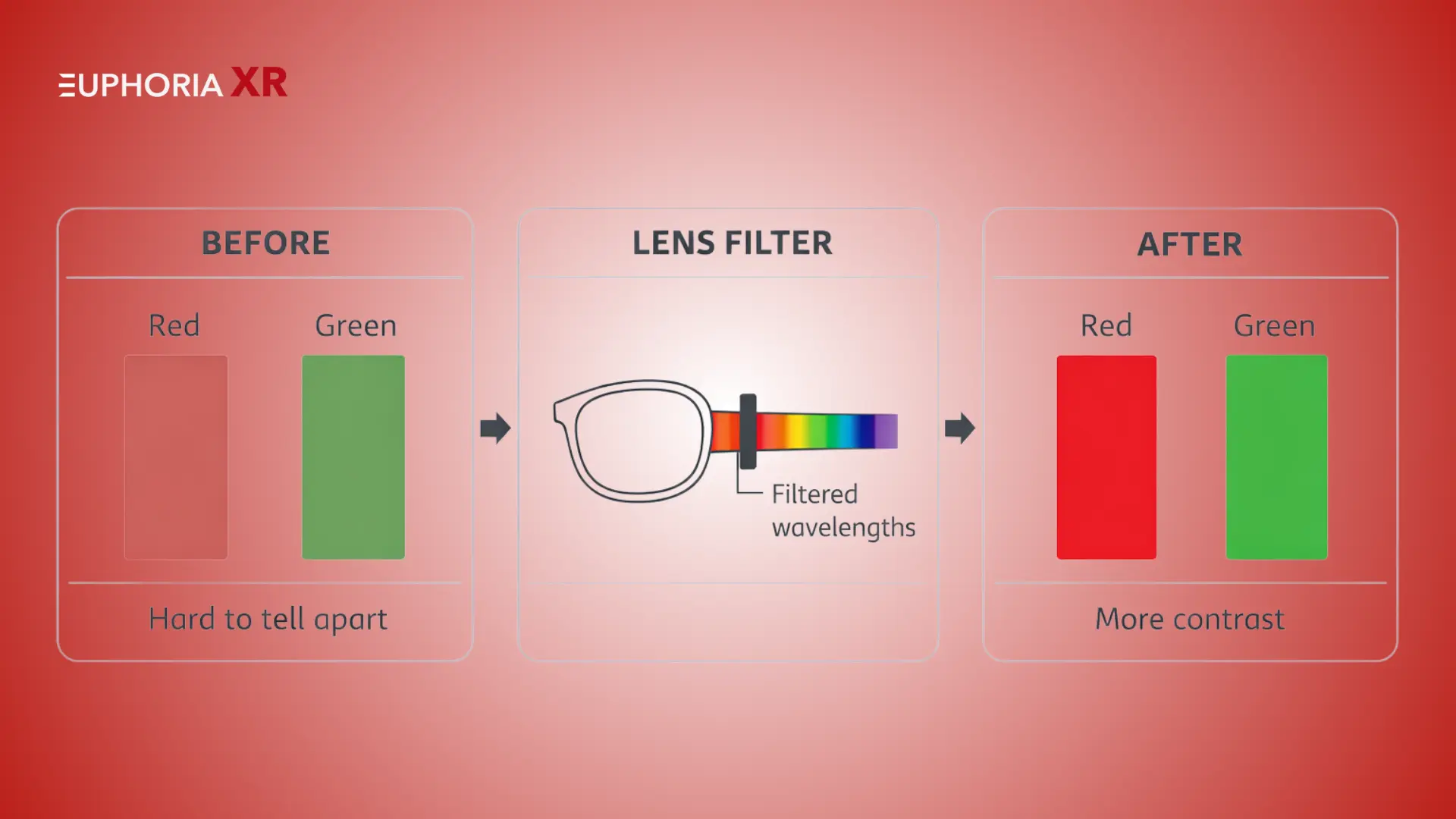
Colorblind glasses operate on the ability to filter components of light.

  • Light has many colour waves.

  • These waves are read by the eye, forming cone cells.

  • There is increased overlap of some cone signals in the case of a defect of colour vision.

  • The overlap gives some colours the appearance of sameness.

  • That alienation is minimized by special filters on the lenses.

  • They prevent the passage of very specific light wavelengths.

  • This can create problem colours, which appear more distant.

Important points:

  • They enhance contrast and do not add new colours.

  • They tend to work better in the bright light.

  • Weaker results can be attained by indoor lighting.

Curious about the way AR or VR can enhance visual accessibility and training?

Do Colour Blind Spectacles Work for Everyone?

No. That is not true for everybody.

Colour blind spectacles assist in the vision of red and green colour deficiency, as well as red and green colour vision deficiency. However, the news is not uniform, and a lot of individuals observe slight improvements.

Why do results differ?

Colour vision deficiency Type.

There is a tendency for red-green types to change the most.

Other types may see less.

Severity

Less significant cases can be observed being more assisted.

Less may be observed in very severe cases.

Lighting

Most of them perform more effectively in the open daytime.

The glasses may become less useful in low light.

Expectations

When the objective is that of normal vision, individuals get disheartened.

When it is set as a target to have better contrast, individuals are more content.


What do the majority of people ought to anticipate?

  • Certain settings have colours that might be predominant.

  • Some tasks may feel easier

  • It will not be the ideal colour sight.

  • It might be of no use with official colour vision tests.

In case the primary factor to purchase is the license to work or a harsh examination, then it is wiser to discuss the matter with a specialist in the field.


Who Should Consider Colour Blind Spectacles?

Colourblind spectacles have been considered as worth trying when daily life is being spoiled by colour confusion.

They are a good option for:

  • Individuals with a lack of vision when it comes to red-green colour vision usually confuse reds, greens, browns, and oranges.

  • Challenged students in colour charts, maps, science diagrams, and classroom materials.

  • Adults who require colour as an indicator in their jobs, such as wiring, graphs, labels, safety marks, or sorting of products.

  • Any person seeking improved colour distinctions in their daily undertakings, such as shopping, cooking, and accessing clothes.

  • Individuals who spend most of their time in the sunlight because most of the lenses perform well under bright sunlight.

They are not the most appropriate when:

  • The target is a cure and not merely the glasses that will cure the inherited colour blindness.

  • The biggest issue is that of night driving, since certain lenses make things darker.

  • A job demands one to pass through a strict colour sight examination, since the terms are not guaranteed.

  • With colour changes, they are either new or sudden, since that can be a medical problem that requires eye examination first.

When colour mix-ups occur at least once or twice a week, and it is a source of stress or errors, it would be logical to test colour blind spectacles with a good policy of returns.


Types of Glasses for Colorblind People

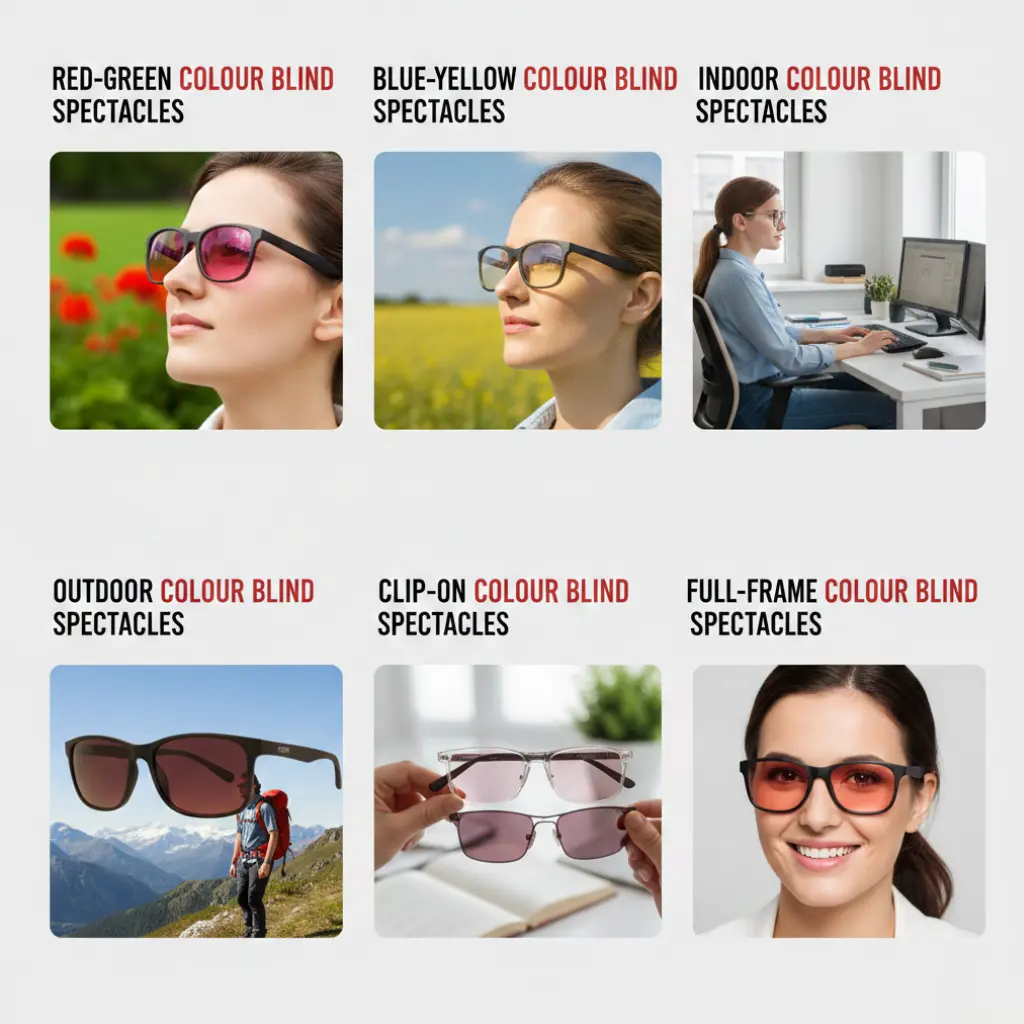
Colour blind spectacles are available in various types depending on the type of deficiency in the colour vision and the purpose of the glasses. Others attempt to assist with the red-green colour confusion, whereas others are designed to help solve blue-yellow problems. Indoor and outdoor, clip-on and full frame choices, available according to comfort, money, and the need for prescription lenses, are also available.
Types of Glasses for Colorblind People - Colour Blind Spectacles - Euphoria XR


Red-Green Colour Blind Spectacles

The most prevalent type is red green colour blind spectacles, as the deficiency of red-green colour vision is the most prevalent type of colour blindness. These lenses can be used to increase contrast between similar colours like red and green, green and brown, red and brown, and so on. They like working most in bright environments, hence many people can best see the largest difference outdoors or in well-lit areas.


Blue-Yellow Colour Blind Spectacles

The blue yellow colour blind spectacles are manufactured for individuals with blue-yellow colour vision deficiency. This kind is not that frequent; however, it may lead to the confusion of the blues and greens, the yellow and light green. The goal of these lenses is to separate such colour signals to make the differences more apparent. The accuracy might change significantly; therefore, in this case, it is important to match the type of lens with the deficiency recorded to confirm.


Indoor Colour Blind Spectacles

The indoor colour blind spectacles are designed to be used in artificial light such as that in offices, classrooms, and screen-heavy areas. A lot of inside areas have LEDs and other lighting that alter the appearance of colours, hence the indoor lenses aim at enhancing the contrast, yet not as dark as sunglass fashion lenses. Their application in the working environment, education, and everyday activities that mostly occur indoors make them a convenient option.


Outdoor Colour Blind Spectacles

Outdoor colour blind spectacles are normally sunglass-type lenses to be worn on sunny days. Faithful sunshine gives the lens filters to play with more light, and lots of individuals experience better colour perception by the sun than by the fluorescent lamps. They are normally preferred to drive during the daytime, sports, nature, and outside jobs. They are darker, and therefore, they might be too dim to be used in low light or within the house.


Clip-On Colour Blind Spectacles

Colour blind spectacles can be clipped onto the existing piece of eyewear, thus making them handy for wearers with already existing vision prescription glasses. It is commonly a cheaper method of experimenting with colour filtering to decide whether to acquire a complete pair or not. Clip-ons are also convenient in cases where a person just needs to support colour when engaging in certain tasks, since they can be attached and unattached easily. Comfort and fit are dependent on their correspondence to the base frame.


Full-Frame Colour Blind Spectacles

Full frame colour blind spectacles Full frame colour blind spectacle are standard glasses to which colour filtering lenses have been fitted into the frame. They tend to be more comfortable and stable than the clip-ons since the lenses are in the right position at all times. Full frame features also appear more as ordinary eyewear, which many would like to use in their day-to-day activities. They may be a more appropriate long-term decision, particularly with someone desiring prescription lenses with colour filtering in one pair.

EuphoriaXR is a professional AR Development Company that has created real-time overlays and visual guidance applications to achieve accessibility, training, and business applications.

Glasses for Daltonism: What to Know Before Buying

Inherited colour blindness is typically called a common (and everyday) word amongst people as Daltonism, usually the red-green version. Daltonism glasses can assist certain individuals to enhance colour contrast; however, they do not apply to all individuals. Usually, the best results tend to be achieved when the type of lens is matched with the actual colour vision deficiency, as well as when the glasses are put into practice in the real world and not just in front of the screen.

The following are the points to consider before purchasing:

  • Know your type first. Red, green, and blue yellow are not identical, and usually there are lens designs that are particular to the type.

  • Set the right expectation. These spectacles can enhance contrast. They do not make a person not colour blind.

  • Lighting matters. Most individuals experience greater influence in a bright environment as compared to a dark room.

  • Return policy matters. A trial period will minimize risk because of conflicting results.

  • Comfort matters. If there is pinching or sliding of the frames, then individuals discontinue putting them on, despite the potential benefit of the lenses.

The most intelligent checklist in buying smart:

  • Confirm deficiency of colour vision type as necessary.

  • Depending on the daily routine to select one inside or outside.

  • Pick a clip-on or a full frame, depending on the level of comfort and the necessity to have a prescription.

  • Test with realistic additional activities such as charts, labels, and clothes, and daylight scenes.


Benefits of Colour Blind Spectacles

Colour blind spectacles may be useful where colour confusion may be the cause: stress, incorrect answer, or wastage of time in second verification. To most, the greatest value is seeing new colour, and the visual experience of realising a greater distinction among the colours that were once blended.

Most of the advantages people seek:

  • Increased contrast of the puzzling colours in the light environments.

  • Even colour-based charts, maps, and graphs are easier to read.

  • Feel more confident when picking items, examining the ripeness of food, or categorizing.

  • Reduction in the use of guessing or consulting people.

Where advantages can be observed:

  • Outdoor: Nature, sports, street signs, daylight driving.

  • School and work: Graphs, display boards, crockett wiring, coloured labels.

  • Every day: Shopping, food preparation, suit-matching clothes.

The following are critical boundaries that should be remembered:

  • It depends on the individual and on the type of deficiency in colour vision.

  • Effects can be less distinct in dark or in some form of indoor lighting.

  • These glasses fail to cure inherited colour blindness.


Do You Need a Prescription for Colour Blind Spectacles?

Colour blind spectacles are sold directly without the prescription of most individuals. The glasses will also require a prescription in case they are also required to correct normal eye problems such as short, long-sightedness, or astigmatism.

Here is a simple way to decide:

  • It does not require prescriptions as long as the vision is clear, and the only aim of the prescriptions is to give colour filters.

  • The prescription can be used together with clear distance or reading glasses.

  • Clip-ons would suit well in case one has already got prescription glasses and needs to support colour occasionally.

  • The best option to wear full-frame prescription on a daily basis should include clarity and colour filtering.

Indications that it is clever to talk to a professional about eye tasks:

  • Any change in colour vision became immediate.

  • It has eye pain, blurred vision, or frequent headaches.

  • Formal colour vision tests and documentation are needed for a job.


How Much Are Color Blind Glasses in 2025?

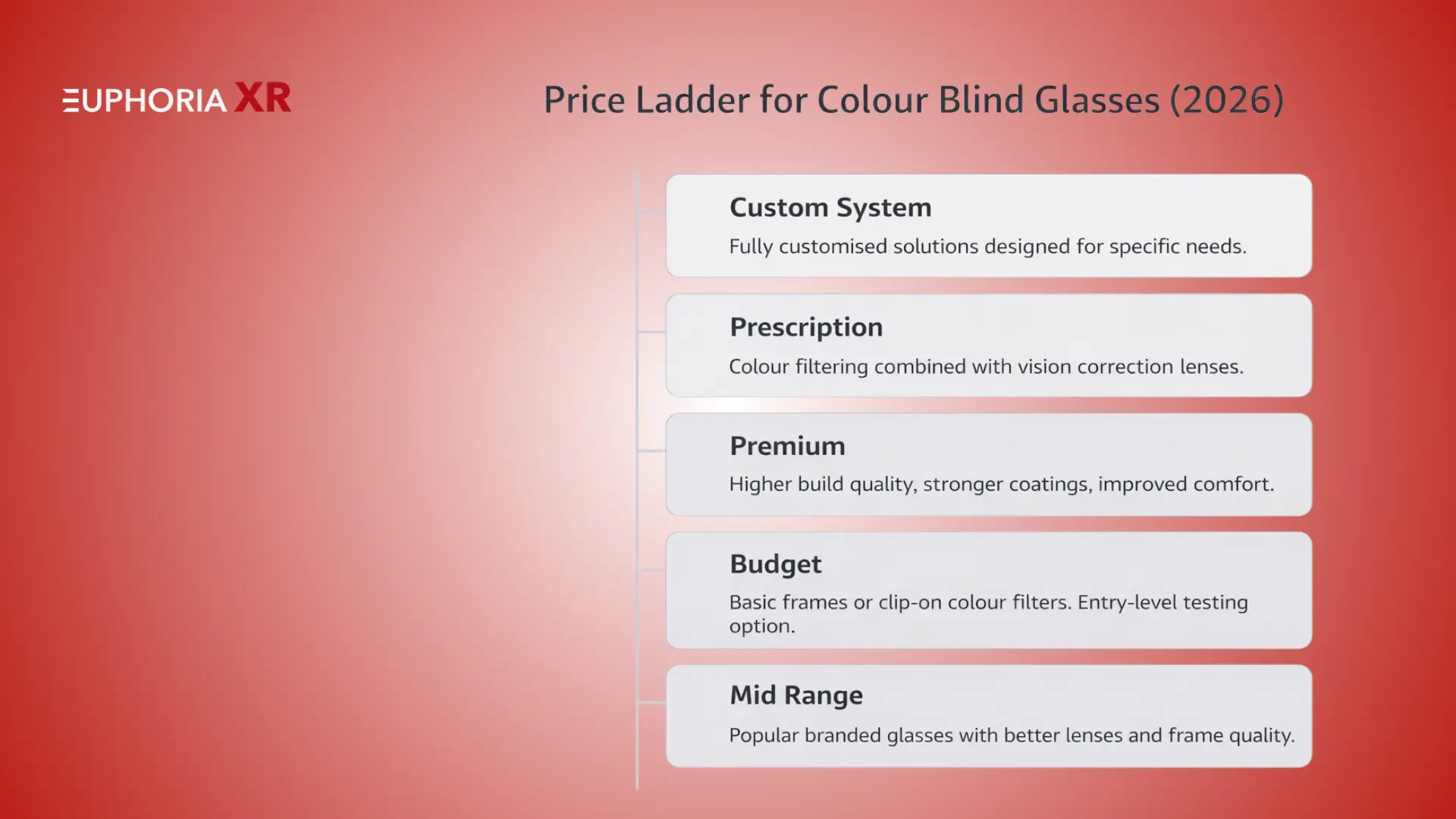
The majority of colour blind spectacles are priced between $100 and $450 without the prescription spectacles. Other systems, such as custom systems, can be several thousand dollars.

Price Ladder for Colour Blind Glasses 2026 - Euphoria XR

Price band What it usually includes Examples
Under $150
Budget frames or basic clip-on options
Many Pilestone-style options fall here
$200 to $350
Most popular brand sunglasses and indoor lenses
Many EnChroma models fall here
$300 to $450
Premium builds, stronger coatings, and some specialty options
Many VINO-style options fall here
$450 plus
Prescription versions and higher-end frames
Prescription versions often land here
Several thousand
Fully custom systems built for specific needs
Custom correction systems can fall here

What makes the price go up?

  • On top of colour filtering, prescription lenses are added.
  • The indoor and outdoor lens designs and coating.
  • Frame material and durability characteristics.
  • The support and return policy is significant, as there are different results.


Guide to Picking the Best Colour Blind Spectacles

Step 1: Determine the type of deficiency in the colour vision.

There is no difference between red-green and blue-yellow.

The glasses are usually targeted at one group.


Step 2: Choose indoor or outdoor, depending on the place of living.

  • Indoors: These are mostly indoor activities, so use indoor-focused lenses.

  • Outdoor: Select outside-focused lenses.


Step 3: Select the format that helps in the everyday process of life.

Insert the clip in case prescription glasses are already put on.

Full frame, provided it is the comfort in daily wear that counts.


Step 4: Ensuring that there is a return policy.

Outputs are fluctuating among individuals.

A probation period guarantees the customer.


Step 5: Live test using real tasks, not just online tests.

Use tasks like:

  • Reading a colour chart of the work dashboard.

  • Matching clothes

  • Choosing ripe fruit

  • Determining coloured signs in the day.

Being a full-service VR development company, EuphoriaXR builds immersive experiences that promote accessibility services, facilitate learning, and reduce the risks of making decisions.

Top 5 Colour Blind Spectacles (2025)

These selections are classified to target various amenities. Some individuals desire the greatest maximum wow during the day. Some want indoor support. Some want a lower-cost test. The following criteria will be used to select the appropriate match.

Quality Evaluation Criteria

Effectiveness

Effectiveness implies that the glasses introduce a practical difference with clarity in real-life activities. The finest lenses are those which correspond in kind and degree of colour vision deficiency. When the sun is shining and the lenses are outdoors, the lenses tend to work better. The indoor lenses would be less noticeable.

Comfort

The glasses are determined by which side of the comfort. Good comfort typically refers to a fit that is stable, does not press the nose, and a tint on the lens that does not hard on the eyes.

Style and Design

It is important in style as they are frequently worn on the street. The frames are supposed to feel like everyday glasses. The tint of the lenses must match the requirement. Clip-ons are sensible, full frames are cleaner.

Durability

Durability implies that the glasses can be used daily. Long-term value is lost due to scratches, loose hinges, and weak frames. Coatings and quality, however, are significant.


#1 Top Pick: LevysVisi Color Blind Glasses

Rating: 9.7 / 10
Pros

  • Intense colour separation to a mineral number of red-green users.

  • Performs outdoors and with natural colours.

  • Long wear Moderate frame comfort.

  • Cool appearance that is indistinguishable from regular eyewear.

Cons

  • The results may be variably dependent on an individual as well as on lighting.

  • May is too robust or colored in some interior settings.

  • Without curing the blindness of colour.

Wrap-Up

Best when the individual seeks a high impact feel in bright light and desires a plain all-around pair to wear on a day-to-day basis. Use at a time when outdoor performance is required most.


#2 Pick: EnChroma Color Blind Glasses

Rating: 8.8 / 10

Pros

  • Established brand and numerous varieties of frames.

  • Good option for outdoor wear and day wear.

  • Good in case people like a mainstream version with numerous options.

Cons

  • A big difference is not evident at all.

  • Some models are too dark inside.

  • Lots of entry possibilities are cheaper.


#3 Pick: Pilestone TP-029 Lens B Color Blind Glasses

Rating: 8.3 / 10

Pros

  • Lens B is usually used in a stronger bias of red and green colour confusion.

  • An inexpensive method of testing colour correction.

  • Using a clear purpose lens is practical for those in need.

Cons

  • The selections in style may be less flexible than high-end.

  • The tint of the lens may appear conspicuous to certain individuals.

  • The indoor performance is a subtle performance depending on the lighting.


#4 Pick: Pilestone TP-006 Lens A Color Blind Glasses

Rating: 7.8 / 10

Pros

  • The mild to moderate red-green deficiency is frequently treated using lens A.

  • It is easier to try because of the low price point.

  • Helps with colour-based school and work projects.

Cons

  • Not perfect in severe deficiency of colour vision.

  • May can be a small change for some of the users.

  • Frame comfort is dependent on the model.


#5 Pick: EnChroma Rockridge Color Correcting Glasses

Rating: 7.1 / 10

Pros

  • The good design would suit individuals who prefer a particular frame design.

  • Intended as a colour correction choice of a brand under recognition.

  • Performs optimally in sunny outdoor environments.

Cons

  • Red is graded primarily on a value basis compared to other grades.

  • It is not guaranteed to be an improvement for all users.

  • It would not be worth it in the case of the primary indoor application.

Who Should Consider Colour Blind Spectacles?

Colour blind spectacles are most applicable where confusion of colours is a real issue in real life. They are not a cure. They are an instrument that might simplify differentiating among some of the colours in some contexts.


Individuals who ought to take them into account

  • Individuals who covertly confuse reds and greens, or greens and browns.

  • Learners who find difficulty in learning by using colour, such as charts, maps, and science diagrams.

  • Adults who manipulate colour indicators in the workplace, such as wiring, labelling, dashboards, or sorting of products.

  • Individuals who become stressed when buying clothes, checking the level of food ripeness, and reading colour-coded materials.

  • Any person spending some of his time outdoors when the sun is bright, as so many lenses are stronger by day.


People who should be careful

  • Any person who is anticipating a complete cure or normal colour vision.

  • Individuals who travel at night and travel a lot as tinted lenses can dim brightness.

  • Individuals who experience sudden changes in colour vision, pain in the eyes, or blurred vision should have it has to be checked in the eye first.

  • Individuals who have to undergo rigorous colour vision exams to work due to the failure of the results to be assured.


Do Meta Orion, Ray-Ban Meta, and TCL Glasses Have This Functionality?

The majority of the smart glasses are constructed with either camera, audio, or AI features, or display viewing. They do not market as colour blind remedial glasses. Physical lens filters are used in colour blind spectacles. Smart glasses typically depend on the software effects, and they also have to display them when they have a display.


Meta Orion and Colour Blind Functionality

Meta Orion has been mentioned as real AR glasses with having digital overlay. It does not position itself as colour blind corrective eyewear. It does not have any built-in standard feature that serves as colour blind spectacles.


Ray-Ban Meta and Colour Blind Functionality

The Ray-Ban Meta glasses are predominantly AI glasses equipped with an image-taking and speaker. Their lenses are not created and sold to help correct colour blindness.


Meta Ray-Ban Display and Colour Blind Modes

Display-based smart glasses may even be able to allow accessibility settings, though this is not the case with colour blind spectacles. Colour filters or colour correction mode can never be assumed unless a product clearly mentions it.


TCL Smart Glasses and Colour Blind Support

The TCL smart glasses, such as the display-style ones, are aimed at providing a big-screen viewing experience. They are not popularised as colour blind corrective glasses. The eyewear would not serve as filter spectacles, but as others would have to be fed by the device or app to colour the display.


What Is the Role of AR and VR in Color Vision Assistance?

AR and VR have the potential to assist the colour vision, unlike spectacles. AR and VR can either adjust the colours that you currently view on a screen or place information atop the world, as opposed to filtering light.


AR for Colour Enhancement and Real-Time Correction

AR involves a camera shot that is viewed, and the colours are then altered and displayed again on a screen. In simple terms, it can:

  • Enhance disparities between mixed colours.

  • The problem turns into light colours.

  • Label colours in real time.

This is useful in that it is able to adapt to the environment and the person. However, it relies on a camera and the screen, and that is why it is not as such, unlike natural sight.


VR for Accessibility Colour Filters

Colour filters can be provided on VR headsets since all the features are displayed on a screen. That means VR can:

  • Map colours through the headset

  • Add contrast filters to improve separation.

  • Make individual preferences for various requirements.

This may be used in VR learning, training, games, and any headset-based viewing.


Optical Spectacles vs Digital AR/VR Correction (Key Differences)

Feature Colour blind spectacles AR and VR assistance
How it works
Filters light entering the eye
Changes colours on a screen or overlay
Needs power
No
Yes
Works in the real world with no device
Yes
No
Can label colours
No
Yes
Adjusts per environment
Limited
Strong potential
Main drawback
Not guaranteed for everyone
Needs camera, screen, battery

Limitations of Colour Blind Spectacles

Some people can be helped by colour blind spectacles, but there are obvious limits. This is because you can know these limits before making a purchase.

  • They are of no use in colour-blindness. Deficiency of inherited colour vision cannot be improved by glasses. The lenses do not alter the light going into the eye.

  • The same cannot be said of the rest. Two individuals who suffer from red-green colour blindness may have a variety of results because the severity may vary.

  • Lighting changes the effect. Bright daylight is the time of the most noticeable contrast to many people. The effect can be minimized using indoor lighting.

  • They can reduce brightness. Some lenses are darker. This may complicate the low-light processes.

  • They can shift colours. Other users experience a change of tint or a strange colour. It is weird to start with.

  • They are not likely to assist in official colour tests. Some jobs are strictly tested. Such glasses are not a panacea for that.

  • They fail to address all colour issues. In even cases where they aid, they aid certain incomprehensible colour pairs, but not all shades.

Do colour blind glasses really work? Expert Insights

Some people can be assisted by colour blind spectacles, which enhance contrast between indistinguishable colours, particularly in common red-green colour vision deficiency. They fail to treat the colour blindness, and the outcomes are highly uneven.


What industry experts say

Dr. Alexandra Williamson, OD (Cleveland Clinic).

Says that colour blind glasses are not the solution since they cannot alter the functioning of the cone cells of the eyes.

Describes how they themselves appear to be a filter that allows certain shades to be better visible, which indicates they enhance contrast as opposed to enabling normal colour vision.

Issues a warning that the viral reaction videos may be spurious since excitement and anticipation may influence the descriptions made by people.

John S. Werner (Professor of Ophthalmology, UC Davis)

A published study of spectral notch filter glasses reported to induce a measurable shift in the colour contrast response of individuals with anomalous trichromacy participants with an extended period of use.

However, this confirms the notion that filters can modify colour cues in a quantifiable manner, and yet does not necessarily imply the same result in all individuals.

Got an idea of a project or require solutions that are immersive and are industry-specific to you? We are here to assist you.

Conclusion

Colour blind spectacles could be helpful with individuals who have issues with colour confusion, such as ordinary red-green colour vision deficiency. Their effects are not a cure for colour blindness, but to enhance the contrast via filtering light. Some individuals interpret a subjective difference, particularly under bright light. Only minor changes can be seen by others. The most optimal outcomes are realized in the selection of the appropriate lens type, which should be used either indoors or outdoors, and experimentation with the glasses under realistic conditions during the actual activities.

Get Started With Euphoria XR

• Award-Winning AR/VR/AI Development & Consulting Services
• Flexible Business Models – Project Based or Dedicated Hiring
• 10+ Years of Industry Experience with Global Clientele
• Globally Recognized by Clutch, GoodFirms & DesignRush

Recent Posts

Company's Stats

Successful Projects
0 +
Success Rate
0 %
Pro Team Members
0 +
Years of Experience
0 +

Let's talk about your project

We are here to turn your ideas into reality