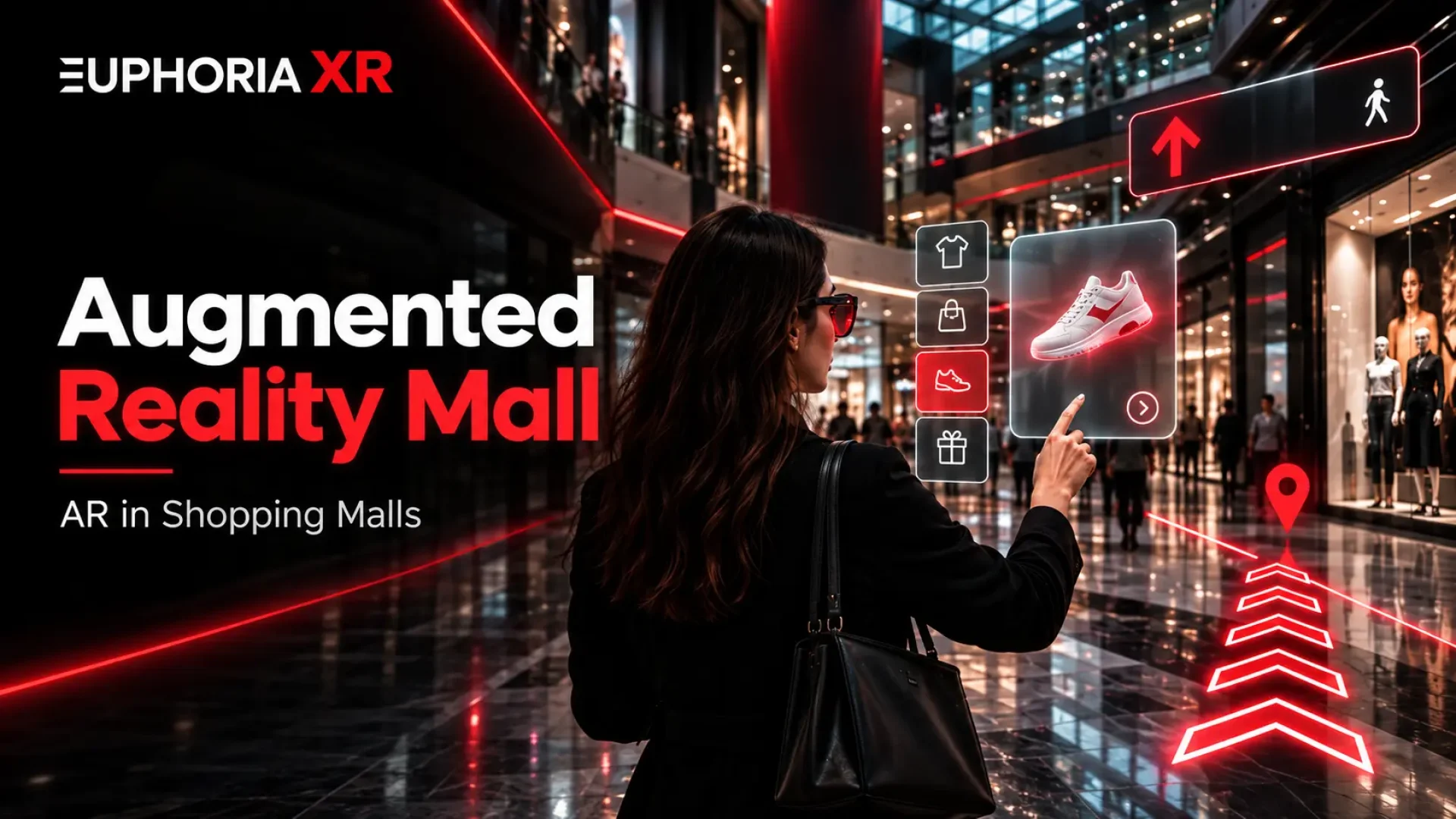
Augmented reality in shopping malls adds digital content to the physical mall environment through smartphones, WebAR, AR mirrors, interactive displays, and other AR-enabled devices. Malls can use AR for indoor navigation, virtual try-ons, product discovery, games, advertising, events, and loyalty programs. The right approach depends on the mall’s goals, audience, physical environment, budget, and existing technology.
Shopping malls are no longer competing only with the mall across town. They have to go up against online shopping, which allows users to access products, shop around, and make a purchase in mere moments.
Therefore, how can a physical mall attract visitors, keep them longer, and make them return?
An augmented reality mall merges the online experience with the in-store experience. Consumers are able to visit AR outlets and follow them as they go to individual stores, virtually try out products, interact with 3D displays, play location-based games, unlock offers, and participate in immersive brand experiences.
Navigating, engaging customers, discovering products, loyalty programs, events, and marketing campaigns represent other areas where AR can help for mall owners and retailers. When handled appropriately, it will not be anything more than a substitute for shopping. It makes the real mall open up to exploration and appeal.
What is an Augmented Reality Mall?
An augmented reality mall is a shopping center that provides digital content within the physical environment. AR mirrors, interactive panels, and wearable devices will enable shoppers to get directions, products, games, offers, and more digital elements within the mall.
AR does not substitute physical space as virtual reality does. It enhances or adds interactive layers to the products that are seen by the customers around them.
For instance, someone could take a virtual tour to a retail outlet, virtually try on a pair of sunglasses, look at 3D images of a product before purchasing it, or unlock an offer by visiting a certain location. This is ideal for customer engagement, marketing, entertainment, and retail navigation, all within one building.
Design and implement a mall AR experience around actual visitor objectives, ranging from navigation to engagement.
AR can enhance the shopping mall experience, whether functional or purely for entertainment purposes. It can be used to direct consumers through massive stores, help shoppers tour products, build interactive campaigns, and link physical and digital rewards. The right usage is dictated by what the mall’s goals are: improve convenience, generate more engagement, enable retailers, or to provide new experiences for guests.
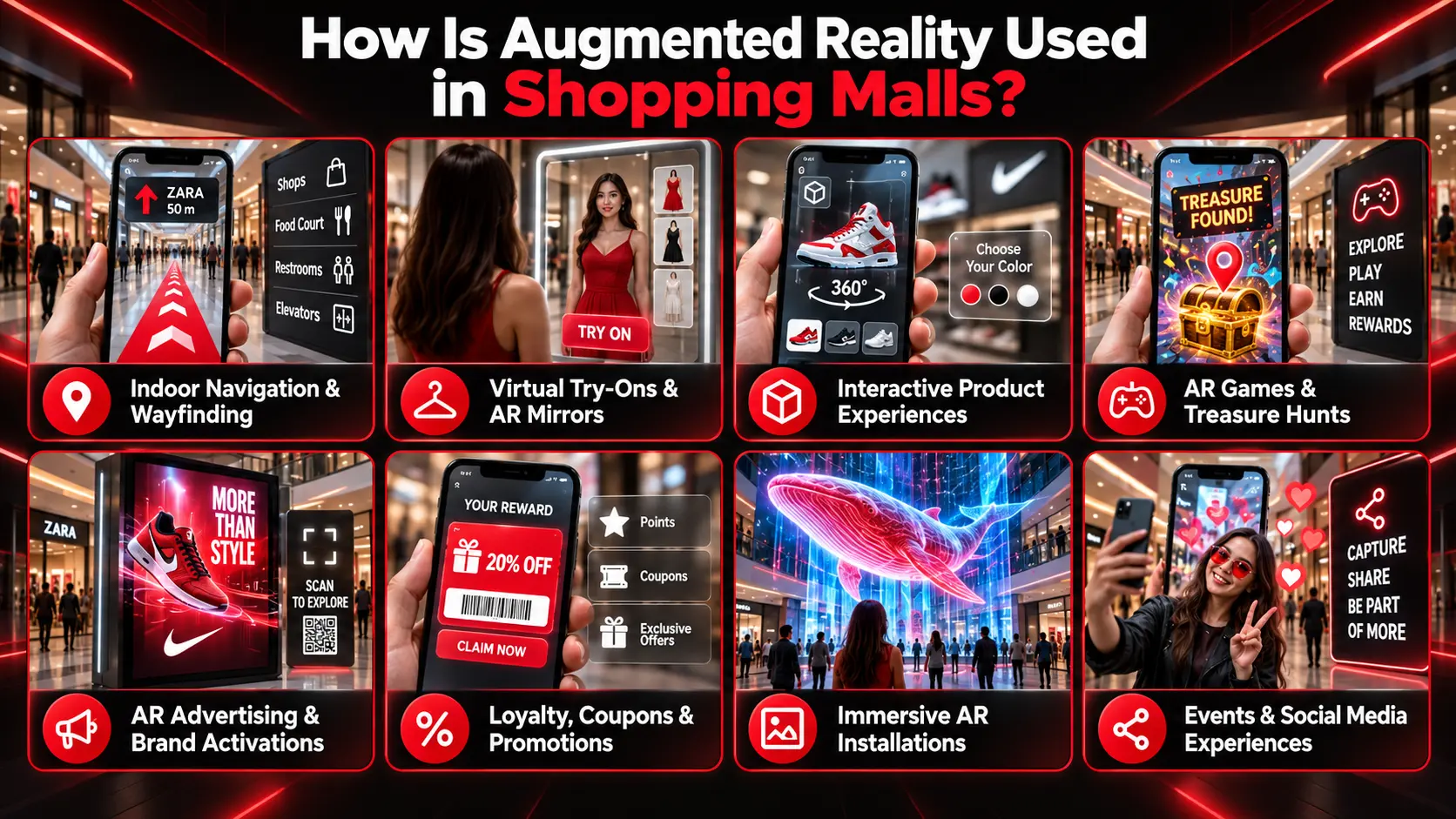
AR Indoor Navigation and Wayfinding
AR wayfinding overlays digital arrows and displays floor-level information and points of interest on a shopper’s real-time camera display. It can direct visitors to shops, restaurants, toilets, parking, elevators, and event areas.
GPS may not function indoors properly; therefore, indoor systems can integrate AR with computer-generated floor maps, Wi-Fi positioning, Bluetooth beacons, visual positioning, in-house sensors, or computer vision. Another study reveals that indoor navigation is one of the key services in complex shopping centres.
Virtual Try-Ons and AR Mirrors
Virtual try-on lets customers see products without going through a test on all of their options.
Digital versions of sunglasses, makeup, jewellery, accessories and some clothing items can be virtually “lifted” onto a person’s face or body using an AR mirror or phone camera. This allows you to easily compare styles, colours, and options when picking a product.
Retailers can provide these experiences in-store, via the mobile app, or other camera-dependent interface.
Interactive Product Experiences
AR can turn a normal product display into an interactive source of information.
A customer can navigate to a 3D model, a demonstration of a product, the optional colour, specifications, instructions, videos, or other items by scanning a product on display, a package, a poster, or a QR code.
Perfect for products that require extra information not found on the shelf. It can be used across a range of industries, including electronics, furniture, beauty, automotive, fashion, and high-end retail stores, to create an interactive shopping experience.
AR Games, Treasure Hunts and Mall Gamification
The concept of mall gamification is essentially using digital games and challenges to help visitors of any shopping centre get active.
Purchasers can collect virtual objects, complete quizzes, treasure hunts or reach location-based checkpoints, or earn points by finishing challenges. Rewards can then be linked with the participating retailers or loyalty programs that they are using.
Mall of the Emirates has done this once before with an AR gaming app that integrated a live locations feature, coin collecting, trivia, and challenges with rewards.
Interactive AR Advertising and Brand Activations
AR advertising enables users to engage with an ad, instead of just seeing it.
Brands can develop digital characters, 3D unveilings, interactive billboards, digital photo experiences, or location-based material throughout bustling mall zones.
The Karma activation would be a good choice for product launches, seasonal campaigns, entertainment promotions, or sponsored events. Large atriums and common areas can also be interactive branding spaces, without changing the physical environment permanently.
AR Loyalty Programs, Coupons and Promotions
AR can help to better associate mall loyalty programs with the physical experience.AR can create a greater association between mall loyalty programs and the experience.
Consumers could receive a coupon upon arriving at the store, pick up digital coupons in multiple stores, or earn store credit in an interactive game.
It is also possible for promotions to be presented at certain locations or events. As a result, malls have additional channels of connection to the offers they have for store discovery, repeat visits, seasonal messages, and customers’ involvement beyond the typical discount communication.
AR Entertainment and Immersive Installations
AR can be applied for entertainment purposes in shopping centres.
Atriums or event areas can become attractions with large, interactive displays, virtual animals, digital characters, themed areas, or immersive installations.
These are great experiences for families, holidays around the schools, special occasions, or areas for entertaining. INDE, for instance, has installed large-screen AR displays at various ECE shopping centres in Europe, enabling the audience to interact with virtual content within the physical space.
AR Events and Social Media Experiences
AR can simplify sharing of events taking place inside the mall.
Each visitor can use virtual characters, brand filters, event filters for photos, digital backgrounds, or even camera filters, and save the images for sharing on their social media.
This could bring the event to a mall or brand, taking it away from the venue. People who visit experience it, and their pictures and videos share their experience online and kick off the campaign.
The best social AR experiences make something of the visitor, not just something that they post.
Real-World Examples of Augmented Reality in Shopping Malls
AR has already been deployed in shopping malls for family activities, branded experiences, entertainment, and interactive campaigns. The examples demonstrate some ways to use digital content to make ordinary spaces at the mall memorable experiences for visitors.
BBC Frozen Planet AR at U.S. Shopping Malls
INDE designed a BBC Frozen Planet Arctic Explorer exhibit that connected with life-sized images of Arctic animals on a big screen and made mall space an interactive wildlife experience at three locations: Short Hills Mall, Woodfield Mall, and Sunvalley Mall in the USA.
National Geographic Traveller AR at 360 Mall
INDE and National Geographic took the Traveller experience into the shopping centre by using a large-screen AR in 360 Mall Kuwait. They could speak to the virtual animals directly and even find themselves immersed in the scenes in nature without having to wear a headset.
Back to the Jurassic at Colombo City Centre Mall
The Back to the Jurassic Experience took place at Colombo City Centre Mall, where people encountered life-sized virtual dinosaurs in the mall environment by INDE. Consumers might even visualize themselves interacting with prehistoric creatures on the screen, offering a family-friendly attraction in the real-life retail store.
Ocean Adventure at Telford Plaza
The Ocean Adventure AR was installed in Telford Plaza in Hong Kong, where digital marine life was introduced into the shopping centre. People could walk around with large life-size virtual orcas, replacing a typical area of the mall with an undersea theme.
Augmented reality can help reduce the hassle of navigating a shopping centre, increase interactions and value for visitors, and help retailers in their business. It could be used for routine activities such as navigating or for new uses to market stores, host events, and enhance engagement.
Enhances customer interaction: Interactive games, product experiences, and AR installations offer extra opportunities to stop and engage.
Enables indoor mapping: AR directions can be used to find stores, a food court, parking lot, toilets, or event venues more quickly.
Increases product discovery: Digital overlays can show product details, 3D models, colours, offers, and recommendations.
Creates interactive marketing opportunities: Brands can use AR for launches, campaigns, photo experiences, and sponsored activations.
Supports loyalty programs: Malls can link digital challenges, rewards, coupons, and repeat visits.
Adds entertainment: Virtual characters, games, art, and large-screen AR can make malls more enjoyable for families and event visitors.
Helps retailers offer virtual try-ons: Shoppers can preview eyewear, makeup, accessories, and other products before buying.
Creates shareable experiences: AR events can encourage visitors to capture and share photos or videos online.
How to Implement Augmented Reality in a Shopping Mall
The key to a successful mall AR project is to begin with a clear goal and a simple user journey. The technology needs to be used in a service that addresses a need of visitors or businesses and is not for the sake of it.
Define the Business Goal
Determine the goals of the experience. The aim could be better navigation, a better level of event participation, more product engagement, store discovery, building stronger loyalty, or even navigating to the goal of a more interactive marketing campaign.
Choose the Right AR Experience
Coordinate an AR experience with the objective. Use wayfinding for navigation, virtual try-ons for retail, or gamification for engagement, as well as interactive installations for events and brand campaigns.
Decide How Visitors Will Access the Experience
Choose between a mobile app, WebAR, QR code, AR mirror, interactive screen, or wearable device. It is best to choose the one that’s most likely to get used, for a given level of preparation.
Map the Physical Mall Environment
Recognize the different areas of the floor plan, including floors, stores, entrance, corridors, elevators, parking, event areas, and AR trigger points. Having accurate mapping is crucial for navigation and location-based experiences.
Develop the AR Content and Experience
Build the user interface, 3D assets, animations, interactions, games, directions, and digital content. Instructions should be brief for visitors to grasp the experience in a short period of time.
Integrate Mall Systems
Link the AR solution to relevant systems like mall apps, in-house maps, loyalty programs, store directories, CRM platforms, product databases, and analytics tools as required.
Test, Launch, and Measure Performance
Experiment with it in real-world settings on various devices, under different light and load levels. Once launched, monitor participation rates, completion rates, store and visit counts, claims on rewards, route success, and conversions.
Mobile App vs WebAR vs AR Installation for Shopping Malls
Shopping malls can provide AR in mobile applications, browsers, and physical installations. This choice will vary depending on the duration of the campaign, functionality required, user actions, and whether the experience must be developed using dedicated hardware.
AR Option
Best For
App Download
Main Advantage
Main Limitation
Mobile AR App
Long-term mall experiences, navigation, loyalty, games
Yes
Supports advanced features and repeat use
Download can create extra friction
WebAR
Short campaigns, promotions, product experiences
No
Fast access through a link or QR code
Browser and device support can vary
AR Mirror
Virtual try-ons in retail stores
No
Simple in-store product interaction
Requires dedicated hardware
Large-Screen AR Installation
Events, family entertainment, brand activations
No
Visible to groups and passing visitors
Needs physical space and equipment
Wearable AR
Guided tours, premium or hands-free experiences
Usually No Phone
Keeps the user's hands free
Hardware is less common and harder to manage
Challenges of Using AR in Shopping Malls
While AR can enhance the shopping experience, malls have to plan for technical, operational, and user issues. The typical hurdles are positioning, device support, changing environments, privacy, and ease of use.
Indoor positioning accuracy: GPS cannot be used in an indoor environment, so navigation may require Wi-Fi, Bluetooth beacons, visual localization, QR codes, or indoor maps.
Device compatibility: Older phones may not support advanced AR features or may deliver slower performance.
User adoption: Users can bypass the experience if it is too complicated, needs too many permissions, or requires downloading an app.
Changing mall layouts: Store openings, closures, temporary displays, and construction can affect maps and location-based AR.
Slow Internet Connection: Poor mobile or Wi-Fi signals may affect page loading times and experience.
Content maintenance: Regularly updating 3D assets, product information, maps, offers, and games.
Privacy and permissions: Only collect camera, location, and customer data when required, and with explicit consent.
Development and Hardware costs: Larger budgets are needed for complex navigation systems, custom 3D content, AR mirrors, and larger installations.
Measuring ROI: AR metrics should be paired with specific goals like visits, engagement, redemption, leads, sales, etc. for malls.
Looking for a custom feature, integration, or mall-wide AR experience? Hire AR developerexpertise for your project.
What Does a Futuristic Shopping Mall Look Like?
The future of shopping is blending the physical with AR, AI, smart navigation, interactive displays, digital rewards, and connected customer experiences all in one shopping mall. These technologies do not replace stores; rather, they are used to assist shopping to become simpler, more personal, and interactive.
More WebAR and Frictionless Experiences
WebAR enables shoppers to enter into interactive experiences without the need to download a special app, using a browser, a link, or a QR Code. This is helpful if you have a short campaign, promotion, product experience, or event where you need quick access.
AI-Powered Personalized AR
AI can be useful to AR to demonstrate more contextually relevant content according to shopper needs, location, preferences, or prior interactions. This might be part of the site instead of delivering the same information to all visitors.
AR Glasses and Spatial Computing
With the help of AR glasses and spatial computing devices, digital directions, product info, translation, and interactive electronic content can be seen without the need to continuously hold a smartphone. Adoption, comfort, cost, and availability of devices will affect their broader presence in malls.
Persistent Mall-Wide AR Experiences
The AR experience and content stays connected to a particular physical space over time as a persistent AR context. These could be characters, information points, games, rewards, or interactive displays associated with that mall area that visitors can return to find updated.
AR and Indoor Navigation
A future navigation system for the mall may include computer vision, live store information, in-mall maps, accessibility routes, and AR directions. Customers could proceed on a direct path, via sight, through the structure rather than continually referring to a fixed map to help them navigate.
Gamified Loyalty Ecosystems
AR challenges, store visits, digital collectibles or items, points, coupons, and rewards could be elements of a mall loyalty program. It can encourage shoppers to delve deeper and provide them with some new reasons to seek you out for future activities.
Need an AR project for your shopping mall or retail space?
Augmented reality malls integrate similar digital experiences to real-world malls.
Navigation, virtual try-ons, product discovery, games, advertising, events, and loyalty programs are some ideas for potential applications of AR.
Indoor wayfinding usually needs more than GPS to provide accurate positioning.
WebAR can minimize access friction, whereas mobile apps are ideal for long experiences.
Retailers can enhance product exploration with AR mirrors and interactive Product tools.
Gamification can align a customer’s shopping journey to discovery, rewards, and conversion.
Large screen installations are suited for high-traffic areas and public events.
The appropriate AR format should be selected based on the goals of the mall, its target audience, the mall design, the budget, and the current AR systems in place.
The possibilities for future malls may be a fusion of AR, AI, spatial computing, smart navigation, and connected loyalty programs.
The only metric for AR projects should be business results and not the number of interactions.
Wrapping Up
The augmented reality mall can enhance a shopping centre by transforming it into a more interactive, useful, and engaging environment. By adding these capabilities to a shopping centre, the augmented reality mall can make a more interactive, useful, and engaging retail environment. The most successful implementations are when AR is paired with a specific visitor or business goal that is not just added for the sake of it. AR could be a key element of the retail journey as malls switch to more intelligent retail systems.
Costs vary based on features, platform, 3D content, integrations, and hardware. Simple WebAR campaigns are more cost-effective than custom-wide AR systems in malls.
Yes. If technically feasible, existing mall apps can offer additional features on their own to give them AR navigation and games, promotions, product experiences, and loyalty elements.
It depends on the goal. Large-screen AR works for events, AR mirrors work for support, WebAR works for short campaigns, and Apps for long experiences.
Get Started With Euphoria XR • Award-Winning AR/VR/AI Development & Consulting Services • Flexible Business Models – Project Based or Dedicated Hiring • 10+ Years of Industry Experience with Global Clientele • Globally Recognized by Clutch, GoodFirms & DesignRush
I’m Amelia Rose, a Content Writer and Copywriter with 7+ years of experience creating research-driven, SEO-focused content. I stay updated with Google algorithm changes, search intent trends, and E-E-A-T principles to ensure my content remains useful, credible, and search-friendly. I specialize in simplifying complex topics across AR, VR, AI, software development, and emerging technologies for both readers and search engines.