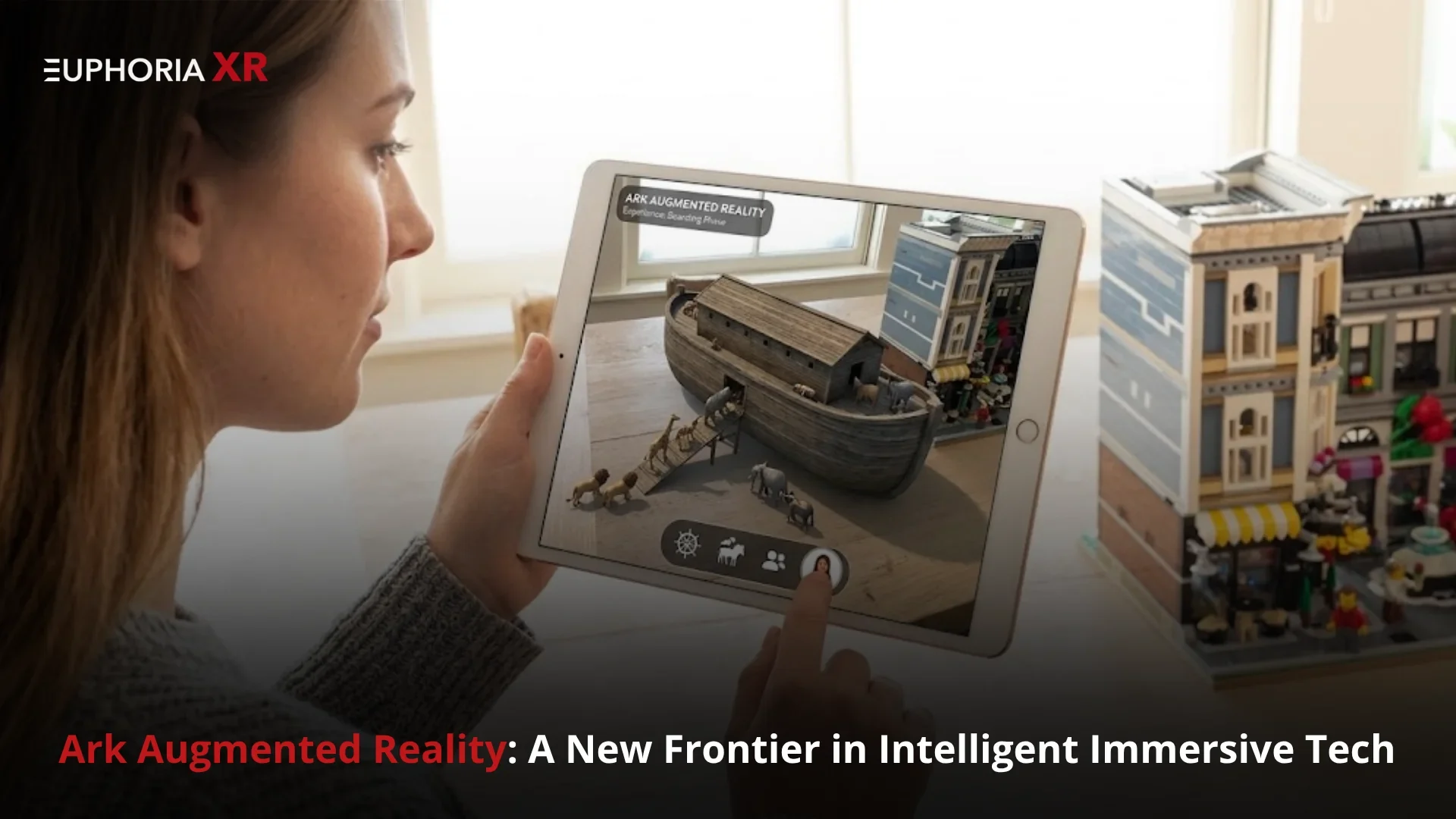
Have you ever thought about why certain experiences with augmented reality are perceived as smart and others as flat?
The primary function of most AR apps is to place digital objects on your screen. They do not understand you. They do not learn. They do not adapt.
That is where Ark augmented reality comes in.
Ark augmented reality does not simply surround digitized information.It is the creation of AR systems capable of monitoring, learning, and acting upon the real world as time goes by.That is the change that is drawing the attention of researchers, developers, and investors.
What is Ark Augmented Reality?
Ark Augmented Reality is a superior version of augmented reality that does not solely entail the use of inanimate digital objects in the real world.
Ark augmented reality is, in simple terms, AR with artificial intelligence that enables the system to comprehend its environment, adapt to the users, and enhance with time.
In the traditional AR, the content is displayed in this way all the time.
Ark augmented reality is contextual.
In simple words:
Ark augmented reality is a smart AR solution where computer-generated content becomes dynamic, learns, and reacts in the real world on the basis of intelligence and environmental information that is used by AI.
Ready to know how Ark augmented reality can be applied in your business?
Understanding the Technical Foundation of Ark Augmented Reality
Ark augmented reality is constructed based on more than the camera and 3D graphics.It is based on a stratified technical aspect extending the system to monitor the universe, understand the event unfolding in it, and act intelligently.It is based on this that Ark AR can change and not continue to replicate the fixed behavior.
Core Technologies Behind Ark AR
Ark augmented reality takes a combination of a number of developed technologies into one adaptive system.
Computer Vision: It enables the system to identify objects, surfaces, and movement in real-time.This involves the recognition of depth, edges, and space associations in comparison to flat images.
Spatial Mapping: It develops real time 3D perception of the surveillance.The system is aware of the existence of the walls, floors, and objects and their relationship with one another.
Sensor Fusion: It is a combination of motion sensors, cameras, depth sensors, and GPS.This gives a better depiction of the actual world than any one sensor would.
Artificial Intelligence Models: Patterns and context are interpreted by the artificial intelligence models.These models determine the behavior of digital content according to the surroundings, human intervention, and historical interactions.
Real-time Processing: Response can be provided in real-time, making it natural. An AR system based on ARKs must have a response time of a few milliseconds to remain in the scene and be useful.
The combination of these technologies enables Ark augmented reality to act like a person and not a machine.
How Ark Augmented Reality Works?
Ark augmented reality is more of an ongoing learning process rather than a one-autonomous act.
An overview of the system is the initial stage, where the system monitors the physical environment with sensors and cameras.
It then interprets what is perceived with the help of spatial data, movements, and user activities.
After which, it reacts by modifying the digital content on the fly.
Lastly, it analyzes by storing feedback and enhancing future interactions.
This cycle repeats itself whenever the system is employed.
Normal AR systems cease when content is shown.Ark augmented reality has been going on.With time, experience becomes more real and personal; it is more context-sensitive.
Such adaptive loop is the technical core which is the defining definition of Ark augmented reality.
Ark Augmented Reality vs Traditional AR, VR, and Mixed Reality
To realize the importance of Ark augmented reality, it is worthwhile to have a glimpse of it in the wider context of immersive technology.AR, VR, and mixed reality are all solutions to various issues.Ark AR is an expansion of AR with the addition of intelligence and learning.
Augmented Reality, Virtual Reality, and Mixed Reality Explained
Augmented reality introduces digital aspects into the actual world. You continue to observe what is going on around you, except that digital items are overlaid on them. The majority of mobile AR applications are like this.
The virtual reality substitutes the real one. A fully digital world is entered using a headset by the users.
Mixed reality is more of a combination of physical and digital. The digital objects can communicate with the real-world surfaces and react to the movement of the users.
Ark augmented reality comes into the AR category, but it goes further by adding adaptive and learning behavior.
Key Differences Between Ark AR and Conventional AR
Intelligence is the primary distinction between the Ark AR and traditional AR.
Conventional AR is bound to set rules.
Ark AR is context-responsive.
Aspect
Conventional AR
Ark Augmented Reality
Environment Understanding
Basic Surface Detection
Deep Spatial Awareness
Behavior
Predefined
Adaptive
Learning Over Time
None
Continuous
User Interaction
Static
Context-Aware
Experience Evolution
Same Every Time
Improves with Use
Such a movement transforms AR into a more interactive interface.
The ArK Model Explained (Huang et al., 2023)
The ARK model refers to a research framework that defines Ark augmented reality formally.
Huang and others proposed the model in 2023, but it is dedicated to emergent behavior in AR systems.The system does not need all responses to be scripted because, through real-world usage, the system builds upon the responses.
Three principal concepts are highlighted in the model.
To start with, the environment is approached as a learning place and not as a background.
Second, the feedback of the interaction between the user creates future behavior.
Third, digital content evolves according to the experience one gains.
This evidence-based practice is the reason why Ark augmented reality has been viewed as the basis of future smart AR networks, but not as an individual product or application.
Collaborate with a professional AR development company in the creation of smart, dynamic augmented reality applications that were designed with industry-level impact.
Interactive and Adaptive AR Systems
Intelligent and adaptive AR systems are meant to react to responses rather than repeat their predefined behaviour.Ark augmented reality belongs to this category.
Conventional AR systems respond to stimuli.The adaptive AR systems update further.By monitoring behavior, regulating behavior, and enhancing their performance with time, they observe behavior.
In human-computer interaction studies, adaptive AR has been observed to provide useful improvements to task accuracy and interest.IEEE published studies indicate that the use of context-aware AR systems has an effect of improving user performance by more than 30 percent in training and simulation activities.
The adaptive method employed by Ark augmented reality makes experiences responsive, personal, and conscious of their environment.
Practical Applications of Ark Augmented Reality
Ark augmented reality is a developing phenomenon; however, there are already a number of practical applications in various industries.
Education and Training
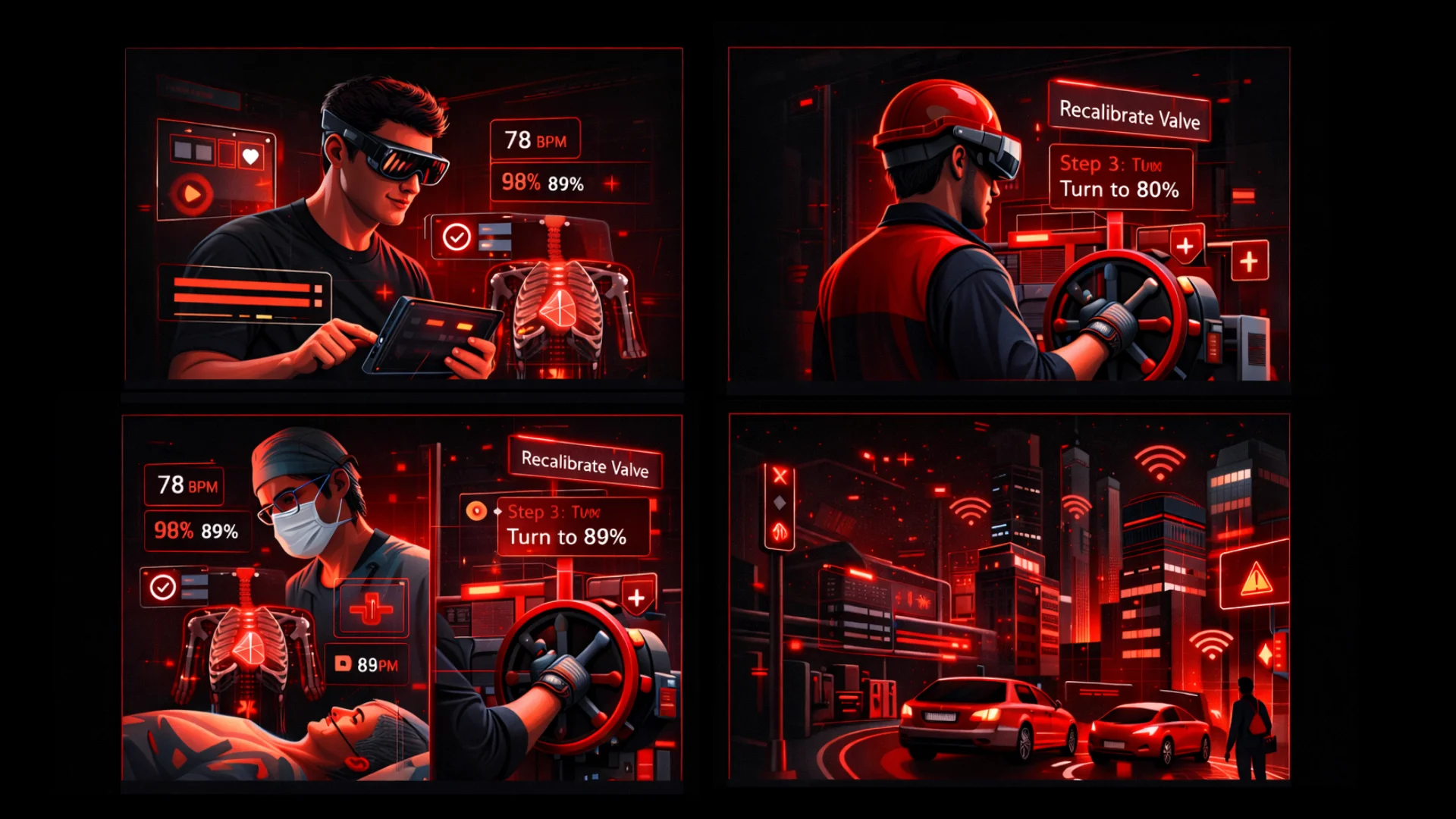
Ark augmented reality assists learners in practicing in settings that are real.The system adapts according to the performance of the learner through the difficult and guided system.
AR-based learning has been demonstrated to save up to 40 percent of the training duration, besides enhancing retention in technical training.This is further improved by adaptive AR systems such as Ark AR by adapting instructions based on personal progress.
Healthcare and Medical Visualization
Ark augmented reality is useful in healthcare for dynamic visualization.The medical worker can observe the patient’s information according to motion and anatomy.
Adaptive AR systems aid in minimizing errors due to real-time changes in the procedures.A study conducted on medical simulation indicates that AR-assisted visualization enhances accuracy and confidence in complicated tasks.
Enterprise and Industrial Use
Ark augmented reality helps in reactive direction in the industrial environment.Instructions can be edited by systems depending on the experience of the worker, errors, or variations in circumstances.
Productivity hosted by enterprises utilizing AR in maintenance and assembly reports a 25 to 35 percent increase in productivity.Ark AR takes the same direction by learning from the repetitive workflows.
Smart Environments and Infrastructure
Ark AR is used to facilitate smarter scenes like smart buildings and cities.Digital overlays respond to the movement of the traffic, safety situations, and human activity.
It allows more responsive systems regarding infrastructure and open spaces by reacting to environmental data dynamically.
These applications demonstrate how Ark augmented reality identifies above visual enhancement to an intelligent threshold layer between people and the physical world.
Ark Augmented Reality Market Signals and Growth Trends (U.S.)
The United States is experiencing a rapid growth of the augmented reality market.Statista forecasts that the AR market within the U.S. will reach over 35 billion dollars in 2028, fueled by the implementation of AR in enterprises and the mobile experience.Such expansion represents the expansion of investment in technologies, which mix digital content and the real environment.
Systems that are built on artificial intelligence and flexibility are attracting attention among the AR technologies.In a survey of technological executives, it was discovered that 56 percent of businesses intend to devote greater resources to an AI-assisted AR and immersive technologies in the upcoming three-year period.This trend is likely to indicate that firms find value in more intelligent AR experiences and not simple overlays.
There is also an upsurge in investment in venture capital.Cash competition investments in space computing, adaptive interaction companies, and AI augmented interfaces have increased annually.This confirms the notion that smart AR systems, such as Ark augmented reality, do not exist in the realm of theories, but they belong to business development.
Need to develop AR experiences of the next generation? Hire AR developerexperts who have working experience in adaptive and AI-driven AR systems.
Why Is There Growing Interest in Ark Augmented Reality?
Ark augmented reality is of interest because of various critical changes in technology and user requirements:
Weaknesses of Traditional AR: Traditional AR superimposes digital objects on real surfaces but seldom learns or adjusts to them.With more complex use cases, there is a sense of constraint provided by static behavior.
AI Integration: The innovations in artificial intelligence have made it possible to implement real-time learning and context awareness, which are the main conditions of adaptive AR systems.Now it is possible to use AI models processing the visual and spatial data promptly enough to provide interactive feedback.
Need for Individualization: Customers want a setting that matches their situations and actions.Ark augmented reality satisfies this requirement with its responses being modified according to its learning.
Enterprise Value: The businesses seek solutions that should enhance efficiency, training results, and user interactions.Adaptive AR systems have the capability of minimizing errors, learning curves, and dynamic support in a complex setting.
Research Momentum: The academic research supporting the idea of the ArK model has an in-depth theoretical and technical basis in place that propels the ArK AR beyond the simple AR applications.References to research and peer-reviewed articles allow raising this idea to the position of a current technological change.
All of this is why the attention towards Ark AR is increasing despite low search volumes.The innovations can first be found in research and in business before they can find their way to the general consumer demand.
How to Build Ark-Like Augmented Reality Systems?
To create augmented reality systems such as Ark, it takes a lot of regular AR development.It encompasses integration of AR tools, machine learning, and self-correcting feedback loops. Here are the core components:
AR Development Platforms
To begin with, the developers work with AR platforms such as:
ARKit (Apple)
ARCore (Google)
These algorithms deal with surface recognition, tracking of motion, and simple space interpretation.
Machine Learning Frameworks
AI is necessary in adaptive behavior. Common frameworks include:
TensorFlow
PyTorch
These assist in training models that may be used to obtain the interpretation of patterns and make choices depending on the surroundings and the interaction with users.
Sensor and Data Integration
Real-world data comes from:
Device cameras
Motion sensors
GPS and depth sensors
A combination of such data develops a more in-depth knowledge of the environment.
Feedback Loops
Ark-style systems enhance themselves with perpetual learning on the behavior of the user.Feedback loops gather the data about performance and modify the future reaction. This requires:
Real-time data analysis
The history of interaction is stored.
Incremental learning or model retraining.
Ethical and Privacy Design
An adaptive system gathers environmental and behavioral information, and to that end, it is essential to have privacy as an integral aspect of the system as it is created. Best practices include:
Minimizing data retention
Secrecy of personal life.
Transparent user consent
Testing and Iteration
Due to the development of the Ark-like systems, there should be continuous testing. This includes:
Real-user field testing.
Bias or accidental behavior tracking.
It involves periodical performance appraisals.
Advantages and Limitations of Ark Augmented Reality
Ark augmented reality, just like any other up-and-coming technology, has serious advantages and a notable drawback.This is because when both sides are understood, the side that adopts can do it responsibly, and the expectation is clear.
Advantages of Ark AR
Ark augmented reality enhances the interrelationship between digital systems and reality.
Adaptive interaction: Ark AR changes depending on the setting and user behavior.This renders experiences more natural and reactive with time.
Context awareness: The system interprets space, movement, and the surroundings as opposed to having fixed triggers.This provides the placement and behavior of digital content to be smarter.
Learning over time:Ark AR, unlike traditional AR, is enhanced through repeated use.Every interaction is done to narrow down the response in the future.
Reduced manual updates:Since the system learns, there is a reduced need to use hard-coded rules.This reduces the maintenance effort on a long-term basis.
Greater involvement and performance: Adaptive learning system research demonstrates that it has greater accuracy in tasks and better retention when compared to fixed AR experiences.
Technical Limits and Ethical Considerations
There are also significant challenges facing the use of ARk augmented reality.
Demanding computation time: Usual AR does not need as much processing, memory, and energy as adaptive systems do.
Hardware dependency: High-tech sensors and functioning devices are required, which restricts availability.
Privacy and data concerns: Ark AR depends on the environmental and behavioral data.The inability to handle the data properly may result in privacy and surveillance threats.
Bias in learning models:When the training data is biased, it may have an effect or even be emphasized by the system behavior.
Complex validation and testing: Due to the evolution of the system, there is more difficulty in ensuring that the behavior is consistent and safe in comparison to static AR.
These restrictions are research areas under investigation and should be dealt with conscientious design and control.
Got an idea of a project, want to ask questions about the Ark augmented reality? Let us begin the conversation.
Ark augmented reality is a paradigm change in the design of AR systems.
Rather than presenting digital content, Ark AR learns and is adaptable, and perceives the real world.This methodology conforms to the larger trends in spatial computing and artificial intelligence
It is still in its infancy, but it gives us an idea of the way immersive technology will proceed.With the advancement of hardware and the development of ethical frameworks, adaptive AR systems will become an essential aspect of how people relate to digital information.
Its applications include research laboratory, sophisticated training systems, healthcare visualization, and enterprise pilot programs.
Get Started With Euphoria XR • Award-Winning AR/VR/AI Development & Consulting Services • Flexible Business Models – Project Based or Dedicated Hiring • 10+ Years of Industry Experience with Global Clientele • Globally Recognized by Clutch, GoodFirms & DesignRush
I’m Amelia Rose, a Content Writer and Copywriter with 7+ years of experience creating research-driven, SEO-focused content. I stay updated with Google algorithm changes, search intent trends, and E-E-A-T principles to ensure my content remains useful, credible, and search-friendly. I specialize in simplifying complex topics across AR, VR, AI, software development, and emerging technologies for both readers and search engines.