















TL;DR
XREAL Aura is the better fit for people who want transparent AR glasses, Android XR, Gemini AI, and spatial productivity. Meta VR Glasses look more appealing for immersive gaming, movies, eye tracking, and the Meta Quest ecosystem.
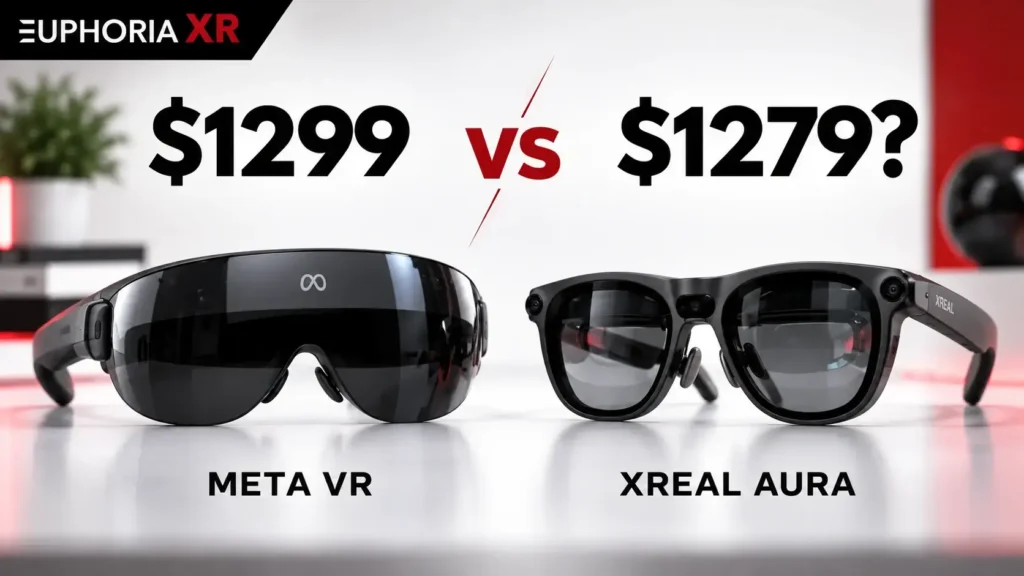
XREAL Aura starts at $1,279, compared with $1,299.99 for Meta VR Glasses. That’s a difference of $20.99.
XREAL also has an earlier planned shipping window, while Meta’s glasses are scheduled for spring 2027.
However, both products still need extensive independent testing. The best choice depends on how you plan to use them, not their nearly identical prices.
Would you ever spend almost $1,300 on smart glasses, only to find another set priced $20 less? Would you opt for the cheaper one, or would the additional money get you something better?
That’s the main question behind the XREAL Aura vs Meta VR Glasses comparison.
XREAL Aura starts at $1,279, while Meta VR Glasses cost $1,299.99. Both have high-resolution screens, Spatial Computing, hand tracking, and a pocket-sized computing device.
But here’s the difference. One lets you see the real world directly. The other uses cameras to show your surroundings and create a more immersive experience
Then, which one should you choose to invest in? The costs are not the primary concern here: the answer lies in far more than $20.
XREAL Aura vs Meta VR Glasses: Quick Verdict
The most obvious contrast between these two devices is how they combine digital content with the real world.
XREAL Aura adopts optical see-through displays. The image of the objects and the screen appears in front of you, while you are looking straight through the lenses.
Meta VR Glasses use video passthrough. The room around you is shown on the cameras, which then displays that view along with virtual content.
Both approaches are compatible, but they can offer different experiences in combination with mixed reality.
| Your Main Priority | Better Fit | Why |
|---|---|---|
| Seeing Your Surroundings Directly | XREAL Aura | Transparent optical display |
| Immersive Movies and Entertainment | Meta VR Glasses | Higher display resolution and Dolby Vision |
| Eye-Based Navigation | Meta VR Glasses | Built-in eye tracking |
| Android Apps and Gemini | XREAL Aura | Google Android XR platform |
| Meta Quest Games | Meta VR Glasses | Shared software ecosystem |
| Virtual Monitors and Productivity | Both | Different input methods and display strengths |
| Earlier Availability | XREAL Aura | Planned 2026 shipping |
Initial hands-on experience with WIRED and Tom’s Guide revealed that Meta’s interaction system was more refined. XREAL was better at providing the physical world, but still needed work with some gestures and apps.
Early verdict: XREAL comes out with a clear seal of success in real-world visibility, while Meta has more early evidence of success in entertainment and control.
Do you have an XR project planned? Euphoria XR can help you discuss your ideas and choose the best solution.
XREAL Aura vs Meta VR Glasses: Specifications Compared
So, first let’s take a look at the hardware to compare before everyday performance.
Both products feature micro-OLED displays, advanced processors, and spatial tracking and wired computing pucks. There are certain differences, though, found in the detailed specifications of both.
| Specification | XREAL Aura | Meta VR Glasses |
|---|---|---|
| Starting Price | $1,279 | $1,299.99 |
| Display Technology | Sony micro-OLED | 5K Infinite Display, micro-OLED |
| Optical System | X Prism, optical see-through | Pancake lenses, video passthrough |
| Resolution Per Eye | 1920 × 1200 | 2412 × 2288 |
| Refresh Rate | Up to 120Hz | 120Hz |
| Field of View | 70° diagonal | 70° horizontal, 66° vertical |
| Pixel Density | 32 PPD | 37 PPD |
| Glasses Weight | 95 grams | Approximately 100 grams |
| Main Processor | Snapdragon Reality Elite | Snapdragon Reality Elite* |
| Spatial Processor | X1S coprocessor | Not Separately Specified |
| RAM | 12GB / 16GB | 12GB |
| Storage | 256GB / 512GB | Not Publicly Specified |
| Operating System | Android XR | Meta Horizon OS |
| AI Assistant | Google Gemini | Meta AI |
| Hand Tracking | Yes | Yes |
| Eye Tracking | No Announced Support | Yes |
| 6DoF Tracking | Yes | Yes |
| Real-World Viewing | Direct Optical View | Color Camera Passthrough |
| Display Dimming | Five Transparency Levels | Opaque Display |
| Audio | Bose-Tuned Audio | Dolby Atmos |
| Battery | 34.84Wh in Puck | Up to 3 Hours of Media Playback |
| Connectivity | Wi-Fi 6/6E, Bluetooth 5.3 | Wi-Fi 7, Bluetooth 5.4 |
| External Display Input | DisplayPort Input | DisplayPort Input |
| Expected Availability | Before 2026 Holidays in Initial Markets | Spring 2027 |
There are three specifications that stand out.
Firstly, Meta has better pixels per eye, which might help you see small text and fine details in images.
Next, XREAL creates the vision directly, and Meta uses the cameras.
Third, while both promise 70-degree FOV, these are in different directions. Diagonal being XREAL’s 70 degrees, while Meta is horizontal. These field-of-view measurements cannot be compared directly.
These differences in display technology explain why two similarly priced devices can offer very different experiences.
XREAL Aura vs Meta Price Comparison: What Does the Extra $20 Buy?
XREAL Aura starts at $1,279, while Meta VR Glasses cost $1,299.99. Meta costs just $20.99 more. The real differences lie in display technology, eye tracking, software, and entertainment features.
XREAL Aura Price and Available Configurations
XREAL has two different setups:
| Configuration | Price |
|---|---|
| 12GB RAM + 256GB Storage | $1,279 |
| 16GB RAM + 512GB Storage | $1,499 |
Both options feature the same display technology and core features while offering the added benefits of increased memory and storage in the $220 upgrade.
The package includes the computing puck, prescription insert frame, cables, and carrying case.
Meta VR Glasses Price and What’s Included
Meta VR Glasses will retail for $1,299.99 and feature a computing puck to process, power, and store data.
The additional $20.99 helps with its higher display resolution, built-in eye tracking, Dolby Vision, and access to Meta’s VR space.
But the Meta Quest Touch Plus controller is not included. The exact details of final retail packaging remain to be finalized.
The Hidden Costs Beyond the $20 Difference
The price posted is not for all possible costs.
Further accessories, paid applications, prescription lenses, taxes, and the game controller may raise the cost.
With the XREAL product comes a prescription insert frame, and custom lenses are included with a separate purchase. Some games require controllers to be used by Meta players.
In conclusion: See the full package, not just the original prices.
Display Technology: Optical See-Through vs Video Passthrough
The distinguishing feature between XREAL Aura and Meta VR Glasses is their approach to showing you the real world.
XREAL employs transparent optics, whereas Meta employs cameras and screens. Both support spatial computing, though the viewing experience varies.
How XREAL Aura’s Optical See-Through Display Works
With XREAL’s optical see-through technology, what you see through the lenses is what you see directly in front of you.
Computer-generated displays/3D objects are projected over the physical one. There may be times when you can read instructions as you watch equipment, or have virtual monitors next to your workstation.
This eliminates the delay of camera passthrough in your physical-world view, while virtual content still needs tracking and rendering.
How Meta VR Glasses Use Pancake Lenses and Video Passthrough
Meta uses pancake lenses with micro-OLED displays. You can see what’s happening around you and match it up with virtual elements through the camera.
Unlike transparent AR glasses, Meta VR Glasses can control the entire displayed image, producing deeper blacks and stronger contrast. This adds depth to the blacks, contrast, and an immersive virtual world experience.
Of course, camera capabilities and processing determine the chief perspective on the surroundings.
Resolution, Field of View and Image Clarity
| Feature | XREAL Aura | Meta VR Glasses |
|---|---|---|
| Resolution Per Eye | 1920 × 1200 | 2412 × 2288 |
| Field of View | 70° Diagonal | 70° Horizontal |
| Pixel Density | 32 PPD | 37 PPD |
| Refresh Rate | Up to 120Hz | 120Hz |
Meta provides greater resolution and pixel density, making it a potential candidate for clear and better visuals and paragraphs.
They both offer 120Hz refresh rates for smoother movement.
Their 70 degree fields-of-view are in different directions, though, so they can’t be directly compared. At this stage a few preliminary reports that there is some edge blur on the XREAL Aura.
Which Display Works Better in Different Lighting Conditions?
XREAL Aura allows you to achieve 5 electrochromic dimming grades, preventing up to 99.9% of external light when at its highest level of dimming. It is claimed to display 1,050 nits.
This is beneficial when viewing virtual content on light backgrounds.
Meta’s opaque display has a more predictable level of dark scenes and contrast, which is beneficial for movies and games.
Both devices lack adequate independent outdoor testing to determine which works more effectively in all lighting scenarios.
Comfort, Battery Life and Portability: Which Is Better for Daily Use?
The two models feature a separate puck for the processor and battery units, which decreases the weight of the gadget on your face.
However, some factors such as weight, fit, cables, and battery life still impact daily usage.
Glasses Weight, Fit and Prescription Support
XREAL Aura has a weight of around 95 grams, and Meta VR Glasses weigh around 100 grams.
XREAL is available in medium & large sizes for various interpupillary distances (IPD) and also in prescription lens inserts.
The manual IPD adjustment at 56–70mm is supported by Meta.
The difference of 5 g is insignificant. For longer sessions, more attention will be given to the weight distribution, fit, and nose pressure.
Compute Puck, Battery Life and Cable Management
The two products are linked with a cable to a pocket computer puck.
The battery inside XREAL’s puck is theoretically rated at 34.84Wh, but there are limitations on standardized real-world run times.
Meta has asserted it supports up to three hours of high-resolution media playback and will take part in 45W fast charging.
Battery capacity and runtime aren’t directly comparable.
Carrying a wired computing puck may feel inconvenient, especially when traveling.
Tracking and Controls: Hand Tracking, Eye Tracking and Spatial Interaction
Both devices enable users to interact with virtual objects without any conventional controllers. But they introduce eye-tracking features as an addition, and XREAL has puck controls.
Meta VR Glasses: Eye, Hand and Voice Controls
Meta merges eye tracking, hand gestures, and voice controls.
Users can view the application’s icon and pin their fingers to pick the desired application. They can also use menus without having to frequently lift their hand off the touchscreen.
Other options for games are the compatible Quest controllers.
Meta’s hand and eye tracking systems react and were tested in early stages, but not tested for the retail game.
XREAL Aura: Hand Tracking, Spatial Anchoring and Puck Touchpad
XREAL Aura supports hand tracking, voice input, and a touchpad on its computing puck.
Virtual objects remain fixed in the real world with its 6DoF tracking.
X1S spatial coprocessor enables low-latency motion-to-photon tracking and display processing with up to 3ms of latency.
But that’s not the response time for all applications. XREAL also has no announced built-in eye tracking.
Which Interaction System Is More Practical?
For imagining objects with your eyes, the early edge goes to Meta since they have gesture-based navigation.
XREAL offers greater physical input versatility with its puck, Bluetooth keyboard, mouse, and controllers.
Meta’s eye tracking might have more appeal as a fun feature. XREAL has external input support that might be helpful for productivity.
Actual reliability will be dependent on software and final hardware testing.
Android XR vs Meta Horizon OS: Apps, AI and Software Ecosystem
The software can have a more important effect on the value than the hardware.
XREAL Aura runs Google’s Android XR, while Meta VR Glasses use Meta Horizon OS.
XREAL Aura: Android XR, Google Apps and Gemini AI
XREAL Aura shows how AI-powered Smart Glasses can bring Google Play apps, Gemini AI, and spatial computing into everyday use.
Multiple virtual windows can be opened to browse the web, watch YouTube, and communicate with Gemini via auditory feedback.
Additionally, XREAL has up to 5 virtual screens and wired PC display mirroring.
Although millions of Android applications exist in Google Play, not all of them have been created with spatial interaction in mind.
Meta VR Glasses: Horizon OS, Meta AI and Quest Compatibility
Meta VR Glasses use Meta Horizon OS, which is the same operating system used by Meta Quest devices.
Users can explore games and projects they can play, engage in immersive entertainment, interact with Meta AI, and enter virtual workspaces.
Meta also supports eye-based navigation, external displays, and extra-bought Quest controllers.
But certain applications may require updates and/or input modifications to function correctly on the glasses.
Which Ecosystem Offers Better Long-Term Value?
XREAL has an advantage for Google services and Android applications. Meta has more of a solid base in the VR gaming and entertainment space.
Both platforms provide developer capabilities to create spatial applications.
Long-term value dependency will be related to app compatibility, regular updates, and watershed success according to the respective companies.
XREAL Aura vs Meta VR Glasses: Which Is Better for Real-World Use?
While specifications can be useful, real-world experiences teach us what really matters in features.
Let’s compare both devices in the following scenarios.
Gaming and Immersive Entertainment
Meta seems more geared towards content-driven gaming and cinematic viewing.
It can handle Quest games, Dolby Vision, Dolby Atmos, and IMAX Enhanced content. Meta has announced more than 75 games designed for hand-tracking controls at launch.
XREAL supports Android games, large virtual screens, and AR and VR Gaming Experiences through compatible XR applications.
Each of them has its own advantages for gaming, with Meta dominating in virtual reality and XREAL in the realm of entertainment and immediate physical presence.
Productivity, Multitasking and Virtual Monitors
Both devices support virtual workspaces.
XREAL supports five virtual screens and mirroring of compatible PCs via DisplayPort input.
Meta does support virtual monitors, desktop connections and eye-controlled interfaces. It could also be useful for small text thanks to its increased pixel density.
But none can yet do a full-screen replacement for a laptop or a computer desk.
Travel, Everyday AR and Staying Aware of Your Surroundings
Using XREAL’s clear lenses, it’s easier to more clearly see one’s physical environment directly when using the virtual screens.
Camera passthrough, but thanks to Meta’s open design, there is also peripheral awareness.
Both have entertainment and workspace solutions for flight time or hotel room options.
Comfort, however, is still a limitation, as are battery life and cables. Both should be avoided when operating a vehicle and in situations when safety is essential.
Video Calls, AI Assistance and Spatial Collaboration
Meta has confirmed that it is introducing hologram calling, live streaming as avatars for supported phone calls.
The emphasis of XREAL is on Gemini-powered assistance, contextual information, and Android XR applications.
Both have room that can be used for virtual meetings, and they share virtual 3D workspaces.
But, in the case of advanced collaboration, there should be software that is compatible and connections that are reliable.
XREAL Aura vs Meta VR Glasses for Businesses and XR Developers
In addition to personal entertainment, both devices have options for workplace training, design, and custom XR applications.
The answer depends on the required activity of the employees.
Potential Applications in Training, Design and Remote Assistance
XREAL’s optical see-through system may be used in a multitude of ways for guided maintenance, instructions on equipment, and 3D visualisations over real items.
Meta’s immersive displays may be better suited for Virtual Reality Training, simulated environments, and interactive 3D design reviews.
The following are possible use cases. However, software has to be tested for compatibility and accuracy of tracking and workspace safety before it is deployed in the workplace.
Android XR vs Meta’s Developer Ecosystem
XREAL supports Augmented Reality Development through Android XR applications, Google’s development tools, and the wider Android ecosystem.
Horizon OS is available for development for a range of platforms, including Unity and Unreal Engine, supported by the VR beta. Meta offers development tools for the Horizon OS, which supports Unity and Unreal Engine and other apps compatible with the VR beta.
Before deciding on one platform or the other, developers should conduct an examination of the different SDKs, supported sensors, user input methods, and app deployment needs and requirements.
What Enterprises Must Verify Before Deployment
Businesses investing in Spatial Computing Development should assess application compatibility, device management, data security, camera privacy, employee comfort, battery life, and ongoing support costs.
They should also evaluate the tracking accuracy and performance of the system in real working conditions.
Limits can be discovered with a smaller pilot project than a full team; a small pilot project can reveal limits before having to invest in devices for an entire team.
Release Dates and Availability: Buy XREAL Aura Now or Wait for Meta?
XREAL Aura will likely be available to customers before Meta VR Glasses. But there are two different ordering times for both devices.
XREAL Aura Preorders and Shipping Timeline
On 7th October 2026, XREAL revealed the final pricing of Aura, and the preorder was available to all qualified reservation holders.
The company anticipates shipping to four markets: the United States, Canada, Japan, and South Korea before the 2026 holiday season.
Availability in other regions hasn’t been confirmed, but general orders are scheduled to take place in the coming weeks.
Purchasers may look at the official XREAL shop for ongoing ordering alternatives.
Meta VR Glasses Release Date
The release of Meta VR Glasses is targeted for Spring 2027, and the price tag will be set at $1,299.99.
Meta officially introduced the device on September 23, 2026, but it hasn’t specified when it will hit store shelves.
Unlike XREAL, Meta has not yet announced that it will have general retail sales of VR Glasses coming in.
Is Waiting for Meta Worth It?
If you’re a VR game enthusiast, interested in eye-tracking technology, prefer more display detail, and want Meta Quest compatibility, then waiting will make sense.
But with XREAL, its arrival comes a bit earlier, along with clear AR screens and then Android XR with Gemini.
Are you in need of spatial computing sooner? XREAL is the more immediate choice. If not, waiting for any independent reviews that you may find can help you in making the purchase.
What We Still Don’t Know About Either Device
Both devices have plenty of questions that have yet to be answered, despite their impressive specifications.
Both companies show some promise with their features, but it is hard to say what a short time spent in the hands of two experts will show about their long-term performance.
There are a few more months until we know the winner, depending on independent testing of final retail hardware.
XREAL Aura vs Meta VR Glasses: Which Should You Buy?
The most recommended option is to depend on how you’re going to use spatial computing.
If you’re looking to create virtual screens without compromising on your real-life surroundings, then XREAL Aura is a better option.
For those who like immersive entertainment and are already users of the MetaVR ecosystem, applying MetaVR Glasses will appear attractive.
Both devices have yet to be shown to be capable of fully replacing a laptop, screen, or classic gaming console, though.
With Euphoria XR’s custom development services, you may realize your AR, VR, or AI concepts.
Key Takeaways
XREAL Aura starts at $1,279, while Meta VR Glasses cost $1,299.99, a difference of $20.99.
XREAL uses optical see-through displays, while Meta relies on video passthrough.
Meta offers higher resolution, 37 PPD, and integrated eye tracking.
XREAL supports Android XR, Google Gemini, and direct real-world visibility.
Both use lightweight glasses connected to a separate computing puck.
Meta has an advantage for existing Quest users and immersive entertainment.
XREAL expects initial shipping before the 2026 holidays, while Meta launches in spring 2027.
Real-world battery life, comfort, and long-term performance still need independent testing.
Final Verdict: Is the $20 Price Difference Worth It?
The point of the XREAL Aura vs Meta VR glasses comparison is not about saving $20.
If you’re looking for enhanced displays, eye tracking, and the immersion of games, then paying an extra $20.99 for Meta might be worth it.
XREAL Aura may offer better value for users who prefer transparent AR displays, Android XR, and Gemini-powered productivity.
No single device is best for everyone. Make sure that you know which features you’re going to use, and try to wait for the full reviews before spending almost $1,300.
Frequently Asked Questions (FAQs)
Is XREAL Aura Cheaper Than Meta VR Glasses?
Yes. XREAL Aura starts at $1,279, while Meta VR Glasses cost $1,299.99. The difference in price before taxes/accessories is 20.99. For those wanting more RAM and storage, there is an optional $1499 config of XREAL that also offers it.
What Are the Main XREAL Aura Specifications?
XREAL Aura features dual micro-OLED displays with 1920 × 1200 resolution per eye and a pixel density of 32 PPD. It also features 6DoF, Android XR, Gemini AI, and Snapdragon Reality Elite processing.
Does XREAL Aura Have Eye Tracking?
No. XREAL Aura does not offer announced built-in eye tracking. Instead, it uses hand tracking, voice commands, and a touchpad on its computing puck. Meta VR Glasses also feature built-in eye tracking capabilities to operate virtual interfaces.
Can Meta VR Glasses Run Existing Meta Quest Games?
Yes. Meta VR Glasses run on the all-new Meta Horizon OS and are compatible with the popular Meta Quest games. Some titles do require separately owned Quest Touch Plus controllers or updates for eye and hand tracking, though. Not every game will work without adjustments.
Can XREAL Aura Replace a Laptop or External Monitor?
XREAL Aura supports virtual screen and mirrored display for compatible laptops via DisplayPort input. This can help to alleviate physical monitor requirements. It cannot ever be a substitute, however, for every activity on the laptop, particularly where there is a need for specialized software.
When Will XREAL Aura and Meta VR Glasses Be Available?
XREAL Aura likely will start shipping before the 2026 U.S., Canada, Japan, or South Korean holidays. Meta VR glasses will enter the market sometime in the spring of 2027. The exact date of delivery, as well as further geographical availability, is subject to confirmation.