













TL;DR
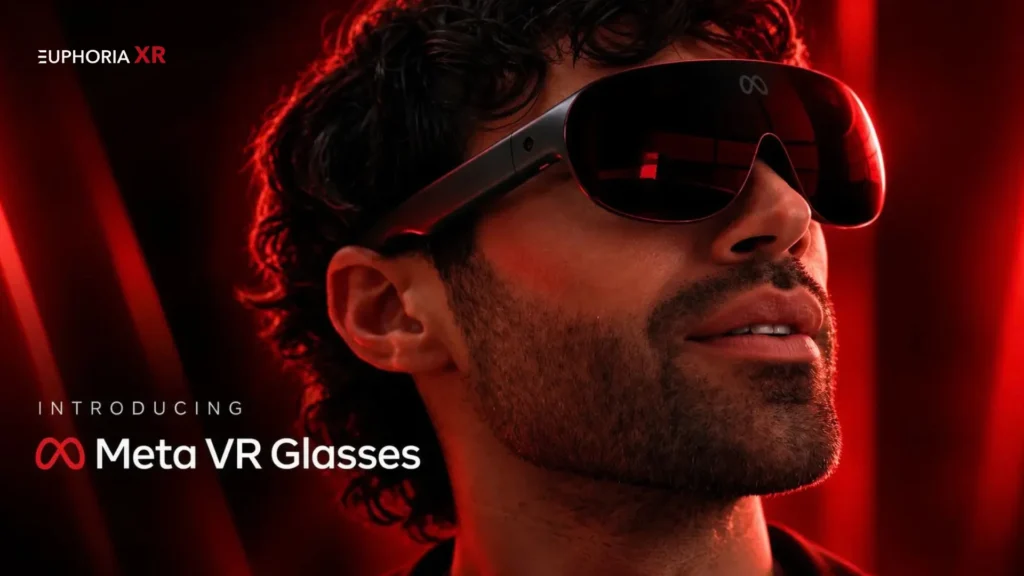
Meta VR Glasses are a lightweight mixed-reality headset in a glasses form factor. They weigh about 100 g on the face because the heavy hardware lives in a roughly 300 g compute puck connected by an optical tether.
Quick facts
| Price | $1,299.99 (US) |
|---|---|
| Release | Spring 2027 |
| Weight | ~100 g glasses + ~300 g puck |
| Display | Dual micro-OLED, 2,412 × 2,288 per eye, up to 120Hz |
| Sharpness | 37 pixels per degree (PPD) |
| Field of View | 70° horizontal × 66° vertical |
| Passthrough | Full-color, ~26 PPD |
| Chip | Snapdragon Reality Elite (XR2 Gen 3 class) |
| Memory/Storage | 12GB RAM, 128GB + microSD up to 1TB |
| Battery | ~3 hours, 45W fast charging |
| Controllers | Optional, sold separately |
Imagine a VR headset that weighs about as much as a deck of cards: no thick strap pulling on your head and no battery pressing against your forehead. That is the pitch behind Meta VR Glasses, which Meta announced at Connect on September 23, 2026.
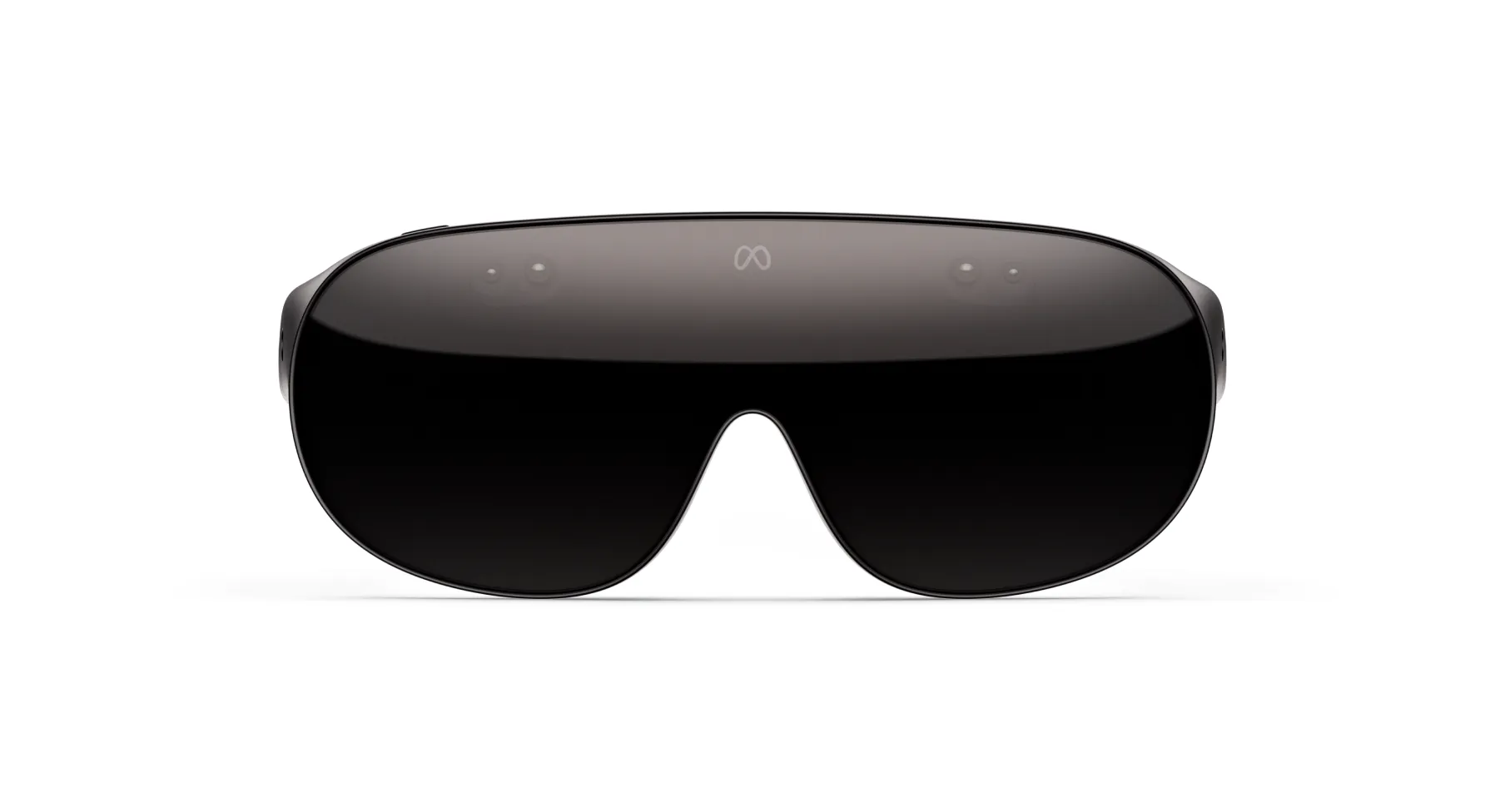
The glasses weigh about 100 grams on the face. Meta says that it is roughly five times lighter than Quest 3. The catch is that Meta didn’t fit a whole VR computer into 100 grams. It moved the processor, battery, and storage into a separate pocket-sized compute puck, and that design choice matters more than the weight figure itself.
Want your app ready for Meta VR Glasses on launch day?Â
How Much Do Meta VR Glasses Cost?
Meta VR Glasses cost $1,299.99 in the United States. That puts them well above Meta Quest 3, which currently sells for $499.99, and far below Apple Vision Pro at $3,499.
The price makes clear this isn’t meant to be the cheapest way into VR, because Quest already fills that role. Meta is targeting buyers who will pay more for lower on-face weight, sharper displays, eye tracking, and a form factor you can wear for a whole movie or work session. For context, it is also $200 less than the Quest Pro cost when it launched in 2022.
Controllers are not included. The glasses are designed around eye and hand input, and Meta Quest Touch Plus controllers are an optional extra purchase.
When is the Release Date of Meta VR Glasses?
Meta VR Glasses go on sale in spring 2027, and Meta hasn’t announced an exact date yet. Several markets are planned at launch: the US, UK, Canada, several European countries, Japan, South Korea, Taiwan, Singapore, Australia, and New Zealand, among others.
That leaves a gap of several months between announcement and retail. Every hands-on impression so far comes from controlled demos at Connect. Long-term comfort, heat, real battery life, and software stability won’t be clear until independent reviewers have retail units.
Meta VR Glasses Specs
| Specification | Meta VR Glasses |
|---|---|
| Display | Dual micro-OLED ("5K" branding [VERIFY exact name]) |
| Resolution | 2,412 × 2,288 per eye (~5.5 MP per eye) |
| Pixel Density | 37 PPD |
| Refresh Rate | Up to 120Hz |
| HDR | Yes, Dolby Vision support |
| Lenses | Pancake |
| Field of View | 70° H × 66° V (~88° diagonal) |
| IPD Adjustment | Manual, 56–70 mm |
| Prescription | Zenni Optical inserts |
| Processor | Snapdragon Reality Elite |
| RAM | 12GB |
| Storage | 128GB + microSD (up to 1TB, card not included) |
| Passthrough | Full-color, ~26 PPD |
| Eye Tracking | Four cameras (two per eye) |
| Tracking | 6DoF, inside-out |
| Audio | Spatial audio in the frames, Dolby Atmos |
| Weight | ~100 g glasses, ~300 g puck |
| Battery | ~3 hours (see battery section) |
| Charging | 45W USB-C, usable while charging |
| Video Input | USB-C DisplayPort Alt Mode |
| Price | $1,299.99 |
Are Meta VR Glasses the Quest 4?
No. Meta VR Glasses are a new product line, and Meta did not announce a Quest 4 at Connect 2026. Earlier reports linked this device to the codenames Puffin, Loma, and Phoenix, while a separate gaming-focused headset has been reported under the codename Griffin.
The two devices are related, though. Meta VR Glasses run the same operating system as Quest and use the same store, so most Quest apps work on both.
Â
How Do Meta VR Glasses Weigh Only 100 Grams?
The battery, processor, and storage aren’t in the glasses. Meta calls this a two-part system, which is often described as a split or disaggregated architecture.
A desktop PC is a useful comparison. Your monitor shows the picture, and the computer sits somewhere else. Meta applies the same idea to a wearable. The glasses keep only what has to be near your eyes: displays, pancake optics, cameras, and tracking sensors. The puck holds the processor, battery, RAM, and storage. An optical tether connects the two.
This matters because comfort depends on where weight sits as well as how much there is. Quest 3 weighs about 515 grams, most of it hanging off the front of your face and pressing on your forehead and cheeks. Moving that hardware to your pocket removes most of the load and most of the heat. UploadVR reports that the glasses use a magnesium-alloy frame with passive cooling, so there is no fan on your head.
The weight hasn’t disappeared, though. It has been redistributed. The full system is roughly 400 grams, and you are physically tethered to a puck in your pocket, on your belt, or in a bag. Some people will find that far more comfortable than a headset, and others will find the cable annoying. Retail testing will settle it.
The Display: Micro-OLED at 37 PPD
Each eye gets a 2,412 × 2,288 micro-OLED panel running at up to 120Hz, with HDR and Dolby Vision support. Once they ship, these will be the highest-resolution displays Meta has put in a VR product.
The “5K” in Meta’s display branding describes the combined pixel count across both eyes. Each eye does not get a conventional 5K panel. That is why some outlets, including UploadVR, describe the panels as 2.4K.
The switch to micro-OLED matters as much as the resolution. Quest 3 uses LCD panels, which rely on a backlight, so blacks tend to look dark grey. Micro-OLED pixels produce their own light and switch off completely for black. The result is deeper blacks, stronger contrast, and much better dark scenes, which is exactly what you want from a device Meta is pitching as a personal cinema. Road to VR’s hands-on reported deep blacks and no obvious OLED smearing.
Sharper, but Narrower: The PPD vs Field-of-View Trade-Off
Pixels per degree (PPD) measures how many pixels fill each degree of your vision. Higher PPD means crisper text and finer detail. Quest 3 manages about 25 PPD, and Meta VR Glasses reach 37, a big jump for reading documents, browsing, and watching subtitles.
Meta gets there partly by shrinking the view. The field of view is 70° horizontal and 66° vertical, compared with about 110° and 96° on Quest 3. Think of it as a smaller but sharper window. Road to VR’s tester found the field of view noticeably smaller than Quest 3’s.
The open-sided design helps in mixed reality, because your natural peripheral vision fills in around the display. In fully immersive VR, people who value a wide view will notice the difference. Meta will also sell an optional light-blocker accessory for anyone who wants a more closed-off experience.
When comparing headsets, don’t judge the display by resolution alone. PPD, field of view, optics, contrast, brightness, and refresh rate together determine what you actually see.
Passthrough and Mixed Reality
Passthrough uses cameras to show you the real world inside the headset, and it is the foundation of mixed reality. Meta VR Glasses offer full-color passthrough at about 26 PPD, compared with roughly 18 PPD on Quest 3.
Early impressions are strong. Road to VR’s Scott Hayden called it the best passthrough he had seen on a standalone headset, with no visible stitching lines, no noticeable latency, and good color. That was a controlled demo, but the device is clearly designed for moving between virtual content and your real surroundings rather than keeping you fully immersed.
Eye Tracking and Hand Tracking
Four eye-tracking cameras, two per eye, let the system know where you’re looking. You look at an element and confirm with a hand gesture. Eye tracking also enables biometric unlock. Extra front-facing and downward-facing cameras widen the hand-tracking range, so you don’t have to hold your hands in front of your face to interact.
Eye tracking also enables foveated rendering. Your vision is only sharp where you’re looking directly, so the system renders that spot at full detail and reduces detail elsewhere. This is how the device can run Quest content at noticeably higher resolution without overwhelming the chip.
Snapdragon Reality Elite: The Chip in the Puck
The puck runs Qualcomm’s Snapdragon Reality Elite, which several outlets describe as the XR2 Gen 3 generation. Qualcomm claims the following improvements over the XR2+ Gen 2:
GPU: up to 60% faster
CPU: up to 30% faster
NPU: up to 160% faster, with up to 48 TOPS of AI performance
Battery life: up to 20% longer at the same workload
Temperature: up to 12°C cooler under load
These are Qualcomm’s platform claims, not independent benchmarks of Meta VR Glasses. Qualcomm designed Reality Elite for both all-in-one headsets and split designs like this one. That suggests Meta won’t be the only company building puck-based XR hardware.
Battery Life and Charging
Meta quotes up to three hours of high-resolution media playback, and Road to VR reports a claimed 3+ hours of mixed use. That is enough for a feature film, a stretch of a flight or a focused work session, but it isn’t all-day computing. The puck charges at 45W and keeps powering the glasses while plugged into its included USB-C charger.
The lighter wearing experience doesn’t change battery life, which remains in line with today’s XR devices.
Â
What You Can Do With Meta VR Glasses
Gaming. The full Quest catalog is available, with 75+ titles supported at launch. You can use hand tracking or optional Touch Plus controllers. Xbox Cloud Gaming works with a Bluetooth gamepad, and you can play big-screen games from a connected handheld.
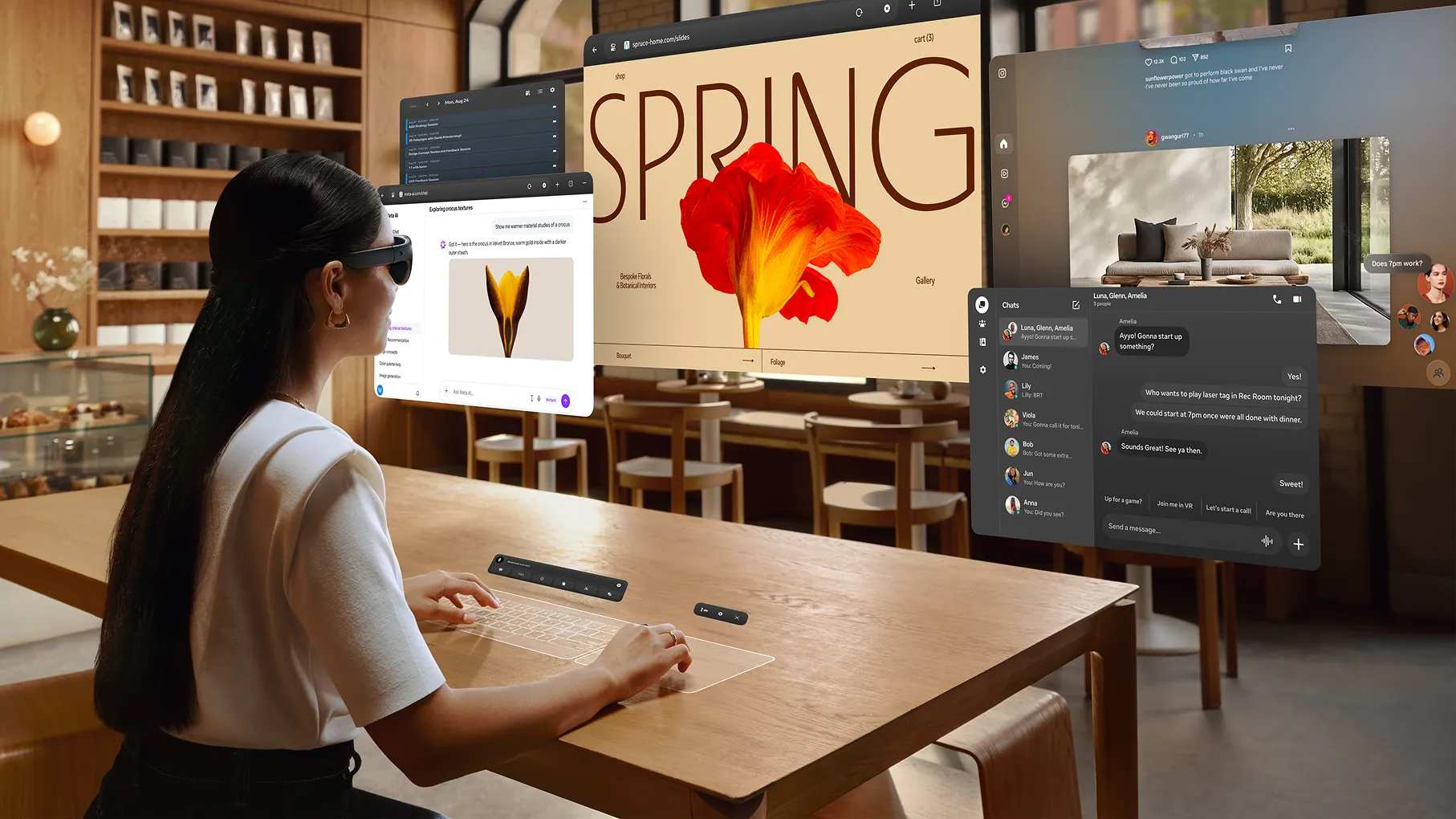
Work. You can set up one large private screen or several virtual monitors. Any table can act as a surface keyboard and touchpad for light tasks. You can also connect a Mac or Windows PC wirelessly or over USB-C and use your own keyboard and mouse, with passthrough keeping your desk visible.
Entertainment. Micro-OLED with HDR, Dolby Vision and Dolby Atmos makes this Meta’s strongest personal-cinema device so far. USB-C DisplayPort input means phones, laptops and handhelds can play directly on the glasses.
Social. Hologram calling uses photorealistic, full-body avatars for video calls.
Â
Meta VR Glasses vs Meta Quest 3
| Feature | Meta VR Glasses | Meta Quest 3 |
|---|---|---|
| On-Face Weight | ~100 g | ~515 g |
| Architecture | Split (glasses + puck) | All-in-One |
| Display | Micro-OLED | LCD |
| Resolution Per Eye | 2,412 × 2,288 | 2,064 × 2,208 |
| Pixel Density | 37 PPD | ~25 PPD |
| Field of View (H × V) | 70° × 66° | 110° × 96° |
| Passthrough | ~26 PPD Color | ~18 PPD Color |
| Eye Tracking | Yes | No |
| Processor | Snapdragon Reality Elite | Snapdragon XR2 Gen 2 |
| RAM | 12GB | 8GB |
| Battery Location | External Puck | In Headset |
| Controllers | Optional, Sold Separately | Included |
| US Price | $1,299.99 | $499.99 |
The two differ more in design philosophy than in raw power. Quest 3 puts everything on your head and gives you a much wider view, and it remains the better-value gaming headset. Meta VR Glasses trade field of view for far less facial weight, sharper micro-OLED panels, and eye tracking. Neither replaces the other; they make different compromises.
Â
Meta VR Glasses Vs Apple Vision Pro
| Feature | Meta VR Glasses | Apple Vision Pro (M5) |
|---|---|---|
| On-Head Weight | ~100 g | 750–800 g |
| External Hardware | ~300 g compute + battery puck | 353 g battery |
| Display | Micro-OLED, 2,412 × 2,288 per eye | Micro-OLED, 23 million pixels total |
| Refresh Rate | Up to 120Hz | Up to 120Hz |
| Processor | Snapdragon Reality Elite (in puck) | Apple M5 + R1 (in headset) |
| Eye and Hand Tracking | Yes | Yes |
| Battery | ~3 hours | Up to 3 hours of video playback |
| US Price | $1,299.99 | $3,499 |
Both companies move the battery off the head, but Apple keeps its M5 and R1 chips in the headset. Meta moves the computer off too. Apple has built a powerful computer you wear on your head. Meta has built a light display tethered to a computer in your pocket, at well under half the price. Which approach wins may become one of the defining hardware debates in XR.
Â
How They Compare With Steam Frame and Galaxy XR
Meta VR Glasses aren’t the only premium headset this cycle. Valve’s Steam Frame launched nine days before Connect. It is a more conventional all-in-one headset that emphasizes PC VR streaming and SteamOS, with LCD panels, a wider field of view, and eye-tracked foveated streaming. Samsung’s Galaxy XR, running Android XR, is the closest rival to Vision Pro, with high-resolution micro-OLED panels and an external battery, at around $1,799.
Meta VR Glasses stand out mainly for their on-face weight. The other two are traditional head-mounted designs, while Meta is betting on a glasses form factor with a pocket computer.
Choosing a headset for your next project or team?Â
See our full VR headset comparison guideÂ
What Meta VR Glasses Mean for XR Developers
For studios building XR apps, this device matters more than its sales numbers suggest. It introduces a new hardware profile apps will need to support and shows where the industry may be heading. Here’s what we’re telling clients to prepare for.
Design for a 70° field of view. UI placed at the edges of a Quest 3 view may fall outside, or only partly inside, the visible area. Keep critical UI, notifications, and text within a tighter central zone, and test that interfaces don’t depend on peripheral vision. Apps that already follow comfort-zone guidelines will adapt most easily.
Take advantage of 37 PPD. Text that needed oversized fonts on Quest 3 can be rendered smaller and denser. That makes productivity, reading, and data-heavy apps much more practical. Consider responsive UI scaling based on the display profile rather than one fixed size.
Build for eye-tracked foveated rendering. With eye tracking as a standard, foveated rendering becomes a baseline performance tool rather than a Quest Pro edge case. Shaders, post-processing, and fine UI detail should hold up in the lower-detail periphery. Eye tracking also opens up gaze-based interaction, but gaze data is sensitive, so handle it carefully.
Treat passthrough as the default. The open-sided design and strong passthrough suggest many sessions will be mixed reality rather than full immersion. Apps that anchor content to real surfaces, respect the user’s surroundings, and move smoothly between MR and VR will feel native.
Don’t assume controllers. Controllers are sold separately, so that many users won’t have them. Hand tracking and gaze-plus-pinch input should be fully supported, not added as an afterthought.
Plan for the split-architecture future. The broader lesson is architectural. Qualcomm built Reality Elite for split designs, so expect more devices that separate a light display from the compute. Apps that scale across form factors, including full headsets, video-passthrough glasses, and eventually optical AR glasses, will age best.
Euphoria XR’s VR development services help you launch on Meta VR Glasses with apps built for the 70° field of view, foveated rendering, and hand-first input. Start before the hardware ships to be ready on launch day.Â
Trade-Offs Meta Still Has to Solve
Meta VR Glasses solve one major VR problem: facial weight. They don’t solve everything.
Strengths
Very low on-face weight
High 37 PPD sharpness
Micro-OLED with HDR
Eye tracking
Excellent passthrough in demos
Less heat near the face
Limitations
Narrow 70° horizontal field of view
A 300 g puck and a physical tether
Battery life of about three hours
Controllers sold separately
$1,299.99 price
No long-term independent testing yet
Comfort still has to be proven. Even at 100 grams, frame shape, nose pressure, cable pull, and lens position decide how the device feels after a few hours.
Â
Are Meta VR Glasses the Start of a New VR Form Factor?
Quite possibly. The most important thing about Meta VR Glasses may not be the micro-OLED panels or the 100-gram frame. It may be the decision to stop treating a VR device as a single box.
Once the display and the computer are separated, the engineering problem changes. Glasses can get thinner without weakening the processor, chips can run faster without putting heat on your forehead, and batteries can grow without adding weight to your face. The long-term goal will be removing the cable while keeping those comfort gains. For now, Meta VR Glasses offer a clear view of one likely future: less computer on your face, more computing around your body.
The real test begins in spring 2027. If buyers accept the puck and the narrower view in exchange for a device they can comfortably wear, split computing could shape the next generation of XR hardware.
Planning an app for Meta VR Glasses?Â
Key Takeaways
Meta VR Glasses weigh about 100 g on the face, roughly a fifth of Quest 3, thanks to a separate 300 g compute puck.
They cost $1,299.99 and launch in spring 2027. They are not Quest 4.
Micro-OLED panels at 2,412 × 2,288 per eye deliver 37 PPD, but the field of view narrows to 70° horizontal.
Snapdragon Reality Elite, eye-tracked foveated rendering, and 26 PPD passthrough make it a mixed-reality-first device.
It runs the Quest OS and store, but developers should adapt UI for the narrower field of view and prioritize hand and gaze input.
Â
Frequently Asked Questions
Are Meta VR Glasses the same as Quest 4?
No. Meta VR Glasses are a separate product line. Meta didn’t announce a Quest 4 at Connect 2026, though both product lines share the Quest operating system and store.
How much do Meta VR Glasses weigh?
The glasses weigh about 100 grams. The compute puck adds about 300 grams, but it goes in your pocket or bag rather than on your head.
Do Meta VR Glasses come with controllers?
No. The glasses are designed around eye tracking and hand gestures. Meta Quest Touch Plus controllers are supported but sold separately.
Can you wear Meta VR Glasses with prescription lenses?
Yes. Meta partner Zenni Optical offers prescription lens inserts, and the lenses adjust manually for an IPD range of 56 to 70 mm.
Can Meta VR Glasses connect to a PC, phone, or handheld?
Yes. You can connect a Mac or Windows PC wirelessly or over USB-C to use virtual monitors. The puck also supports USB-C DisplayPort Alt Mode, so compatible phones, laptops, and gaming handhelds can display directly on the glasses. Phone mirroring is also supported.
Will Quest apps and games work on Meta VR Glasses?
Yes. The glasses run the same operating system and store as Quest, with 75+ games supported at launch. Developers may still optimize for the smaller field of view, higher pixel density, and eye tracking.
Do Meta VR Glasses have expandable storage?
Yes. The puck has 128GB of internal storage and a microSD slot supporting cards up to 1TB. The card isn’t included.
How long does the battery last?
Meta quotes up to three hours of high-resolution media playback, and Road to VR reports a claimed 3+ hours of mixed use. The puck supports 45W fast charging and can run while plugged in.
Where will Meta VR Glasses be available?
Launch markets include the US, UK, Canada, several European countries, Japan, South Korea, Taiwan, Singapore, Australia, and New Zealand, among others. A full worldwide release hasn’t been announced.
Are Meta VR Glasses good for enterprise use?
They have several work-friendly features: virtual monitors, surface keyboard input, full-color passthrough, and lightweight hardware. Enterprise readiness will also depend on device management, security, and support details, which Meta hasn’t fully detailed yet.