














Shopping on the Internet is convenient. But there is a problem with it, as well.
Individuals cannot touch the product. They are unable to test it out. They are not always able to know whether it will fit, suit, or appear in real life.
Such a little hole causes a lot of trouble. Shoppers hesitate. Carts get abandoned. Returns go up. And e-commerce brands miss sales that are won.
This is why the augmented reality for e-commerce is so important nowadays. It makes individuals view merchandise in a more lifelike manner prior to making a purchase. They are able to preview, as opposed to guessing. They can not feel unsure; they can feel more confident.
And that is important since confidence can be followed through to action.
AR and 3D product content have been demonstrated to generate good returns in some e-commerce case studies, such as increasing conversion and decreasing returns. This is why the number of online stores that consider AR an effective feature of shopping, rather than a pleasant additional functionality, is increasing.
What is Augmented Reality for E-commerce?
AR (augmented reality) is the introduction of digital content to the physical world using a phone, tablet, or other similar device.
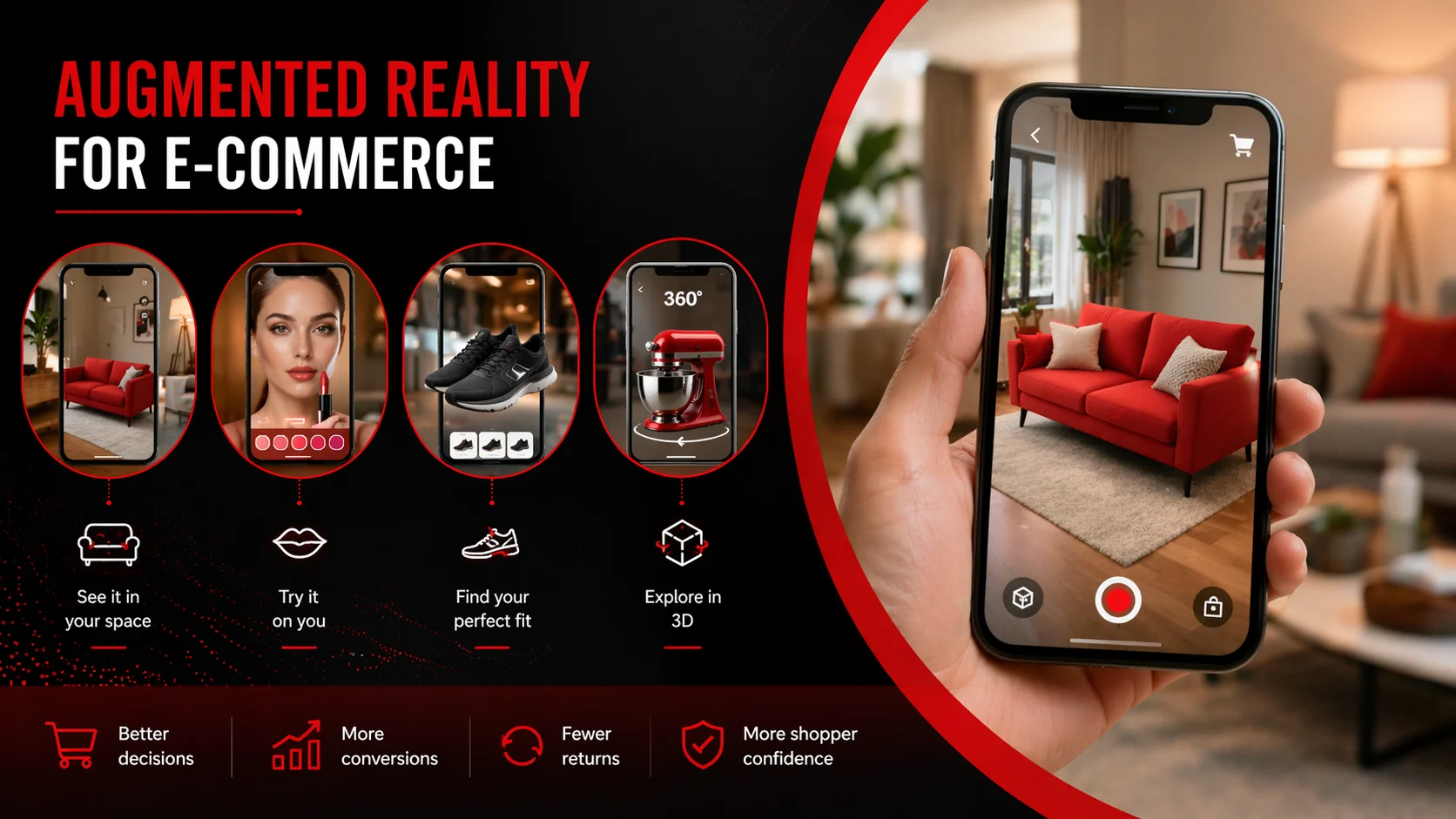
It does not take the place of reality. It builds on it.
As an illustration, a shopper will be able to pick a phone and view the appearance of a sofa in the living room. Before placing an order, a customer is able to apply lipstick shades on the face. A person who is purchasing glasses will be able to view the potential appearance of the frames prior to making a decision.
This is what the e-commerce augmented reality does. It assists individuals in getting familiar with products better in online shopping.
Why Augmented Reality Matters for E-commerce?
The frequent questions before purchasing that are posed by e-commerce shoppers are:
Will this fit me
Will this suit my room?
Will this appear as in the photo?
Will this size be correct?
AR can provide answers to those questions before checkout. That is the reason why it is important.
Helps Shoppers Visualize Products Before Buying
There is only so much that can be depicted by photos. AR includes additional context. It assists shoppers to comprehend size, scale, shape, color, and fit in a far better manner.
It is particularly helpful with such products as furniture, glasses, make-up, shoes, and home decor.
Makes Online Shopping More Interactive
AR transforms shopping into an active and not a passive experience. Individuals do not scroll and read only. They experiment, preview, and spin.
Such interaction could be used to make the experience more interesting and beneficial.
Builds Buyer Confidence
One of the largest motivators of online sales is confidence. As soon as shoppers are able to see a product in a realistic manner, they are less confused.
Having less doubt normally implies making better decisions.
Supports Better Purchase Decisions
AR assists shoppers in making decisions due to a better image of the product. That will result in less unexpectedness at the time of delivery and greater satisfaction with the order.
E-commerce Adoption Trends
The need to enhance the product visualization of online shopping is forcing more e-commerce brands to invest in AR. With the increasing rivalry, retail outlets must have a more effective method of ensuring that customers have confidence in their purchases.
AR is emerging as one of such ways.
Shopper Behavior and AR Usage
Customers will most prefer AR when the purchase is based on appearance, fitting, size or where the item will be placed.
The reason why AR works best in the following categories is:
Beauty
Fashion
Footwear
Eyewear
Furniture
Home Decor
2025 Trends in AR for E-commerce
The ongoing trends indicate that there are four distinct directions that AR in e-commerce is taking:
Greater virtual trial on experiences.
Increased integration of mobile shopping.
Additional product previews (3D)
Visualization of products in a more personalized manner.
These tendencies indicate that e-commerce augmented reality is getting more realistic and widespread.
Types of Augmented Reality Applications in E-commerce
All AR experiences do not work in a similar manner. They are of various types, and each type facilitates a shopping experience.
Marker-Based AR
Marker-based AR is a visual experience that is initiated by a visual trigger, which may be a code or image.
It is not as widespread on modern e-commerce product pages, but it can be used in packaging and printed inserts, and campaign materials.
Markerless AR
One of the most useful types of AR, when it comes to e-commerce, is Markerless AR. It allows the shopper to put online products into their physical environment without a printed tag.
This is usually the one that is used to preview furniture and home products.
Projection-Based AR
AR projects that are based on projections display digital images on a surface. This is not as prevalent in regular e-commerce, but may be used to enable special demos and high-tech product experiences.
Location-Based AR
Location-based AR makes use of location data. Not the primary one deployed in e-commerce product pages, but it can be used to augment app-based campaigns and branded experiences.
How Augmented Reality Is Used in E-commerce?
AR ecommerce is not a single feature. It has several handy shopping experiences.
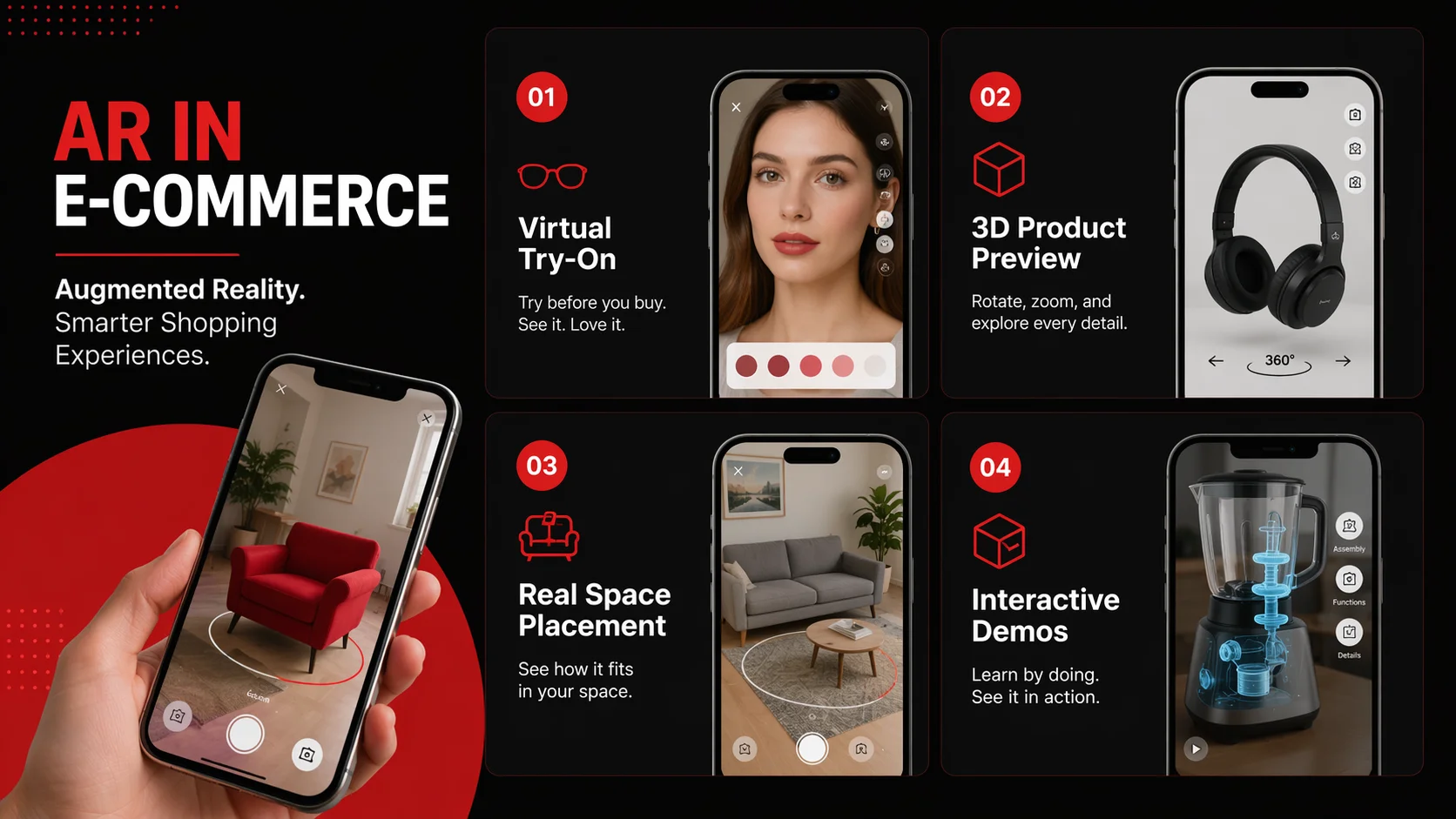
Virtual Try-On Solutions
One of the most popular AR applications in e-commerce is virtual try-on.
It assists shoppers in viewing how an item can appear on them prior to purchasing it.
This is common for:
Makeup
Glasses
Shoes
Clothing
Accessories
The use of virtual fitting room augmented reality in e-commerce is particularly applicable in cases where fit and appearance are significant factors in the purchasing decision.
Product Visualization and 3D Product Preview
Try-on is not necessary for some of the products. They could use an improvement.
The visualization of products and e-commerce augmented reality comes in particularly handy there. A customer will be able to spin the item, zoom, check the details, and see the design at various angles.
This is effective in electronics, decor, tools, toys, and home products.
Product Placement Preview in Real Spaces
This is among the best AR applications in e-commerce.
It assists in answering some simple questions: Will this fit into my space?
That would be important to:
furniture
lighting
home decor
office products
appliances
A preview of a room will enable the shoppers to make their choice quicker and more confidently.
Interactive Product Demonstrations
Some products require elaboration. AR has the ability to demonstrate the functionality of a product rather than simply textually explaining its functionality.
This comes in handy when dealing with products that:
Moving parts
Setup steps
Multiple functions
Technical features
Augmented Reality Apps for E-commerce
E-commerce augmented reality applications allow a customer to preview an item using a phone or a tablet to make a purchase. They are usually applied to virtual try-on, room placement, and 3D product viewing. Such applications render the process of online shopping more interactive and make customers feel more confident in what they are ordering.
Related: https://euphoriaxr.com/augmented-reality-in-retail/
Benefits of Augmented Reality for E-commerce
AR in e-commerce can assist brands with enhancing the shopping experience, as well as resolving the frequent issues in online purchasing. It provides a closer look at products prior to shopping, which may justify enhanced interaction, superior choices, and enhanced store outcomes.
Increases Customer Engagement
AR simplifies the product pages. Customers have an opportunity to browse products rather than merely see pictures, which keeps them more active.
Improves Conversion Rates
Shoppers are likely to purchase a product when they have more knowledge about it. AR will ease hesitation and bring the customers closer to buying.
Reduces Return Rates
AR assists buyers in making a more informed decision before placing an order. This will help minimize returns due to incorrect expectations of fit, size, or appearance.
Improves Product Understanding
AR provides more information than fixed images. It assists customers in having more knowledge of the product with regard to size, shape, fit, and positioning.
Makes Products More Memorable
Product experiences are interactive and are easier to recall compared to normal product photos. This aids in product differentiation.
Helps E-commerce Brands Stand Out
AR provides brands with a more convenient and contemporary way of shopping. That can assist an e-commerce store to appear more innovative and customer-focused in a competitive market.
Examples of Augmented Reality for E-commerce
AR can help a lot of e-commerce brands address a very particular issue. They assist the shopper to be more confident in making a purchase. Others concentrate on trying on. Some are centered on the location of rooms or previews of products.
Sephora
Sephora employs AR to enable online beauty shopping without any risk. Rather than speculating about the appearance of a shade of lipstick or makeup, customers can shop the Sephora app and use the digital beauty tool to test out products and receive more personalized suggestions. It makes AR particularly helpful in the beauty ecommerce, where appearance and color match are major factors influencing the purchase choice.