

Such an expansion in the market is an obvious change of mindset.
Historical reports or delayed analytics are no longer the sole relational sources used by organizations. They are also investing in digital twins to have real-time visibility, predict outcomes, and scale their complexity.
Digital twin technology has gone beyond being optional in current digital transformation plans and strategies.
How Does Digital Twin Technology Work?
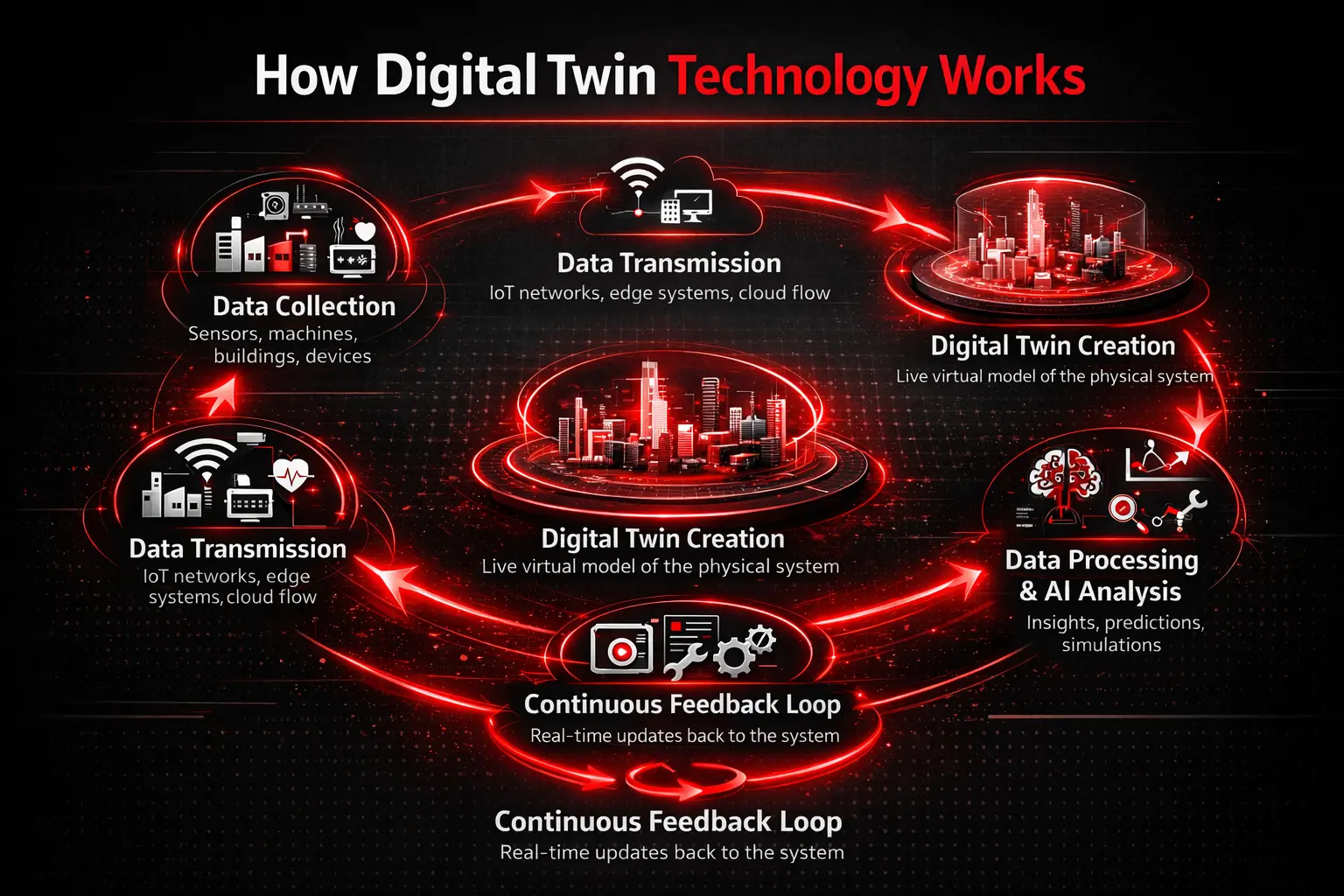
Digital twin technology is a process involving constant rotation.
One step leads on to another.
The two then transform raw information into life decisions.
Data Collection
Everything starts with data.
Physical objects and systems are sensed to provide information.
This may be temperature, pressure, speed, place, use, or human input.
Machines in the manufacturing industry send performance information.
Energy and occupancy are monitored in buildings through systems.
Devices gather patient and equipment information in healthcare.
The quality of a digital twin will be conditioned by the quality of this data.
Data Transmission
After collecting data, it must be able to move fast in a safe manner.
Data is transmitted through:
IoT networks
Edge devices
Cloud platforms
Such transmission may occur in real time or in the near real time.
Incorrect digital twins are incompatible with fast data movement.
The digital twin becomes outdated without the provision of reliable transmission.
Creation of the Digital Twin
The incoming information is read into a digital representation.
This model denotes the physical asset, process, or system.
It may be a 3D representation, a system map, or a process flow.
There is a structural and behavioral reflection of the real-world in the digital twin.
The model is automatically updated as new data comes in.
This is the point of intersection of the physical and the digital worlds.
Data Processing and Analysis
Raw data alone is not useful.
Here, analytics and digital twin AI do enter the scene.
Pattern analysis is conducted by artificial intelligence and machine learning.
They detect anomalies.
They predict failures.
They are used to simulate future events.
For example:
Anticipate the breakdown of a machine.
Check the performance of a system under pressure.
Before problems erupt, discover inefficiencies.
This action transforms information into knowledge.
Action
Insights lead to action.
Measures are either manual or software-based.
Examples include:
Adjusting machine settings
Scheduling maintenance
Optimizing workflows
Updating operational plans
Due to what the digital twin unveils, decisions are made, rather than guesswork.
Feedback Loop
The last process is the feedback loop.
Interventions in the physical world create new information.
Such information gets recirculated with the digital twin.
The model updates again.
This loop runs continuously.
It is what makes digital twins living systems and not one-time simulations.
The 3 Core Components of a Digital Twin
Any digital twin is constructed based on three fundamental elements.
The Physical Entity
This is the actual object, system, or process of the real world.
It may be a machine, a construction, a chain of suppliers, or a human workflow.
The Digital Representation
This is the embodiment image of the real body.
It is a reflection of structure, behavior, and performance.
The model is updated as they change in conditions.
The Data and Intelligence Layer
This layer bridges the physical and digital worlds.
It includes:
Sensors and data streams
Analytics and AI models
Simulation and predictive tools.
This layer facilitates predicting, monitoring, and optimizing.
These three features join forces and enable the digital twin technology to be powerful.
They enable organizations to perceive reality as it is and create the future.
Digital Twin vs Simulation: Key Differences
Simulations and digital twins are mixed up but used for different purposes.
A simulation is typically a test of a short-term or a single occasion.
A digital twin is a living system that is growing along with real-world data.
Here is a clear comparison.
A simulation responds to the question, what might happen.
A digital twin provides an answer to what is going on and what will go on.
It is this real-time linkage that makes digital twin technology more potent for businesses in the present day.
Types of Digital Twins
Digital twins are created on various levels according to what should be watched, analyzed, or optimized. All types have their particular purpose and address different questions of business. They combine to complete a digital twin model.
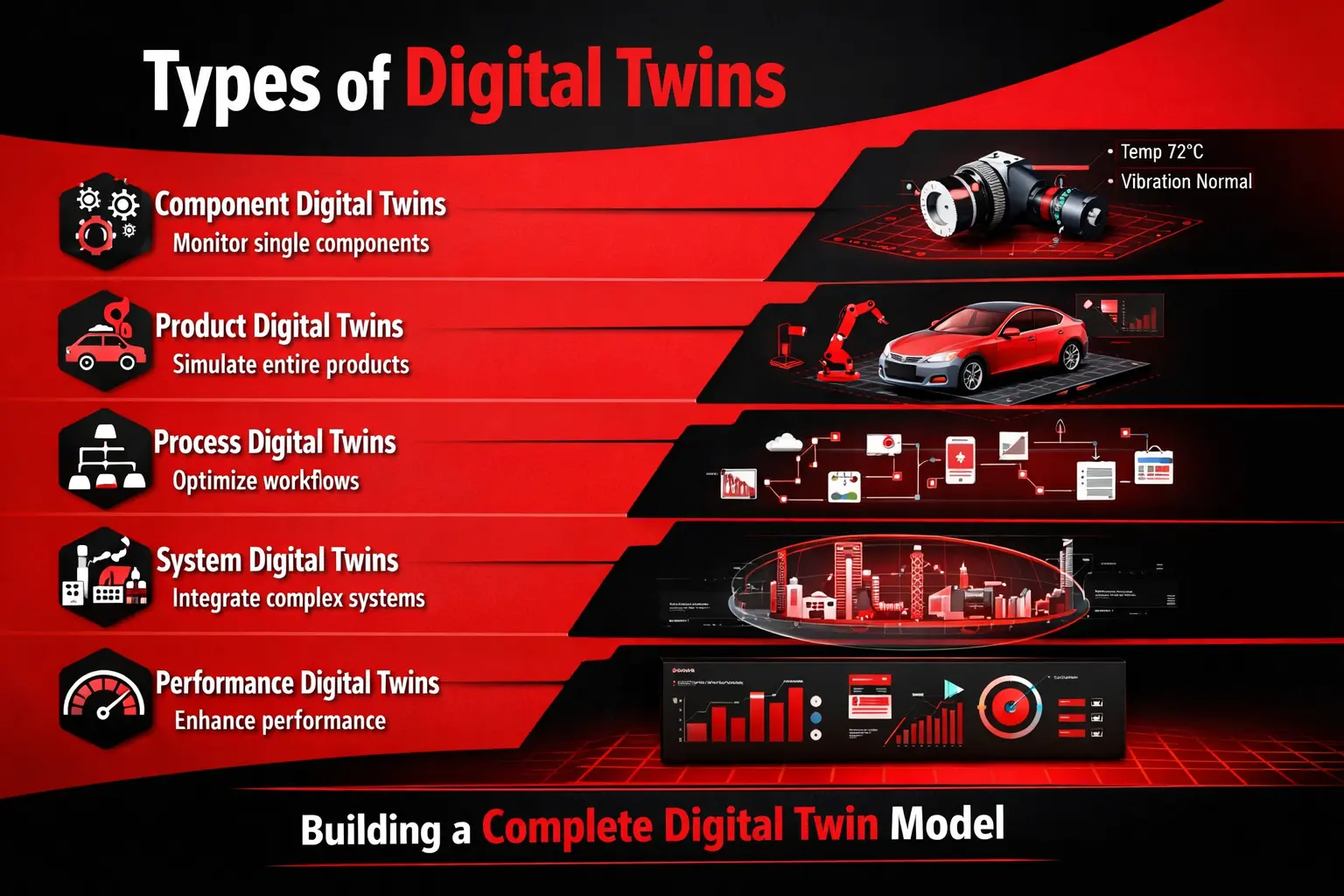
Component Digital Twins
Component digital twins are concerned with single components within a system. These may be mechanical parts, electrical units, or vital machine parts. The digital twin monitors the behavior of that particular component in real-time, through the measurement of its stress, temperature, use, wear, and so on.
This form of digital twin is required in predictive maintenance. Rather than changing parts according to the set schedule, organizations are able to use real data to identify premature failures in time. This minimises downtime, the cost of maintenance, and enhances reliability. An example of this is component digital twins applied in the manufacturing, aerospace, and energy sectors, where the health of equipment is a critical factor.
Product Digital Twins
Product digital twins entail a complete product in its lifecycle. They are employed at the initial design phase up to testing, production, and actual use. Product digital twins are seen as a way for engineers to simulate the way a product will behave under various conditions before it is physically constructed.
After deployment of the product, the digital twin will still receive field data. This assists the teams in pinpointing performance challenges, enhancing future iterations, and increasing the lifecycle of the products. In the automotive, electronics, and industrial equipment development, digital twins of products are widely used when precision and reliability are important factors.
Process Digital Twins
Process digital twins simulate workflow and operations. They do not model physical objects, but rather processes of activity like manufacturing processes, supply chain processes, or service delivery processes.
They can identify inefficiencies, delays, and bottlenecks by visualizing the flow of tasks and materials through every stage. They help organizations to test improvements, evenly distribute workloads, and make total efficiency more efficient without interruption to live operations. Process digital twins are important in the optimization of operations.
System Digital Twins
System digital twins integrate several components and processes into a single digital system. They are complicated systems in which various factors interact and are interdependent. The examples are in the form of factories, power grids, transportation, and huge buildings.
Such a form of digital twin can assist organizations in knowing the impact of the adjustments in a single area on the whole system. When one of the components is underperforming, the system’s digital twin displays the downstream effect. These lessons aid in improved planning, back office risk handling, and decision-making on large-scale principles.
Performance Digital Twins
Performance digital twins aim at measuring and optimizing the results. Instead of modeling structure, they constantly follow the performance indicators of efficiency, quality of output, energy usage, and reliability.
Artificial intelligence is frequently utilized in performance digital twins to make comparisons between the real-time performance and targets or benchmarks. In case of performance decline, the system can identify causes and be able to suggest corrective measures. The digital twins can be useful in long-term optimization and in strategizing.
All forms of digital twins solve a certain level of knowledge. Collectively, they state the reason why digital twin technology is scalable, flexible, and applicable to industries.
Related: https://euphoriaxr.com/digital-twin-environment-in-robotics-training/
Digital Twin Technology Stack
Digital twin technology is functional since more than one technology is united and complements another. Each layer has a clear role.
Internet of Things (IoT)
IoT sensors gather live data of machines, buildings, systems, or environments. This real-time information updates and maintains the digital twin.
Artificial Intelligence and Machine Learning
AI interprets information received by sensors. It identifies patterns, forecasts failures, and assists in better decision-making among digital twins. This is the area where digital twin AI provides the true value.
Cloud Computing
Cloud computing platforms store and process extensive data. They scale digital twins and make them usable in teams and locations.
Extended Reality (XR)
Extended Reality (XR) technologies, such as AR and VR, assist human beings in visualizing and engaging with digital twins. This facilitates the comprehension of complex systems.
How Digital Twins Are Transforming Business Strategy?
Digital twins are useful in ensuring that businesses cease guessing and start knowing.
Teams will be able to view what is actually occurring in real time as opposed to using the outdated reports. They have the opportunity to put decisions to the test digitally and then act in reality. This eliminates risk and enhances trust.
There is also better collaboration using digital twin technology. All employees operate with one data and one model. This leads to more real-time, smarter, and quicker decision-making.
Real-World Digital Twin Applications Across Industries
The values generated by digital twin technology are already being realized in various fields. Digital twins are currently being applied in various industries, as outlined below, and in real-life examples.
Manufacturing Digital Twins
Adoption of digital twin is most popular in manufacturing since even minor gains save large expenditures.
Manufacturing Digital twins are applied in manufacturing to:
Health monitoring of the machine in real-time.
Anticipate failure of equipment in advance.
Streamline production lines and minimise wastage.
Example: Siemens
Siemens relies on digital twins to model a factory before construction, run changes in production in a safe space, and enhance the efficiency in the entire lifecycle of operation.
Healthcare Digital Twins
Healthcare digital twins also concentrate on better results with the use of limited resources.
They are used to:
Virtual responses of patients to therapies.
Optimize hospital layouts and circulation.
Facilitate clinical decision-making.
Example: Personalized Medicine
Digital twins can replicate the profile of single patients in order to guide doctors to allow more effective treatment options with minimal side effects.
Aerospace and Defense Digital Twins
Aerospace systems have to be extremely precise and reliable.
Digital twins help by:
The constant checking of the aircraft’s performance.
Anticipation of maintenance requirements.
Enhancing safety and life cycle management.
Example: Boeing
Digital twins allow Boeing to monitor airplane health, save on maintenance expenses, and increase flight safety.
Automotive Digital Twins
Both the design and operations of automotive companies are based on digital twins.
They use digital twins to:
Digs the design of test vehicles digitally.
Measures the performance of vehicles after deployment.
Enhance systems by updating software.
Example: Tesla
Tesla applies digital twins to process vehicle data and optimize performance based on the never-ending software upgrades.
Energy and Utilities Digital Twins
Energy systems are vast, decentralized, and complicated.
Digital twins are used to:
Supervise power generation resources.
Predict equipment failures
Enhance energy efficiency/reliability.
Example: GE Renewable Energy
GE applies digital twins to wind turbines to monitor their functioning, predict their breakdowns, and to achieve maximum power production.
Smart City Digital Twins
City digital twins help cities operate efficiently in terms of expansion and sustainability.
They help cities to:
Determine traffic and infrastructure alteration.
Maximize resource and energy utilization.
Elaborate long term urbanization.
Example: Singapore
Streaming digital twins at the city scale provides Singapore with city planning, mobility, and environmental management.
Real Estate and Architecture Digital Twins
Digital twins assist in planning, real estate, and architecture.
They are used to:
Design building visualization.
Use the most efficient use of energy efficiently.
Operate the facilities over the lifecycle.
Finance and Insurance Digital Twins
Digital twins are used to model complex systems in financial institutions.
They apply digital twins to:
Simulate financial risk
Test market scenarios
Enhance the forecasting and decision-making process.
Human Digital Twins in Business
Human digital twins simulate the behavior and performance of humans.
They are used for:
Skill development and training.
Performance optimization
Prevention of injury and recovery planning.
Example: U.S. Swim Team
Digital twins help athletes analyze movement patterns and are able to make training more efficient, and minimize the chance of injury.
These applications demonstrate that there is nothing experimental in digital twins. They are feasible, scalable technologies already defining the ways that industries operate, plan, and improve the results.
Benefits of Digital Twin Technology
Digital twin technology assists organizations in making superior decisions by converting real-time information into coherent information. It minimizes uncertainty and enhances the process of planning, monitoring, and optimization of systems.
Key benefits include:
Greater visibility to make better decisions.
Downtime-cutting predictive maintenance.
Reduced operation and maintenance costs.
Increased efficiency and performance.
Quicker testing and innovation, and no risk to the actual world.
Improved sustainability and utilization of resources.
Digital twins can assist businesses to take early actions rather than respond late by indicating what is currently happening and what is likely to happen in the future.
Why Digital Twins Will Be the Backbone of Industry?
Industries are getting more complex and data-oriented. There is a necessity to make decisions much faster and more accurately. The basis of this change can be found in digital twins.
They unify data, systems, and intelligence in a single integrated perspective. This enables organizations to keep track of operations in real-time, develop changes in a secure environment, and scale performance.
With increasing automation, AI, and related systems, digital twins will provide the layer of control that joins physical activities with digital intelligence. This is the reason why they are becoming a necessity in the fields of manufacturing, energy, healthcare, and smart towns.
Challenges and Limitations of Digital Twins
As much as digital twins have great advantages, some pitfalls require companies to handle them carefully.
Data Quality
Digital twins should be based on precise and stable data. Inaccurate or incomplete data may result in wrong implications and conclusions.
Data Security and Privacy
Digital twins tend to utilize sensitive data or personal information regarding operations. It is important to safeguard this data against violation and abuse.
Complexity
The construction and sustenance of digital twins needs a technical skills. Systems can be made complex, particularly when large.
Integration with Existing Systems
Most organizations make use of legacy systems. The process of digital twins integration with the existing older infrastructure may be a challenging and time-consuming task.
Cost
The cost may be substantial at the beginning of working with sensors, software, and infrastructure. Such costs are, however, usually neutralized by long-term savings.
Lack of Standards
The standards of digital twins are undergoing development. Interoperability can be constrained by the differences in platforms and technologies.
Future Trends of Digital Twin Technology
Digital twin is a fast-emerging technology. What began as an instrument of monitoring the machinery is growing into smart linked systems that affect the way individuals live, work, and study.
The following are the current trends that will define the future of digital twins.
Smarter, Self-Updating Digital Twins
Digital twins are becoming autonomous. They never use manual updates, but they constantly learn based on real-time data and change themselves automatically. This enhances higher precision as well as lessening frequent human involvement.
AI-Powered Human Avatars
The human digital twin is coming into existence in the form of AI-enabled avatars. These twins may simulate the human behavior and performance, as well as the decisions. They have been applied as a tool of training, workforce planning, and performance optimization.
Digital Twin as a Service (DTaaS)
Digital twins are becoming more and more available as a cloud service. DTAAS has low entry barriers because it reduces infrastructure expenses and simplifies the deployment, scaling, and management of digital twins.
Genomic and Biological Digital Twins
Digital twins are being used to model biological systems in the field of healthcare and life sciences. Genomic and biological twins assist scientists in mimicking the cause of the disease and the treatment of individuals.
Smart Homes with Living Digital Twins
Smart houses are no longer about automation. Living digital replicas of houses are changing to suit human behavior, energy consumption, and environmental factors in order to enhance comfort and efficiency.
Immersive Twins in the Metaverse
Virtual and augmented reality are making digital twins more lifelike. Within the metaverse, users have the opportunity to engage with virtual twins via joint virtual spaces to collaborate, train, and plan.
Interconnected Digital Twin Ecosystems
The next-generation digital twins will not be autonomous. Several twins will be networked to create ecosystems, e.g., factories are coupled with supply chains, or cities with energy and transportation networks.
Digital Twins for Job Training
Digital twins are challenging and changing training through offering feel-real environments and risk-free. The workers are able to rehearse tasks and procedures as well as respond to emergencies without any real-life effects.
Personalized Education with Learning Twins
Individual student behavior and progress are modeled by learning twins. These digital twins customize the learning routes, speed, and study content to the specific requirements of every learner.
Policy Simulation and Societal Modeling
Digital twins are being applied to simulate policy decisions by governments and other institutions. These models aid in predicting social, economical and environmental impacts before the enactment of policies.