Have you ever wanted to play a game in real life member of a video game, or visit ancient Rome without exerting any effort and leaving your room? This is what Virtual Reality can enable.
Many people are wondering, “What do you know about VR, and why is everyone talking about it?” Some believe it is just to play games. Some believe that it is too complicated. The truth is simple. VR is transforming the learning, training, designing, and connecting experience.
We will simplify it in a simple manner.
What is Virtual Reality VR?
Virtual Reality, frequently abbreviated VR, is a computer-generated world that seems real.
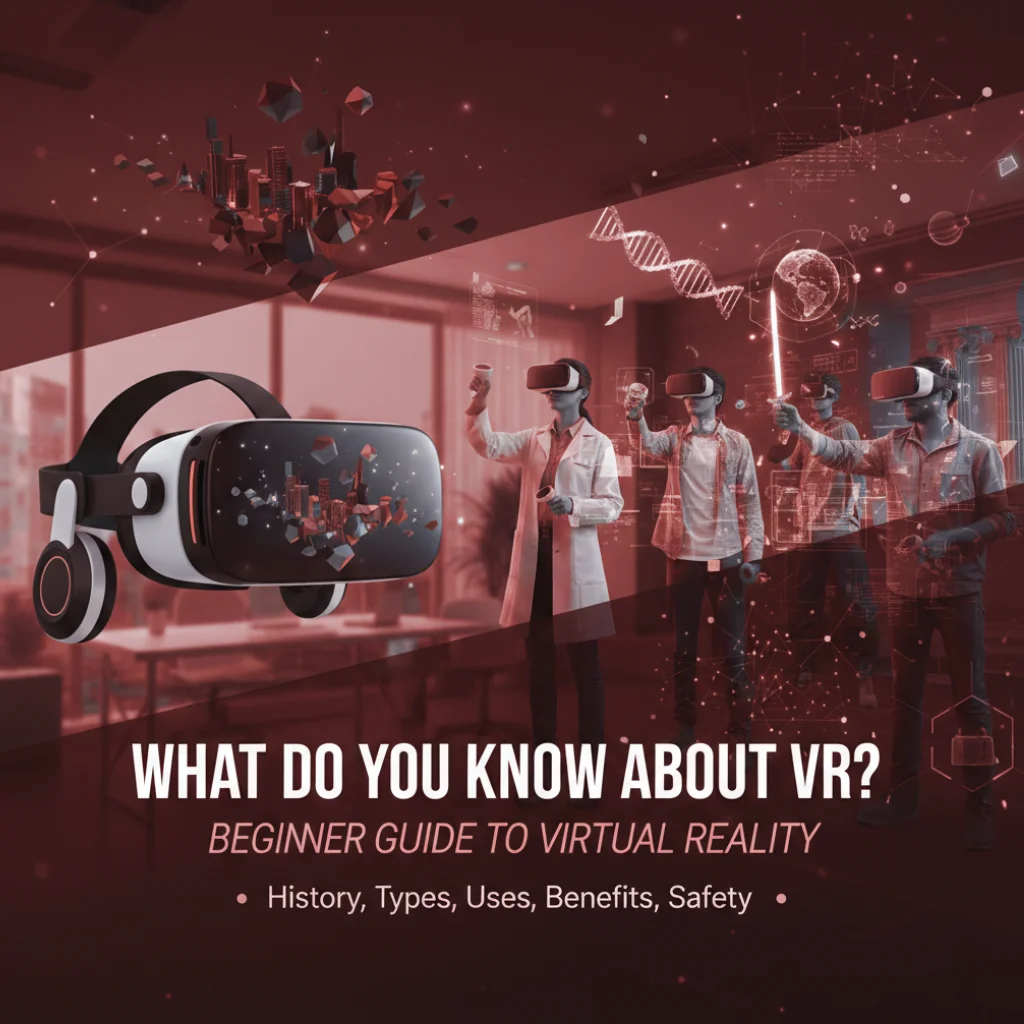
When you are wearing a VR headset, you are seeing and hearing a digital room, rather than the actual room you are in. You are allowed to look left, right, up, and down. The world moves with you.
In short:
Virtual Reality is a technology that involves the use of a VR Headset, and it puts the user in a 3D environment created by the computer, and seem immersive and interactive.
There are generally four characteristics of VR:
It is what distinguishes VR from watching a regular video.
What Is a VR Headset?
A VR headset is a kind of wearable product that envelops your eyes, and sometimes your ears as well. It presents two images of slight difference to every eye. This adds the dimension, as in real life.
In simple words:
A VR device or headset is a product that enables you to view and have access to a virtual world just as though you are there.
Most VR headsets include:
The sensors will also follow your movement when you move your head. The image updates instantly. That makes it seem like it is real.
When Was VR Invented?
The question that many people seek to know is when VR was invented. VR is not a novel concept, as many individuals believe.
Here is a short timeline:
The term “Virtual Reality” appeared in the 1980s. The modern VR began to expand rapidly in 2012.
Statista indicates that the VR market in the world will be more than 22 billion dollars by 2025. The latter demonstrates high growth in the industry.
How Does Virtual Reality Work?
Virtual Reality functions through fooling your brain in an intelligent manner.
It presents your eyes with an electronic world. It monitors the movement of the head and hand. Then it paints the scene in real time in order to make everything natural.
Here is the simple process:
The VR headset illustrates two images that are slightly different, one for each eye.
Special lenses create depth. This brings objects to be either close or distant.
Sensors monitor the movement of your head.
The system also realizes the update of the image in real-time.
Your hands are followed by controllers, and thus you can interact.
This takes place in milliseconds. Any current VR HMD operates at 120 to 72 Hz. Higher refresh rates eliminate motion sickness and eliminate movement.
In short:
Virtual Reality operates based on 3D display and motion tracking, and real-time computing to bring about a lifelike world of computer screens.
Components of Virtual Reality
The VR system consists of software and hardware. All of the parts are significant.
Core Hardware Components
VR headset
Motion tracking sensors
Hand controllers
Display screens
Audio system
Software Components
Here is a simple breakdown:
The lack of these elements working simultaneously would not result in immersion.
How Virtual Reality Provides an Immersive User Experience?
Immersion refers to the feeling of being within the experience.
Virtual Reality brings the sense of immersion in a few ways.
Wide Field of View
The majority of VR headsets provide a field of view of approximately 90 to 110 degrees. This occupies the majority of your sight and distracts you.
Stereoscopic 3D Vision
Two images are shown. Your brain combines them. It gives this a three-dimensional effect.
Real Time Motion Tracking
When you turn your head to the left, the world changes instantly to the left. Delay should understandably remain less than 20 milliseconds to prevent discomfort.
Spatial Audio
The sound varies according to the direction. When there is a sound coming behind you, you hear it behind your back.
Haptic Feedback
The controllers shake when you grab or touch something. This adds realism.
Stanford-based research indicates that immersive experiences of VR may lead to greater emotional involvement as opposed to conventional media. This is because the brain responds to the VR as though it is real.
As soon as the images, movement, and audio are in sync, your mind will buy the fiction.
This is the way Virtual Reality brings a robust, immersive user experience.
Types of Virtual Reality VR Headsets
When a person wonders what you know of VR, one of these questions is knowing the various types of VR headsets. The primary device that allows one to experience virtual reality is a VR headset. It regulates the degree of immersion and intensity of the experience.
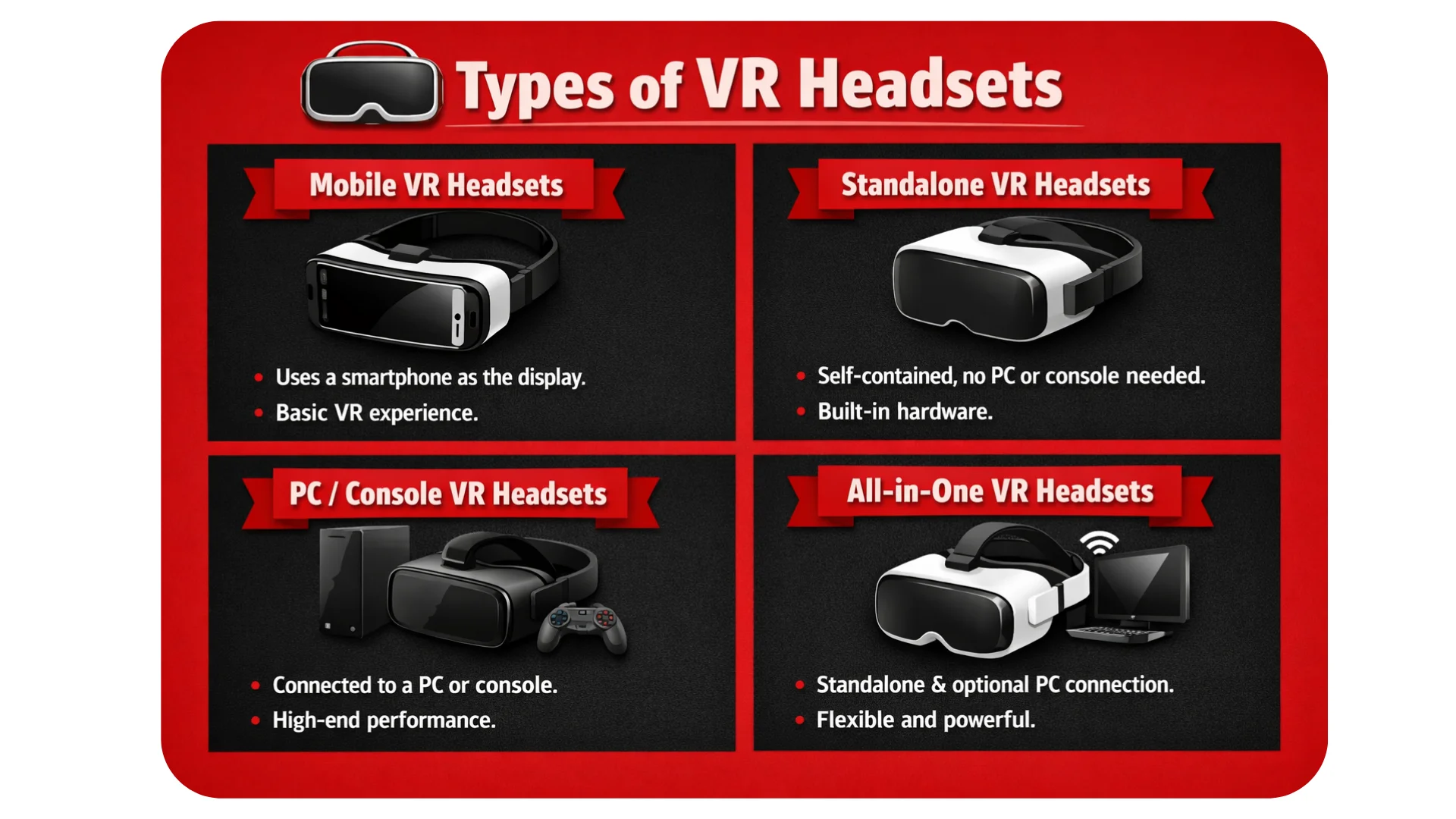
VR headsets that are currently used are of four main types.
Mobile VR Headsets
VR smartphones and tablets are turned into mobile VR headsets. The headset comprises a phone that is inserted into the headset, and the lenses generate a 3D view.
Such a type provides a simple virtual reality. It facilitates easier head tracking but mostly lacks sophisticated hand tracking. Due to the fact that it relies on the smartphone to process, performance is impaired.
Mobile VR had exposed a lot of the population to the concept of virtual reality, although it is less popular these days because it is not as immersive as more recent technologies.
Standalone VR Headsets
VR headsets do not need a phone, PC, or console. Every single piece of hardware is installed in the machine.
These are the processor, sensors, display, and tracking cameras, which are independent of each other. This enables users to boot the device and start using VR applications without the external connections.
Isolated VR headsets are popular since they combine the simplicity of use and high performance. They are usually applied in gaming, learning, and training.
PC / Console Connected VR Headsets
VR headsets that are connected to a PC or console depend on an external graphics processing system. The interconnected computer or console makes a virtual world, and the headset places it.
Such an arrangement gives an improved resolution of images and richer environments. It is most general and popular in professional simulation, advanced gaming, and development modules.
These systems are not as good as the first one because of the amount of space and hardware required to run them, and the strongest VR experience.
All-in-One VR Headsets
All-in-one VR headsets are designed to have remote connectivity, which is optional. On their own, they can be connected to a PC to add advantages to their performance.
This form provides flexibility. They can have wireless mobility and, at the same time, access higher performance when required.
How to Use a VR Headset?
Numerous individuals go online and seek advice on how to use a VR headset since they are in confusion where to begin. It is the process that is simple.
Starting with turning the device to full charge. Turn it on and proceed with the instructions on how to set it up in the form of the headset.
Then, fine-tune the straps so that the VR headset will be firmly and comfortably. When they are properly set in place, they will have clear visuals.
Then define a safe play area. In most systems, you are supposed to define boundaries to avert collisions.
Then, power up and connect the controllers (where they are provided). After being paired, choose a VR application in the menu inside the device and start.
To safely use a VR headset, one should take breaks and stop using it as soon as one feels uncomfortable.
With virtual reality, it will be easy to use. The view is altered immediately with a movement of the head. Interaction with digital objects is possible by hand movement. This is VR real-time tracking that makes it an immersive and effective one.
VR Apps
A VR headset is only helpful in the presence of VR apps. These applications develop the virtual world, regulate the interaction, and determine the experience.
VR apps are focused on immersive 3D spaces, unlike conventional mobile apps. They react to the movement of the head, tracking of hands, as well as the space.
Main Types of VR Apps
Gaming Apps: Such apps put users within interactive 3D worlds. Players are able to move, pick objects, and explore the environments characteristically.
Education Apps: Students are able to understand science models, historical places, or complicated machinery. A study conducted by PwC indicates that VR learners are quicker to be taught as opposed to learners in the classroom.
Training and Simulation Application: Application in medical, aviation, and industrial sectors. Skills are exercised by the professionals in safe virtual settings.
Fitness and Wellness Apps: These convert bodily movement into directive work-outs via motion sensors.
Social VR Apps: People get to know, cooperate; they hold events together in a common virtual space.
The majority of VR applications are made with the help of engines such as Unity or Unreal Engine that create 3D scenes and incorporate motion tracking systems.
Roomscale, Seated, and Standing VR
Experiences in virtual reality are modeled based on the physical space movement of the users. The immersion and comfort depend on the movement mode.
Roomscale VR
Roomscale VR permits users to walk within a specified range. The camera or sensor tracking of the VR headset follows the moves in the room.
Best for:
Interactive simulations
Exploration-based games
Training scenarios
This mode has the most physical immersion.
Standing VR
Standing VR leaves the user in a single position. The system follows the movements of the upper body and the head without movement.
Common uses:
Interactive games
Short simulations
Skill-based applications
It occupies a smaller area physically as compared to roomscale.
Seated VR
Seated VR is created in the form of an experience in which the user is seated.
Examples:
Driving simulators
Flight training
Story-driven experiences
This mode minimizes fatigue, and it is more comfortable during extended sessions.
The application of the appropriate mode enhances safety and minimizes motion discomfort.
Applications of Virtual Reality
There is much more than gaming through the use of Virtual Reality. It has now become a useful tool in any industry.
Education
Virtual laboratories and historical settings can be explored by the students. Immersive learning enhances the level of interaction and retention.
Healthcare
VR is employed in the simulation of surgeries, therapy, and rehabilitation. Research indicates that VR-based therapy has the potential to decrease the anxiety of a patient undergoing treatment.
Corporate Training
Employees rehearse real-world situations with impunity. The VR is utilized in manufacturing and aviation for safety simulations.
Real Estate and Architecture
Clients get their way through the digital models of the properties once they have been constructed. This enhances the accuracy of design and decision-making.
Military and Emergency Response
Simulation of high-risk situations occurs safely. The cost of training reduces, and the level of preparedness is enhanced.
Virtual Reality vs Augmented Reality
Virtual reality and augmented reality are commonly referred to as one, yet these two solutions operate in a very different manner.
Virtual Reality involves a complete digital world that is formed by VR goggles. About AR, it is an overlay of digital components and the real world, which can be done with the help of a smartphone or AR glasses.
This is a clear comparative analysis.
Virtual Reality, in other words, substitutes your environment in simplistic terms. They are augmented by Augmented Reality.
VR would be the better option if the aim is to be fully immersed. AR is more appropriate, in case the objective is the introduction of useful digital information to the actual world.
Benefits of Virtual Reality
VR has real applications that can be applied in any industry and measured. With the help of a VR headset, the user will enter the interactive 3D settings rather than just watching something on TV. This degree of immersion enhances attention, interest, and comprehension.
Key benefits include:
Immersive Learning
Students engage in learning rather than being spectators. According to research conducted by PwC, VR learners are capable of undertaking their training at a higher rate compared to classroom learners.
Safe Skill Practice
Simulation of great dangers, including surgery, aviation, and industrial activities, does not pose a danger to the real world.
Higher Engagement Levels
The immersive environments are more attentive to flat screens.
Better Knowledge Retention
An interactive alternative of 3D enables users to recall more information as opposed to non-interactive passive content (text and videos).
Remote Collaboration
The teams are able to gather and socialize within common virtual spaces, irrespective of the place.
Better Visualization
Large machinery, structures, or even the anatomy of the human body can be viewed in 3D.
These advantages are the reason why Virtual Reality usage is sustained in the scope of education, health, and business.
Challenges of Virtual Reality
Although VR has great strengths, it also has several weaknesses. Acquiring such challenges enables users and organizations to make the right decisions.
Common challenges include:
Motion Sickness
The users can get dizziness in case the refresh rates are low or the movement is not maximized.
Hardware Cost
VR headset systems of high performance, and particularly those that are connected to the PC, may be very expensive.
Space Requirements
Roomscale VR needs a sizeable room to maneuver.
Complexity of Content Development.
Developing good-quality VR applications would need an advanced level of design and programming skills in 3D.
Physical Fatigue
Long hours will result in eye-strain or bodily discomfort.
Nonetheless, the developments in display technology, accuracy of motion tracking, and processing capabilities are gradually making the VR experience more rewarding.
Conclusion
Now, what do you know about VR? Virtual reality refers to an immersive technology, which involves the use of a VR headset to place the users in interactive, 3D environments, in order to learn, train, game, and work. Since we have learnt what VR is and when it was first invented, to how VR headset systems can be used, it is evident that VR is coming out to become a potent tool in the various sectors. VR will keep on defining the way people consume digital content as people become increasingly adoptive and improved technologies enhance it.