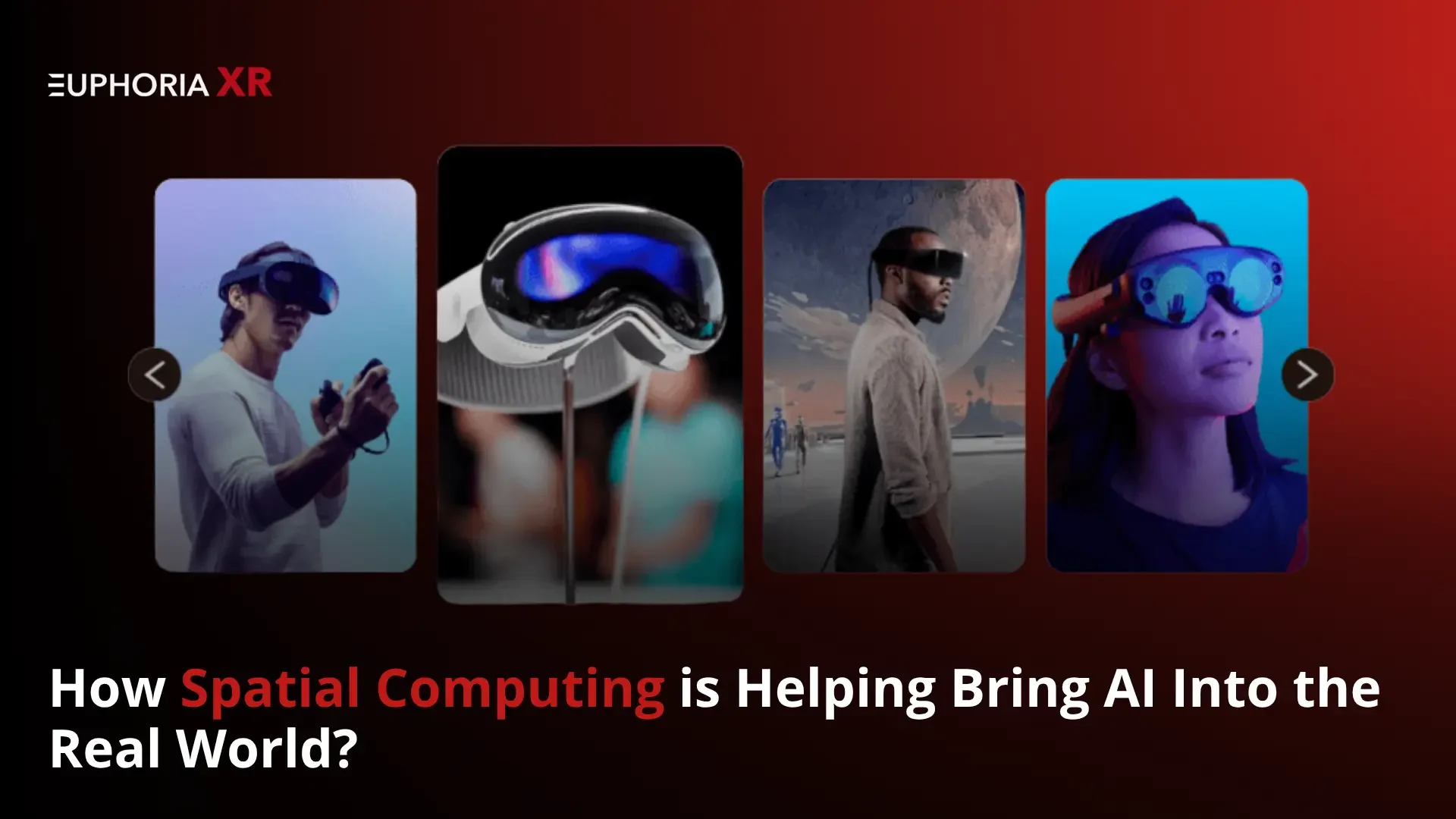


What would happen to computers that no longer live behind computer screens but live with us?
That change is already taking place. It is termed as spatial computing.
People do not tap on a phone, but can interact with digital content in real space. Before purchasing a chair, it should be seen in a room. A physician is able to view a 3D heart floating in front of him. A visual step-by-step can be used to fix machines by a worker.
This is not what the future is. It is currently occurring with gadgets such as the Apple Vision Pro.
Simply, spatial computing is the way AI leaves the screen for the real world.
What Is Spatial Computing?
Spatial Computing is a technology that enables computers to know how to interact and perceive the physical world in three dimensions. Digital content is no longer a screen-bound object but is manifested in the real world and reacts to movement, environment, and human action.
Simply put, traditional computing remains within a screen, whereas spatial computing takes digital experiences outside a screen.
Devices such as the Apple Vision Pro demonstrate how a spatial computer is a combination of digital and physical space in a seamless experience.
How Spatial Computing Works?
Spatial computing is a technology that involves the integration of a number of sophisticated technologies. They all assist the system to comprehend space and place digital material appropriately.
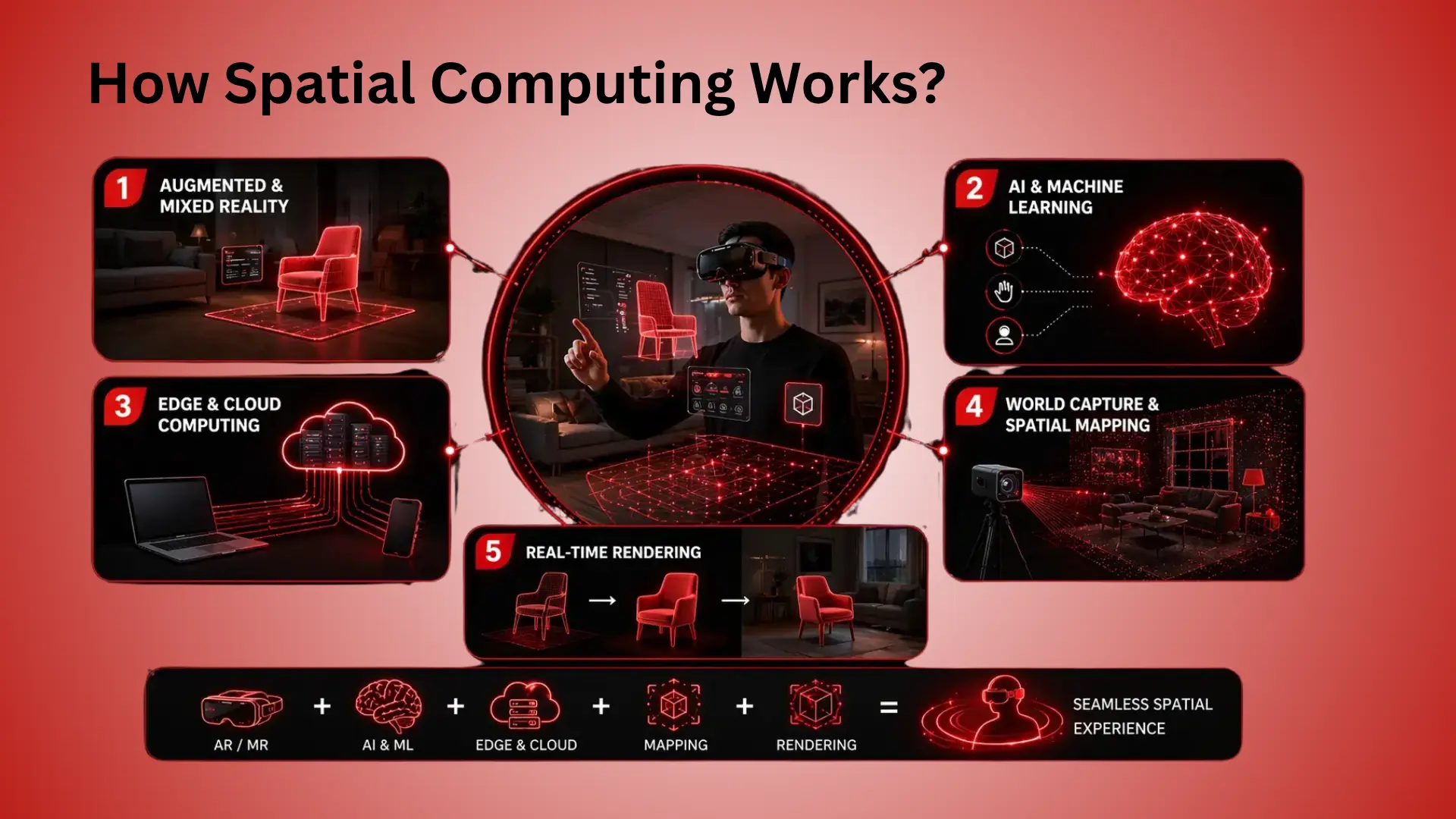
Augmented & Mixed Reality (AR/MR)
AR is the addition of digital objects to the physical environment.
Mixed Reality enables such objects to communicate with the actual environment.
An example is that a virtual object can remain in a room even when an individual is moving.
AI and Machine Learning
AI assists the system in gaining insights into what it sees.
It can:
Recognize objects
Track gestures
Predict user behavior
This renders interactions to be natural and smart.
Edge & Cloud Computing
The processing needed by spatial computing is fast.
Edge computing processes are performed on the machine itself to be fast.
Cloud computing is used to handle big data and intricate operations.
This combination guarantees the smooth performance.
World Capture & Spatial Mapping
Scanners and cameras scan the surroundings.
They draw a 3-dimensional map of the environment.
This enables the digital objects to remain in their actual positions.
Real-Time Rendering
Displaying content is an instant digital display.
Objects are in the right size, depth, and location.
They keep up with the user as he or she moves.
A combination of these technologies enables spatial computing to make the digital and the physical world one interactive experience.
Need to develop your spatial computing solution?
How Spatial Computing Brings AI Into the Real World?
Artificial intelligence is effective when it considers context. Spatial computing provides AI with the context of connecting it to the real world.
Through AI, it can now view, chart, and act upon actual surroundings as opposed to being screen-based.
What is different about spatial computing?
AI has awareness of environments in 3D space.
AI not only interacts with data, but also with physical objects.
AI offers on-the-fly instructions in tangible activities.
| Without Spatial Computing | With Spatial Computing |
|---|---|
|
AI gives text answers |
AI shows visual guidance in space |
|
Works on screens |
Works in real environments |
|
Limited interaction |
Full spatial interaction |
As an illustration, with the help of a spatial computer such as Apple Vision Pro, AI can project the instructions in front of a user as he or she works. This facilitates tasks, making them quicker, simpler, and more precise.
Key Benefits of Spatial Computing
Spatial computing is transforming the manner in which individuals work, learn, and engage with technology. It enhances efficiency and experience by taking the digital content to the real world.
Real-Time Collaboration
Even when separated by distance, teams can collaborate in the same virtual environment. They can see and work with 3D models simultaneously, and this enhances communication and lowers misunderstandings.
Enhanced Training
Education is more feasible and active.
Users do not have to read or watch, but they will be able to engage in real-life simulations.
Studies indicate that up to 75 percent of the learning can be retained with the help of immersive training.
Productivity
Employees perform better when they are given instructions using images that are in front of them.
This eliminates errors and accelerates the processes.
Customer Experience
Customers can interact with products before purchase.
They are able to visualize things within their own space, which creates a sense of trust and enhances decision-making.
Cost Reduction
Spatial computing assists businesses in saving money by:
Eliminating the physical prototyping.
Lowering training expenses
Minimizing operational errors
Sustainability
There is less environmental impact due to less physical production and less travelling.
Digital simulations substitute the real-world materials on numerous occasions.
Real-World Use Cases of Spatial Computing
The use of spatial computing in industries is already in use. It relates the digital intelligence and the physical world.
Gaming & Entertainment
Gaming has come off the screen.
The game players can move around, socialize, and live in the virtual worlds in their real environment.
Gadgets such as the Apple Vision Pro demonstrate how gaming can be more immersive in VR computing.
Education & Training
Experiences are part of the learning process of students and professionals.
Science virtual laboratories.
Flight and engineering simulations.
Risk-free skill-based training.
This enhances interpretations and interaction.
Healthcare
Spatial computing is utilized by healthcare professionals to achieve greater results.
The visualization of organs in 3D.
Surgical planning
Medical training simulations
This enhances precision and minimizes risks in the processes.
Architecture & Design
Designers will be able to view projects before construction.
They are able to navigate areas, make alterations in real-time, and deliver ideas to clients in a straightforward manner.
This minimizes mistakes and makes decisions quicker.
Industrial & Manufacturing
Spatial computing helps factories to be more efficient.
AR-based maintenance guidance
Monitoring digitally twinned.
Real-time performance tracking
This will save time and enhance operations.
Retail & Virtual Shopping
Shopping will be more interactive and personalized.
Customers can:
Install furnishings in their houses.
Try products virtually
Explore digital stores
This enhances confidence and lowers the returns of products.
Data Science & Spatial Analytics
Space visualization helps to comprehend complex data more easily.
Rather than flat charts, the information is presented in 3D spaces.
This helps in:
Identifying patterns faster
Making better decisions
Communicating insights clearly
Industries are not the only ones that are being enhanced by spatial computing. It is reinventing the way humanity uses technology in day-to-day life.
Related: https://euphoriaxr.com/apple-vision-pro-development-visual-innovation/
Top 10 Examples of Spatial Computing
Practical applications demonstrate links between spatial computing, AI, 3D worlds, and the real world. In every example here, a new direction of digital content leaving screens is emphasized.
Apple TV: Spatial Cinema
Apple has redefined the way content is consumed. The Apple Vision Pro enables users to have a big virtual screen anywhere in their space. The system varies in depth, lighting, and scale depending on the environment. This gives the effect of a cinema that seems to be in a real space as opposed to floating in a flat screen.
Meta Codec Avatars: Virtual Meetings
Meta is an AI-based company that develops realistic digital avatars. These avatars record the micro-expression, eye movement, and gestures in real time. This enables meetings to be more natural and human as opposed to the old-fashioned video call. Spatial positioning also enhances more natural conversations since participants seem to be in real space.
Apple Mindfulness: Immersive Meditation
Meditating with the Apple Vision Pro makes it immersive. Users are put in environments that are well-crafted, like serene scenery or quiet areas. These environments react to breathing and concentration implicitly. This minimizes distractions and enables users to remain engaged longer as compared to regular app-based meditation.
Treeview: Digital Twins
Treeview Studio creates digital twins, real-time 3D limits of the actual environment. Such models are applicable in industries to monitor systems, analyze performance, and simulate changes. Businesses can engage with an active spatial model that depicts real-life conditions, as opposed to using fixed data.
Microsoft 365 Suite: Productivity
Microsoft is expanding productivity solutions into the spatial world. The users have the ability to lay out documents, dashboards, and applications around them rather than piling them on one screen. This minimizes context switching and enables one to be more focused. Spatial layouts also assist users in recalling the location of information, and they enhance efficiency in workflow.
Formula 1: Industrial Design
Spatial computing is applied in Formula 1 to do quick design and testing. Engineers can visualize components of cars in full-size, examine them from any angle, and make changes on the spot. This will save the use of physical prototypes and time taken in development processes, which is vital in high-performance settings.
Treeview: Cultural Storytelling
Spatial environments are used at Treeview Studio to show cultural and historical information. Users are not required to read or watch; they can enter into the recreated scenes. This establishes a stronger association with the content as the users get to experience stories more interactively and engagingly.
IKEA Place: Home Design
IKEA Place enables the user to furnish his or her own space with AR. Objects are displayed in the correct size and position, which helps the users of the room to know how the objects fit within the room. This minimizes the uncertainty and enhances purchase decision-making by presenting an image of reality before purchase.
US Army: Integrated Visual Augmentation System
The IVAS system is an integrated system of spatial computing with real-time data overlays. The navigation routes, identification of objects, and data of the missions are displayed in the field of view of soldiers. This enhances knowledge and decision-making in complex situations where speed in decisions is important.
Mercedes-Benz: Remote Assist
Spatial computing is employed by Mercedes-Benz to assist technicians remotely. The same environment can be seen by experts as the technician and visual instructions directly drawn on the components. This makes it unnecessary to have physical supervision and more accurate in resolving issues.
Top Spatial Computing Companies
These companies are at the forefront of creating and adopting spatial computing technologies in industries.
Apple
One of the leaders of spatial computing is Apple, through its products such as the Apple Vision Pro. It is concerned with the integration of digital content into the real world in a seamless manner to bring spatial computing nearer to consumers.
Meta
Meta is promoting virtual presence and communication. It specializes in creating immersive, social, and collaborative spaces in which individuals can engage in digital spaces in a natural manner.
Microsoft
Microsoft incorporates spatial computing in business applications. Its solutions are based on productivity, collaboration, and industrial uses, particularly in mixed reality environments.
Google makes its contributions in the form of spatial mapping, augmented reality platforms, and AI systems. Its technologies are used in navigation, real-world overlays, and location experiences.
NVIDIA
NVIDIA offers the computing capabilities that are needed in spatial computing. Its artificial intelligence (AI) and graphics processing units (GPUs) allow real-time content, simulation, and sophisticated data analysis.
Unity
Unity Technologies allows developers to create spatial computing apps. It aids in the development of game, training, simulation, and enterprise solutions.
These industries and companies demonstrate how spatial computing is already being used in industries. It does not pertain to a single sector. It is influencing the way individuals deal with technology both in personal life and in the workplace.
Spatial Computing vs Related Technologies
Spatial computing can be mixed up with other technologies. Although they are interrelated, they have different purposes. The differences will help to understand the location of spatial computing and its significance.
Spatial Computing vs VR Computing
Significant Difference: Real-world integration and fully virtual environments.
| Feature | Spatial Computing | VR Computing |
|---|---|---|
|
Environment |
Real + digital |
Fully virtual |
|
Interaction |
With real surroundings |
Only inside the virtual world |
|
Use Case |
Work, design, real tasks |
Gaming, simulations |
|
Devices |
Apple Vision Pro |
VR headsets |
Spatial computing integrates digital content in the real world.
VR computing substitutes the actual world with a virtual one.
Spatial Computing vs IoT
Important Difference: Space understanding vs connecting devices.
| Feature | Spatial Computing | IoT |
|---|---|---|
|
Focus |
Environment awareness |
Device connectivity |
|
Function |
Maps and interacts with space |
Shares data between devices |
|
Example |
AR navigation overlay |
Smart home devices
|
IoT is used to connect things such as sensors and appliances.
That data is used to comprehend and engage with the environment using spatial computing.
Spatial Computing vs Edge Computing
Important Difference: Experience layer vs processing layer.
| Feature | Spatial Computing | Edge Computing |
|---|---|---|
|
Role |
User interaction in space |
Fast local data processing |
|
Function |
Displays and interacts with 3D content |
Reduces latency |
|
Dependency |
Uses edge for speed |
Supports spatial systems |
One of the supporting technologies is edge computing.
The experience over it is called spatial computing.
Spatial Twin vs Digital Twin
Differentiating feature: Static simulation and interactive spatial experience.
| Feature | Spatial Twin | Digital Twin |
|---|---|---|
|
Interaction |
Real-time and immersive |
Data-driven model |
|
Experience |
Can be explored in 3D space |
Viewed on dashboards |
|
Use Case |
Training, simulations, AR |
Monitoring systems |
A digital twin is an object model of a physical object or system.
Spatial twin brings about interaction, visualization, and context.
These comparisons indicate that spatial computing is not taking the place of these technologies. It is integrating and stretching them to make them more interactive, intelligent, and more real-world.
What Can Spatial Computing Do?
Spatial computing transforms digital systems into objects in the real world. It links AI, data, and physical environments to enhance the process of work performance.
Seamless Integrations
Spatial computing is related to the current systems, such as IoT, ERP, and cloud systems.
Machine, sensor, and application data can be visualized in the environment. This eliminates the possibility of having to alternate tools.
Performance Management
Visual dashboards located physically can be used by teams to monitor systems in real-time.
Users do not need to read reports, but can view performance metrics superimposed on real equipment or environments.
Spatial Understanding
Objects, spaces, and movement can be identified by the systems.
This will enable AI to assist users, identify problems, and react according to the real-world context, and not merely the inputs of the data.
Optimize Operations
The work processes are quicker and more precise.
Picture instructions lower the error rate among human beings.
Maintenance, inspection, and assembly are some of the tasks that are made simpler to conduct.
Industrial Metaverse
The possibility of virtual replicas of real operations is made possible by spatial computing.
The teams can work as a team, simulate processes, test changes, and apply them to the real world.
This will minimize risk and enhance decision-making.
How to Get Started with Spatial Computing?
One does not need to have advanced expertise to start getting a lot of expertise. The sequential method is most suitable.
Experience Spatial Computing
Experiment with devices and applications with AR or VR.
Apple products such as the Apple Vision Pro are useful in learning the spatial environment’s workings.
Learn Tools (Unity, Unreal, WebXR)
Begin with popular development environments:
Unity
Unreal Engine
WebXR
These are used in the creation and testing of spatial applications.
Explore Careers
Typical positions in this area are:
Spatial computing developer
Spatial solutions architect
XR designer
3D visualization specialist
The demand is increasing with the adoption of this technology by more industries.
Earn Certifications
Credibility is developed with online courses and certifications.
It is possible to learn AR, VR, AI, and develop 3D, which can give an opportunity in the field of spatial computing.
Collaborate with EuphoriaXR to develop spatial experiences that are immersive based on AI and motivate actual business effects.
Spatial Computing Challenges
Spatial computing has a number of challenges despite its potential.
High cost of hardware and devices
Due to scanning the environment all the time, privacy is an issue.
Big data processing needs.
Poor battery life and performance.
Decreased uptake within the traditional industries.
These difficulties are being overcome with the advancement of technology.
Future of Spatial Computing
The use of spatial computing is likely to become an essential component of the technology.
Key trends include:
Expansion of spatial computing businesses and ecosystems.
Further use of spatial computers, such as the Apple Vision Pro.
Combination with AI and robotics.
Growth of the industrial metaverse.
Creation of a three-dimensional version of the internet.
The future of AR and VR indicates that the market will grow to more than 100 billion dollars by the year 2030, meaning that the market has a high potential to grow.
Wrapping Up
Spatial computing is taking technology out of screens and into the real world. It is a mixture of AI, 3D surroundings, and real-time communication to make it more intuitive and efficient.
Its influence is already being felt in terms of enhancing productivity to revolutionizing industries. Spatial computing will keep on influencing the daily life of people in their work, learning, and dealing with digital systems, as the tools will become more accessible.