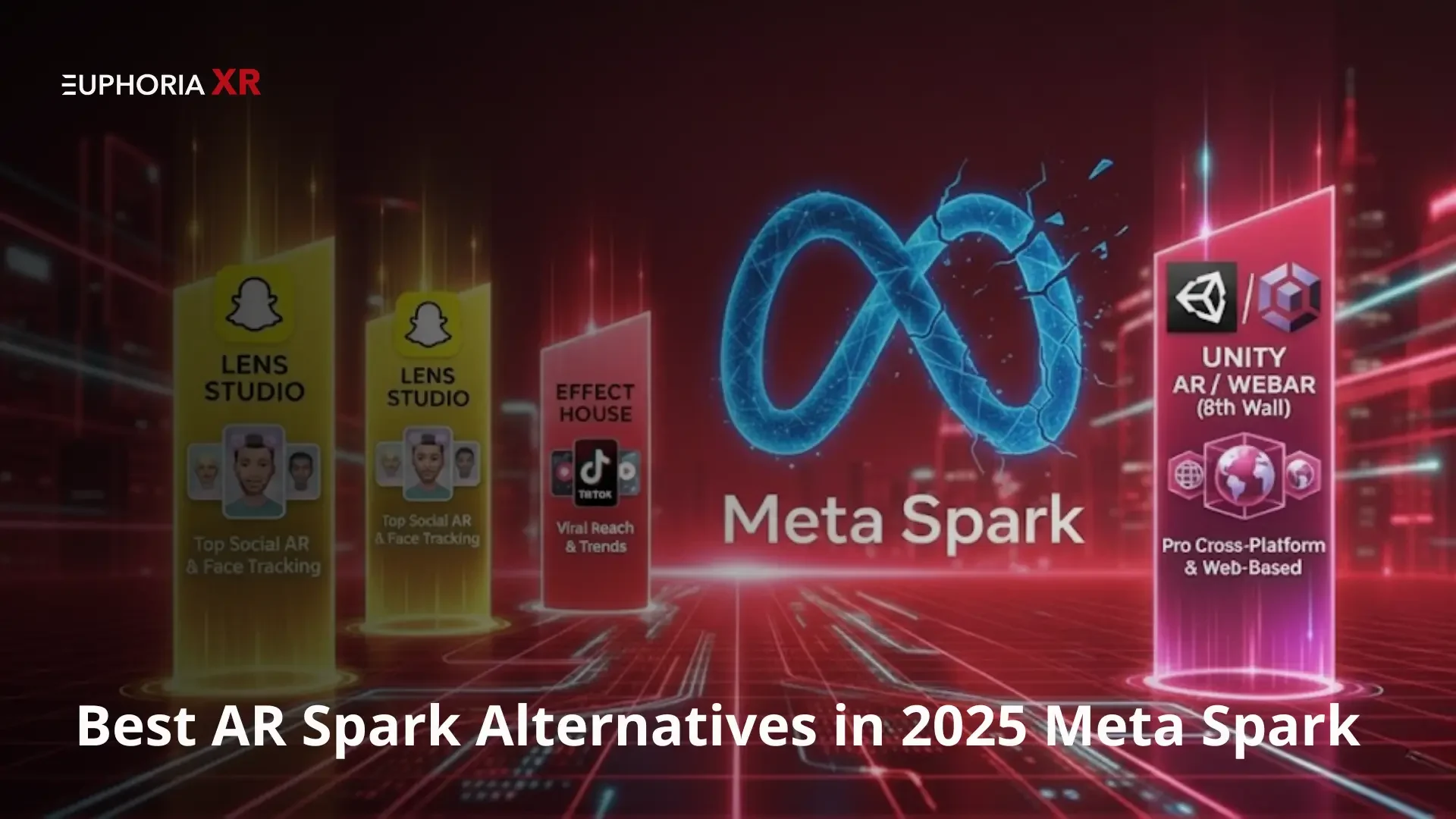


Have you noticed on Instagram Stories that you opened it recently and your favorite AR filters are missing?
It is the confused state of the thousands of creators who will be left behind after Meta closes down Spark AR in January 2025.
Spark AR was not an instrument but rather a blend of imagination as a technology.
Counting millions of augmented reality experiences on Facebook and Instagram that were built with Spark AR, non-profits shared their stories through filters in viral campaigns by brands running Spark AR.
However, with the move by Meta to retire Spark AR, there is a massive question mark in the sky:
Which way forward on AR creators and marketers?
We will dive deeper into the reasons Spark AR fired, how this affects the creators, and the most important part, why you still preserve your AR experiences by maximizing the best Spark AR alternatives in 2025.
What Was Spark AR?
The Spark AR creative studio was the augmented reality tool created by Meta that enabled anyone, including small artists and big brands, to create filters, effects, and immersive camera experiences on Facebook and Instagram.
You didn’t need to be a coder. The drag-and-drop interface allowed it to be easy to make an interactive AR effect that responded to face, gesture, or the surroundings.
Fun fact:
By 2023, one million six hundred and twenty-five creators of AR in 190 countries had published effects through the publication using Spark AR. Meta itself claimed that more than 600 million users are related to Spark AR effects each month.
That’s huge.
Thus, the news about the shutdown shocked the AR creator world.
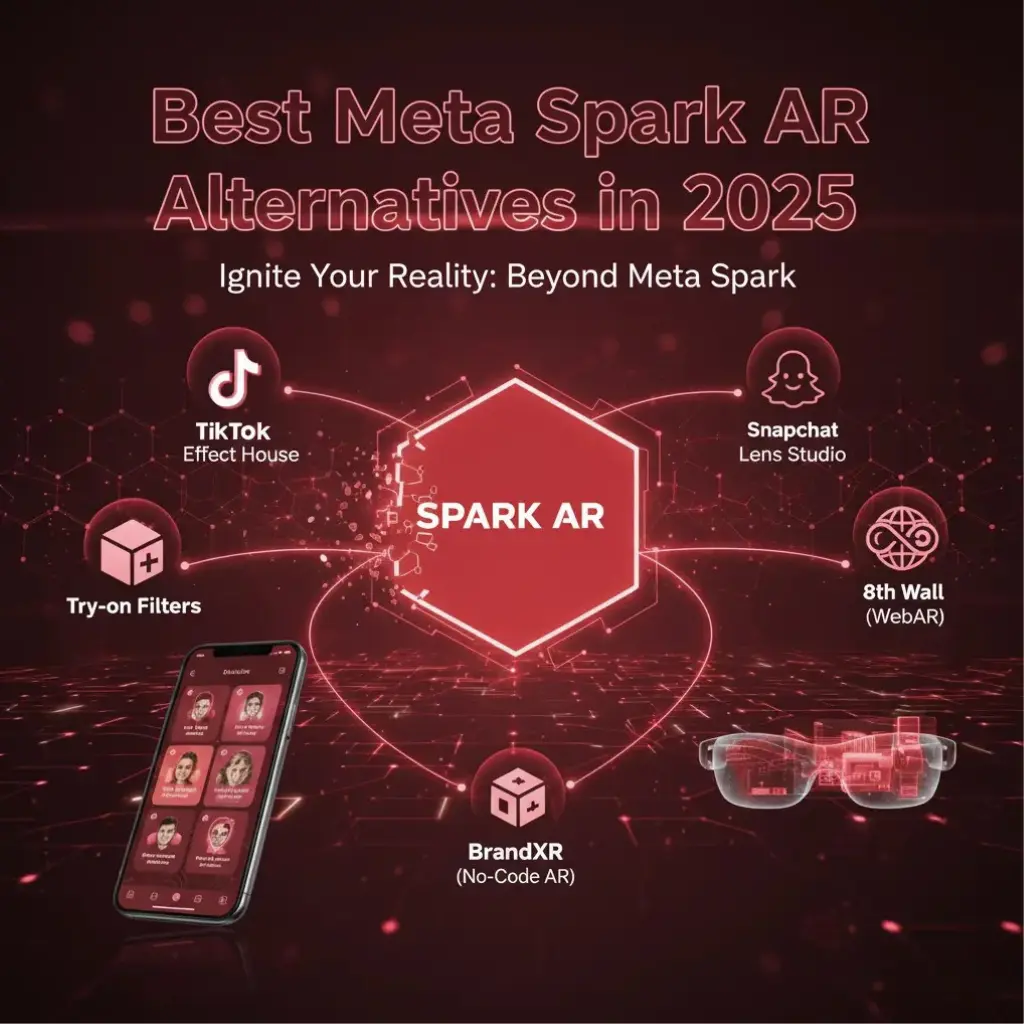
The Best Spark AR Alternatives in 2025
With the announcement of the closure of Spark AR by Meta, creators started searching for new methods to create interactive filters and effects.

The following platforms have been determined to be the best Spark AR alternatives in 2025 to enable brands and educators, as well as developers preserve their AR experiences.
TikTok Effect House
TikTok Effect House is now emerging as one of the most valuable AR creators globally.
It allows you to create interactive effects and filters with the power to make it go viral across millions of TikTok videos in a few hours.
Why TikTok Effect House Stands Out?
It provides creators with trend insights, a simplified interface, and immediate visibility on TikTok. Since TikTok is a platform for short-form content that people can share, your AR filters will have an opportunity to circulate spontaneously through user adoption and challenges.
Pros
Huge worldwide views and built-in virality.
Low-level and easy-to-use AR creation tools.
Effect performance tracking analytics dashboard.
Cons
Restricted in the sphere of TikTok.
Minor influence on the campaigns or brand integrations that happen over time.
Case Study: Bomb Pop: Exploding Awareness on TikTok
Bomb Pop released an AR filter on TikTok in an explosion-flavored color, which allowed users to capture summery videos. The campaign achieved 8 million+ views in the 1st week, and the consumer brand jumped by 32 percentage points.
Snapchat Lens Studio
Snapchat Lens Studio is also one of the richest and most creator-friendly AR platforms that is easily provided.
It allows brands and developers to create immersive 2D, 3D, and real-world AR experiences that have precision tracking and face mapping.
Why Snapchat Lens Studio Stands Out?
AR lens became popular on most social platforms later than on Snapchat. It utilizes the product try-on, gamified advertisements, and storytelling filters to design that allow brands to create interactive content via its depth tracking and segmentation tools.
Pros
Snapchat has a user base of more than 6 billion lens plays in a day.
Supports AR ecommerce and location experiences.
Healthy community and government partnerships.
Cons
Needs to be more technical to use advanced effects.
The filters are operating mostly in the ecosystem of Snapchat.
Case Study: Ounass Ramadan Campaign
Ounass, a luxury retailer, created a lens in Snapchat Lens Studio by realizing an Arabic-based lighting lantern and a Ramadan-specific lens. It had 18 percent more engagement and was one of the shared AR campaigns regionally.
BrandXR
BrandXR is an AR solution that was created to be completely no-code: an interactive experience would be as easy to create as building a PowerPoint. It is created in such a way that it is accessible to marketers, teachers, and organizations that would like to create professional AR experiences without having to learn how to code.
Why BrandXR Stands Out?
BrandXR is positioning itself on accessibility. One can create AR effects, put objects together with the drag-and-drop tool, use a template to create a training or event, and receive real-time performance data without writing a single line of code.
Pros
Zero-code AR developer suitable with zero-technical customers.
Live interaction and data analytics.
Retail, education, and events templates.
Cons
Fewer programming capabilities.
Low social AR platforms integration.
Case Study: No-Code AR for Education & Retail
BrandXR was used by a U.S. university in the creation of a virtual campus tour that reduced the time required to respond to inquiries by 40%.
Likewise, one of the retail brands implemented an AR pop-up to improve in-store interaction and appeal to the younger audiences.
8th Wall (WebAR)
WebAR is pioneered by 8th Wall, in which AR experiences can be viewed via a browser, no longer necessitating the download of an app. It is perfect where the brands and agencies are required to have a cross-platform outreach and not be limited to a platform.
Why 8th Wall Stands Out?
The 8th wall offers unparalleled flexibility to the developers. It also supports custom code written using JavaScript; it combines with 3D libraries such as Three.js, and is compatible with any modern browser, mobile, or desktop.
Pros
It is compatible with multiple devices and browsers.
Extra preference to anticipate distinctive brand experiences.
Comes with major 3D and animation software.
Cons
Technical or developer support is required.
Commercial projects require a paid license.
Case Study: AR Studio Web Campaign Results
Through 8th Wall, a fashion brand launched a WebAR campaign of try before you buy. The result? An increase in conversions of 22 percent and a longer engagement time of 15 percent on the filters in comparison with their former Spark AR filters.
Onirix Studio: Best for Location-Based AR)
Onirix Studio is a cross-platform AR platform that allows artists and brands to develop marker, location, and surface experiences with AR without using a social media platform.
Why Onirix Studio Stands Out?
It provides powerful solutions to geolocation AR, QR-triggered scenes, and 3D experiences with dynamic predecessors. Good in education, tourism, visualization of products, as well as interactive storytelling.
Pros
Powerful location-based AR
Easy-to-use interface
Perfect museums, tours, and training.
Cons
Inapplicable to the viral social filters.
Poor face starving capabilities.
Vossle: Best Instant WebAR for Creators and Brands
Vossle is an online AR application that is employed to develop app-minus filters of AR, try-on, and 3D modeling of products. It is among the most robust Spark AR replacements for brands that desire immediate access to AR with a link or QR code.
Why Vossle Stands Out?
It allows creators to publish AR experiences in a case in seconds without coding or installing an app, and it is very accessible to the global audience.
Pros
No app required
Fast publishing
Preferably to brand activations and try-ons.
Cons
Limited visual scripting
Unsuitable for complicated AR games.
Zoho Lens: Best for AR Remote Assistance
Zoho Lens is an AR remote assistance solution based on AR mechanisms designed to be used in technical, enterprise, and field service applications.
Why Zoho Lens Stands Out?
It can be used by remote specialists who want to see, comment, and assist in live working conditions. It fits the organizations that embrace AR as a means, as opposed to social impacts.
Pros
Great for enterprise use
Real-time annotation
Easy remote collaboration
Cons
Not constructed social AR filters.
Limited creative features
Face AR SDK by Banuba: Best for Face Tracking & Beauty Filters
Face AR SDK by Banuba is a high-performance face filter, beauty effects, avatar, and real-time facial animation SDK.
Why Face AR SDK Stands Out?
It offers the best in the industry face tracking and beautification, so it will fit best in apps, beauty brands, and custom camera products, just like the creators did with Spark AR.
Pros
Exceptional face tracking
Works on mobile and web
Customizable for apps
Cons
Needs a developer to be integrated.
More technical than Spark AR
JigSpace: Best for 3D Product Demos & Presentations
JigSpace is a 3D presentation and AR visualization that a brand can use to develop an interactive product demo, training, and technical explanation.
Why JigSpace Stands Out?
It makes the complicated 3D storytelling process simpler by enabling users to describe products or processes in the AR through a step-by-step guide that is presented visually.
Pros
Strictly speaking, 3D storytelling is extremely easy.
Visuals AR of excellent quality.
Excellent at product demonstrations and training.
Cons
Not for social face filters
There is a deprivation of the facial/body tracking.
Hololink: Best for Interactive QR-Based AR Experiences
Hololink is a no-code AR creation platform with QR-based interactive AR content, particularly in education, print media, and museums.
Why Hololink Stands Out?
It assists in transforming printed material into interactive AR stories, perfect for instructional content, campaigns, and exhibitions.
Pros
No code needed
Superior to teachers and museums.
QR-based accessibility
Cons
Not built for social filters
Limited advanced scripting
echo3D: Best for 3D + Cloud-Based AR Infrastructure
Echo3D is an asset management and 3D delivery platform used by AR VR developers.
Why echo3D Stands Out?
It enables developers to post, optimize, and serve 3D models in AR experiences, and the outcome minimizes build time and maximizes the performance of assets, essential to sophisticated WebAR campaigns.
Pros
Strong 3D asset pipeline
Cloud delivery
Compaq to WebAR engines.
Cons
Not a standalone AR builder
Requires technical setup
BUNDLAR: Best for Enterprise Training AR
BUNDLAR is a company-oriented AR, which is aimed at training, onboard, and interactive learning modules.
Why BUNDLAR Stands Out?
It is no-code-based, which includes LMS extensions and makes it perfect for corporations that choose to adopt AR as an internal process instead of a social network.
Pros
No code
Training-focused
LMS integrations
Cons
No longer an influencer or social AR.
Poor entertainment capabilities.
TINT Virtual Try-On Platform: Best for Brands and E-commerce Try-Ons
TINT is an AR try-on that is designed to support beauty, fashion, and eyewear brands.
Why TINT Stands Out?
It also mimics popular beauty and cosmetic try-on filters made by Spark AR and can be a strong competitor among the brands that used to use Instagram filters successfully.
Pros
Accurate try-on systems
Ideal for beauty and fashion
Works on web and apps
Cons
Not for entertainment AR
Requires brand integration
Magic Mirror: Best for Retail Try-On Experiences
Magic mirror allows having AR in-store experiences of try-on, where the customer can view accessories, makeup, or clothing in real-time.
Why Magic Mirror Stands Out?
The retailers do not have to rely on Instagram or TikTok to use AR, and this is ideal in physical stores that are embracing immersive technology.
Pros
Excellent as an experiential retail.
Real-time try-ons
High engagement
Cons
Hardware-based
Not a creator platform
TeamViewer Frontline: Best for Industrial and Field AR
TeamViewer Frontline is an AR system designed without any hands-free controls and produced to cater to the field service, manufacturing, and inspections of logistics inspections.
Why TeamViewer Frontline stands out?
It enables smart glasses and mobile AR, meaning that a worker can adhere to the digital workflow, be guided through AR, and work with supervisors.
Pros
Enterprise-grade
Smart glasses support
Strong workflow builder
Cons
No replacement of the Spark filter is needed.
Higher enterprise cost
Floori: Best for Home and Interior AR Visualization
Floori provides AR visualization of the flooring and interior design that provides users with an opportunity to test materials in real-life settings.
Why Floori Stands Out?
It works best with home improvement brands, real estate experiences that require straightforward and precise AR positioning.
Pros
Simple AR visualization
Very convenient for interior designers.
Easy to use
Cons
Niche-specific
Inappropriate with face filters.
Gemini (Google): Emerging AI-Driven AR Support
The next-generation AI belonging to Google is called Gemini, which is still starting to support early AR processes, such as scene understanding, creation of 3D objects, and multimodal AR guidance, but is not a direct AR creation tool like Spark AR.
Why Gemini Stands Out?
The AI services in Gemini enable creators to simplify their AR content creation through 3D content generation, scene understanding, and future integrations of AR into Android, Lens, and immersive Google products.
Pros
3D generation and scene generation with the help of AI.
Close alignment with the Google ecosystem.
Best in future AR innovation.
Cons
Not a standalone AR builder
No social AR publishing
The company is still in the early stages of AR adoption.
Cloudinary 3D: Best for Asset Management + AR Optimization
Cloudinary 3D functionality assists in handling and optimizing 3D, AR, VR, and WebAR.
Why It Stands Out?
It simplifies performance and loading of assets, required when running AR on a large scale.
Pros
Great 3D optimization
Integrates with WebAR
Scalable
Cons
Not a creator tool
Needs technical integration.
Thridify: Best for Fast 3D → AR Conversion
Thridify is a 3D-to-AR lightweight of 3D models that is available as a real-time preview on websites.
Why Thridify Stands Out?
It is very quick and assists brands in displaying products in AR without intensive development.
Pros
Fast 3D → AR pipeline
Web-friendly
Great for eCommerce
Cons
Limited customization
No AR creation tools
Shopware AR Extensions: Best for E-commerce AR
The Shopware AR Extensions help e-commerce brands to create product previews of their products in AR and directly pin them to the online store pages, where a consumer can see them in real space and decide what to buy without the need to visit a physical store.
Why Shopware AR Extensions stand out?
They allow for integrating AR seamlessly into e-commerce processes without the need to develop them; it appears that AR shopping can be accessible to medium and large online stores.
Pros
AR integration with e-commerce can be easily done.
Enhances visualization of the product.
Develops 3D and AR-enabled product holdings.
Cons
Only the Shopware platform.
Not because of the face filters or social AR.
Requires quality 3D models
Maintastic / FactoryTalk View: Best for Industrial AR Visualizations
Maintastic and FactoryTalk View are maintenance-oriented industrial AR visualization systems to be used in maintenance, equipment surveillance, digital twins, and plant operations.
Why They Stand Out?
They will give AR-driven insights to industrial teams and map directions and machine data and workflow over the equipment straight onto the equipment, which is great during manufacturing, utility, and plant work.
Pros
Excellent for industrial AR
Facilitates the visualization of workflow.
Combines with business equipment data.
Cons
Unsuitable for social or marketing AR.
Needs enterprise implementation.
More complex to set up