












A Proof of Concept provides answers to one question.
Can this be built?
A Prototype answers another.
What will it look like?
The most crucial question is answered through an MVP.
Do people want this?
This explains why the serious startups transition to MVP as soon as possible.
An MVP is the only thing that gives actual data, actual feedback, and actual guidance over growth.
Why Startups Must Build an MVP First?
The failure of most startups is due to the creation of the wrong product.
This is averted through an MVP, which compels premature learning.
It substitutes speculations with facts.
The MVP is the safest step in MVP building and development.
Validate Product–Market Fit
Product-market fit refers to individuals having an actual desire for the solution.
In its absence, the attempts at growth become futile.
CB Insights research indicates that out of the startups, more than 35 percent fail because of the absence of a market need.
An MVP can be used to validate the demand early because:
Exposing the product to the actual users.
Monitoring the behavior of the users, not their words.
Finding out the value-added and non-value-added.
Such feedback enables teams to scale down to avert failure.
Reduce Development Costs
The development of a complete product without testing is dangerous and costly.
According to the research conducted by IBM, it is possible that it may cost 100 times more to fix the problems post-launch rather than pre-launch.
The cost of an MVP builder and development paradigm is reduced by:
Reducing capabilities to a minimum.
Elimination of unnecessary engineering work.
Eliminating rewrites in the future.
Money is only spent where learning occurs.
Attract Early Investors
Investors seek evidence, not ideas.
A working MVP shows:
Execution capability
User interest
Early traction or learning
First Round Capital claims that startups that have accomplished MVPs are much more likely to raise early money than late-stage startups.
A pitch is transformed into evidence by an MVP.
Build Relationships With Early Adopters
Early adopters are not users.
They help shape the product.
They are open and candid.
They usually turn out to be long-time supporters.
An MVP allows startups to:
Early start relationships with users.
Gain trust by trial and error.
Establish development feedback.
This is the key to a good MVP builder and developer.
Types of MVPs for a 100-Day Build
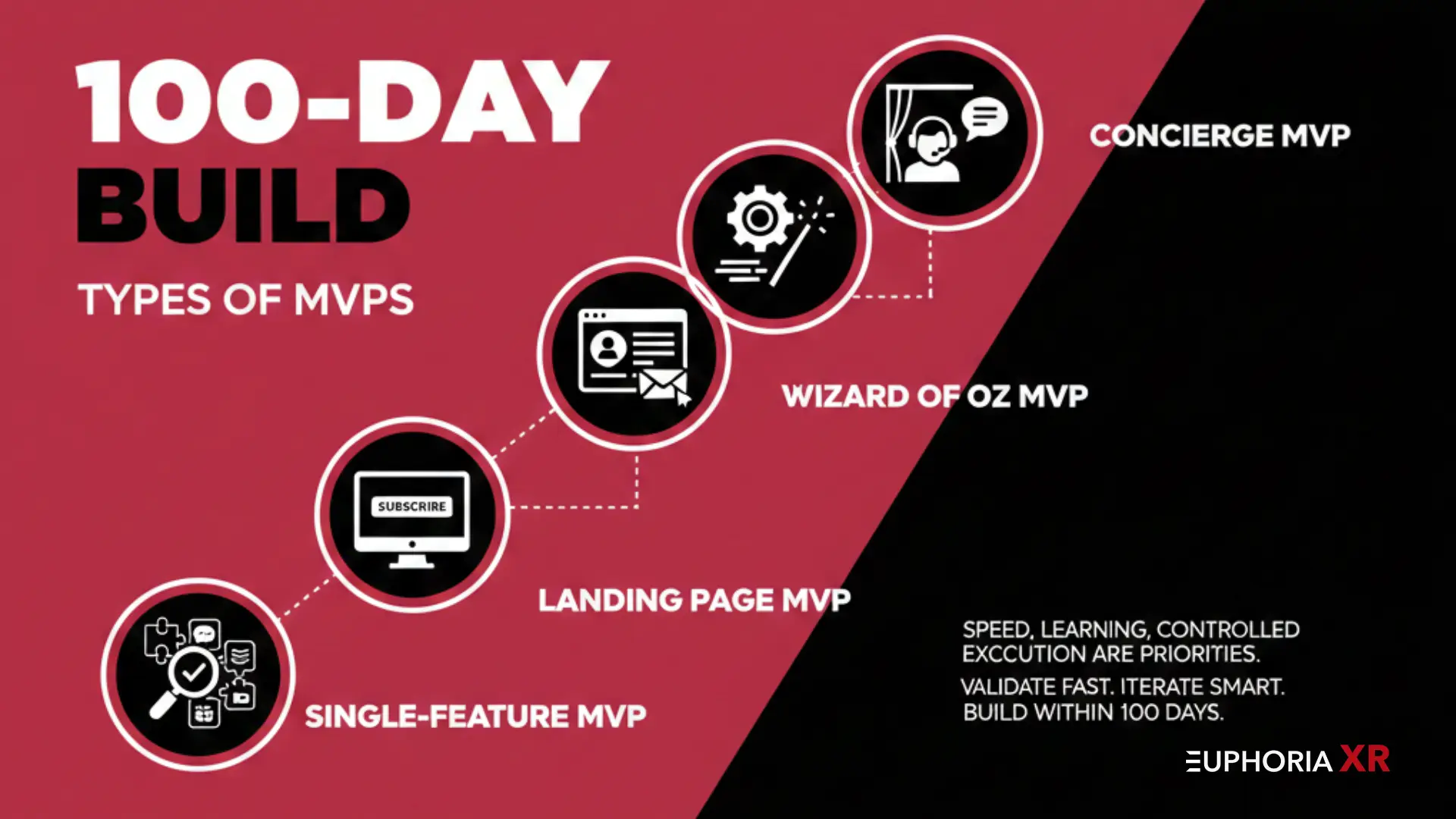
Startups do not require the same kind of MVP. The correct decision will be based on the issue, the market, and the speed at which validation is required. In a 100-day MVP builder-development schedule, speed, learning, and controlled execution are the priorities. The best types of MVPs that are effective at this time are showcased below.
Concierge MVP
A Concierge MVP is a software-free service provider. People work behind the scene and the service is provided to the users as though it were assembled completely. This model is perfect when dealing with service-based concepts in which the way the users behave is of more importance than computerization. It enables the startups to test the demand and optimize the workflow without spending time on sophisticated development. Concierge MVPs are a good idea in MVP builder and development because they entail deep insights at a low technical risk.
Wizard of Oz MVP
A Wizard of Oz MVP may seem automated to the users, whereas processes are done manually in the background. The product is complete and functional to the user. The technique comes in handy where automation is costly or difficult to execute. It assists a startup in seeing actual user behavior prior to investing in the engineering process. In a 100-day build, this technique helps to validate in a short time and contain costs on development.
Landing Page MVP
The MVP of a Landing Page puts the interest before the product is constructed. A user has a clear message regarding the issue and resolution, followed by a simple act like subscription or seeking access. The answer will indicate the demand. The reason why this kind of MVP is frequently employed at the early stages of MVP building and development is that it does not allow teams to create products that do not appeal to anyone.
Single-Feature MVP
Single-feature MVP is about a single primary feature that is the solution to a particular problem. All other things are carefully shunned. In the context of 100 days MVP builder and development strategy, this method yields wonders, since there is no room to go out of scope and every comment or agenda is well-defined. ProductPlan research indicates that products that have focused MVPs are launched more quickly and offer more actionable insights than feature-heavy products.
Piecemeal MVP
A Piecemeal MVP takes existing tools and services and is not a process of creating analogous systems. Various platforms are interlinked to provide the experience that users require. This strategy greatly saves on the build time and cost. Piecemeal MVPs come in particularly handy in MVP builder and development when speed to market is more significant than having custom infrastructure.
The selection of an appropriate type of MVP can help to build it within 100 days. It makes sure that learning occurs at a young age and resources are used judiciously.
How to Build an MVP in 100 Days: Builder & Development Process
Developing an MVP within 100 days is workable when it is structured.
Each phase has a clear goal.
Every step is based on the one that precedes it.
This is a risk reduction, maximum learning, MVP builder, and development process.
Phase 1: Strategy & Validation (Days 1–20)
Direction is determined at this stage.
Mistakes here cause months, which will be wasted in the future.
Step 1: Define the Problem and Target User
Relevant solutions in every successful MVP begin with one problem and one user.
This step aims to respond to three questions:
Who is the user?
What problem are they facing?
Why is such an issue hurtful enough to resolve?
Research published by Harvard Business Review indicates that startups that state the user problem clearly at an early stage have far better chances of attaining product-market fit.
In building and developing an MVP, such a step helps avoid redundant features and complications in the future.
Step 2: Market Research and Opportunity Sizing
After the issue is identified, the market has to be secured.
This includes:
Talking to potential users
Studying competitors
Knowledge of the availability of alternatives.
The opportunity sizing will make the MVP realistic and focused:
TAM is the cumulative market.
SAM depicts the accessible market.
SOM is the actual short-term share.
This measure will keep the MVP scope at par with the actual requirement.
Phase 2: Scope & Experience Design (Days 21–40)
The stage determines what will be constructed and what will not.
Step 3: Map the User Journey
The user journey illustrates the process a user passes through in order to arrive at an outcome.
Only the essential journey is the one that counts in a 100-day MVP:
How does the user start?
What action do they take?
What outcome do they receive?
These studies have demonstrated that simpler journeys result in increased completion rates and increased initial engagement via Google UX.
Step 4: Feature Prioritization (MoSCoW Method)
Not all ideas fit in the MVP.
The MoSCoW technique assists the teams in getting focused:
Core journey is supported by the must-have features.
Should contain added value features, but not essential.
Directed such features on post-validation.
Externalities will not have features that are not intentional.
The majority of unsuccessful MVPs occur because this step is overlooked by the team.
Step 5: Choose the Right Tech Stack
Technological decisions ought to assist in rapidity and ease.
At this stage, teams decide:
Whether there are sufficient code tools.
Need to develop custom or not.
Ease of making changes once they are launched.
The MVP builder and application development strategy are very adaptable, with high priorities for complexity.
Phase 3: MVP Builder & Development Execution (Days 41–80)
This stage makes planning a working product.
Step 6: UX/UI Design and Prototyping
Design focuses on clarity.
Good MVP design:
Uses simple layouts
Makes actions obvious
The visual elements are avoided unnecessarily.
It can be tested using prototypes by teams to determine the usability. According to the research of Nielsen Norman Group, most of the experience issues can be avoided at an early stage through usability testing.
Step 7: Agile Development and Testing
The development is cyclic.
This includes:
Small feature releases
Continuous testing
Regular feedback reviews
According to IBM research, it is much more cost-effective to fix any issue earlier in its development process than to fix it after its release. The agile approaches allow the identification of issues at the initial stages.
Phase 4: Launch, Learn, and Decide (Days 81–100)
This stage is used to test the MVP on authentic users.
Step 8: Soft Launch (Beta Release)
MVP is also deployed among a small group.
A soft launch helps teams:
Observe real user behavior
Collect honest feedback
Fix critical issues quickly
The learning, rather than scaling, is involved in this phase
Step 9: Measure MVP Success
Success is not a matter of opinions or behavior.
Some of the critical MVP metrics are:
User activation
Retention over time
Accomplishment of the main action.
Engagement frequency
Information at this level informs all the decisions to be made in the future.
Step 10: Pivot, Persevere, or Scale
The last one is a decision point.
Based on data, teams choose to:
Fade out in case of no value among the users.
Continue fighting when the engagement is going in the right direction.
Scale in case demand is high and steady.
This choice will be the shift of MVP builder and development into full product growth.
This organized 100-day process helps the teams stay on track, minimize waste, and eliminate assumptions with evidence. That is what the creation of an MVP is all about.
Real-World MVP Builder Examples
Real-life illustrations assist founders in the practical perspective of how MVP builders and development are carried out. These products were not designed with all the features. They were created to justify demand, experiment with behavior, and learn quickly.
Endorsa: SaaS MVP
Endorsa was initially concentrated on a single problem: SaaS MVP. Companies had difficulty gathering and repurposing customer testimonials.
The MVP did not aim at creating the entire marketing solution. Gathering and presenting social evidence in an easy-to-use format.
The MVP builder and development strategy was based on three principles:
One target user segment
One main workflow
One measurable outcome
With a targeted MVP, Endorsa could quickly check the demand and get proper feedback as well as improve the product according to the usage rates, rather than guessing about the preferences. This minimized the risk of development and informed future development.
High Clean Pro: Vertical SaaS MVP
High Clean Pro is a vertical SaaS MVP that is designed to support the laundromat companies. The issue was inefficiency of operations. The owners were having difficulties with scheduling, coordination of the customers, and primitive administration.
As opposed to creating the multi-faceted system, the MVP was concerned with finding a solution to a single operational bottleneck. This was to enable the delivery of the product in a short time and test it on real business.
The MVP strategy and the development strategy are highlighted:
Workflow is uniquely defined by the industry.
User-friendly, non-technical interfaces.
Fast onboarding
Since the MVP is one that addressed a real and imperative problem, it acquired paying users early on. This confirmed the idea behind the product and also confirmed niche focus without having to scale further.
How Much Does MVP Builder & Development Cost in 2026?
The cost of developing MVPs will be based on scope, complexity, and technology options. No specific price, but research results of industry platforms such as Clutch and GoodFirms offer apparent ranges.
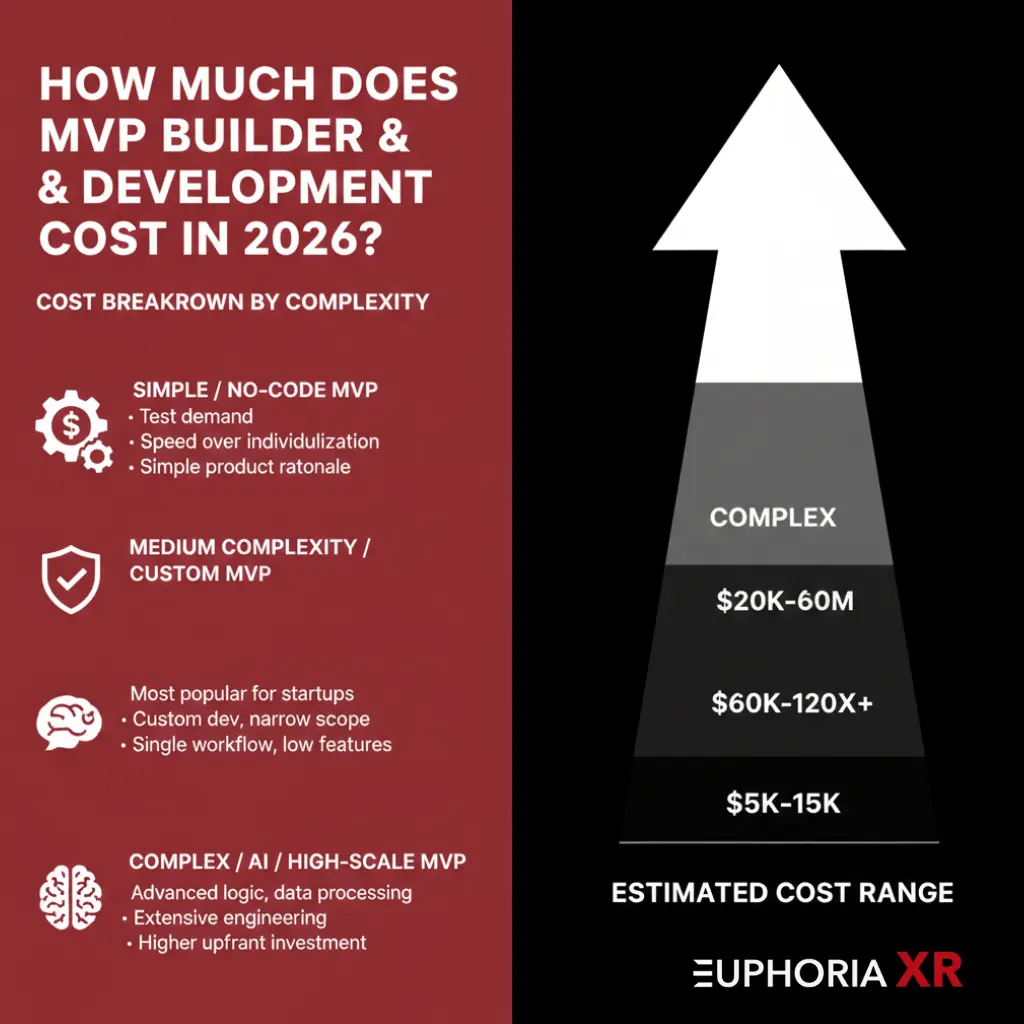
The most important thing is not the amount of money that is spent, but how efficiently the money spent is contributing to the learning process.