Think of training 1,000 people without really having to write a course?
Sounds impossible?
Using generative AI for workforce training, this is not merely achievable, but it already transforms the way companies approach the education and empowerment of their employees. There are no more one-size-fits-all training manuals, time-consuming content developers, and months of instructional design.
In the modern environment, leading organizations are making use of AI-powered systems that create, adjust, and customize learning programs on a large scale, based on the importance of the firm, the level of the employee, and individual learning styles. You might be a fast-growing startup or an established enterprise, but either way, generative AI is assisting teams to train faster, smarter, and more cost-efficiently to date.
The guide details all you should know and can about employing generative AI to train your workforce: use cases, advantages, problems, tools, and the future.
The Role of Generative AI in Workforce Training Programs
Generative AI models are transforming the environment of workforce training by having capabilities of creating, modifying, and producing specialised content with minimal intervention. Since onboarding to compliance, AI systems are now capable of creating modules, reacting to learner input immediately, and suggesting the next course of action depending on the performance. Concisely, generative AI in workforce training is not an instructor aid tool; it is increasingly becoming one of the creators of learning experiences that constantly are moving as your employees progress.
Key Benefits of Generative AI for Workforce Training and Development
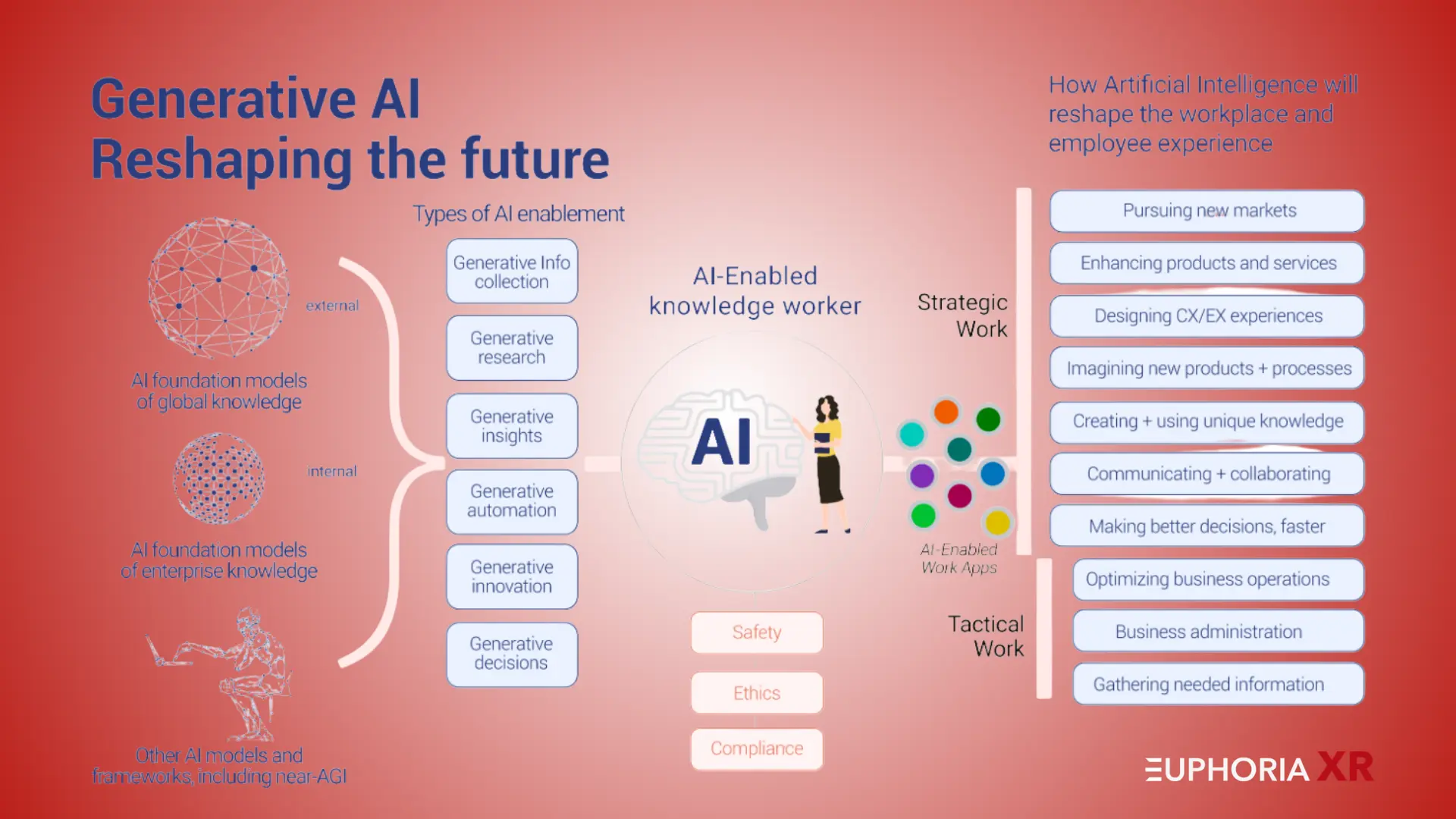
There are a handful of strategic benefits related to the implementation of generative AI in workforce development. It facilitates the creation and production of content, customization of learning paths, modeling real-life, improved use of multimedia and multi-sensory activities, and lowers training expenses. Moreover, AI enables creating live data in order to allow the employer to trace skills progress and anticipate their future learning demands. Such advantages render generative AI in training the workforce an industry changer.
Accelerating Workforce Training with AI-Generated Content
Designing training materials is an activity that requires time, effort, and specialized skill. Generative AI such as ChatGPT, Jasper, and Synthesia can create learning modules, scripts, presentations, and assessments at the touch of a button (or a few minutes). Firms are registering as much as a 60% decrease in the time spent on course formation with AI. The pace enables organizations to respond to changes in real-time, including new compliance requirements or updated SOPs.
Personalized Learning Paths Using Generative AI
Not every employee learn in the same manner. Generative AI allows learning experiences that are genuinely personalised, so the content naturally varies depending on things like job role, level of skills, metrics on performance, and even the way they learn best. As an example, a quick learner can be pushed using the curriculum, but another employee can be provided with more simulations or summations. This scale is one of the largest factors that make organizations resort to workforce training through generative AI.
Simulated Environments Powered by Generative AI
Hands-on skills that require simulations to learn are vital, but they are usually costly to construct. Generative AI is able to design immersive scenario-based simulated experiences based on a combination of natural language, imagery, and predictive reasoning. Consider customer service job functions, crisis management, or technical troubleshooting, which are all enabled with the help of AI-based scripts and decision trees. The simulations are used to put the employees in situations on how to handle things which close to what they expect to face in the real world in a risk-free manner, which can be repeated.
Boosting Engagement Through AI-Generated Multimedia
Traditional learning and training may not be successful since it is tedious. Generative AI tools make content active by making videos interactive, adding voice, personal messages, quiz questions, and visual stories. Such tools as Synthesia can even create talking avatars using a custom script. It is a more active and longer-lasting experience that improves participation and memory, as well as hybrid and offshore workforces.
Cost-Effective Workforce Training with Generative AI
The cost of hiring instructional designers, videographers, and e-learning experts might be high. Generative AI will minimize the number of L&D personnel required since it can take care of most of the content generation. Deloitte predicted that by adopting generative AI, organizations can reduce training costs up to 50 percent with impressive learner satisfaction rates. To the startups and SMBs, this translates to a high level of training at an SMB cost.
Real-Time Training Insights and Analytics via AI
Generative AI not only provides content, but it monitors the interaction with it as well. It has in-built tracking, so that companies can gain an insight into which modules are working, where employees are weak, and where the subject matter should be enhanced. Even skill gaps or the threat of workforce turnover can be identified in advance using predictive analytics. This is a feedback loop in real time that allows HR and L&D departments to make smarter, faster decisions when it comes to employee development.
Suggested: https://euphoriaxr.com/generative-ai-in-healthcare/
Use Cases of Generative AI for Workforce Training Across Sectors
It is not limited to tech giants or Fortune 500 companies anymore. The current data indicate that today, startups, governments, and non-profits are implementing generative AI in workforce training to develop faster, smarter, and more individualized training programs.
It doesn’t matter whether you need to train or develop frontline staff, remote teams, or upskill job seekers; there is a use case of GenAI that will fit the scenario. Now, let us look at the various industries taking advantage of this type of technology:
Corporate Workforce Training with Generative AI
GenAI is assisting enterprises in making employee training very efficient and adaptive. It is changing everything, including onboarding and sales enablement.
Major applications include:
AI-based Onboarding Robots: Welcoming new employees through welcome paths, company spirit, and compliance training.
Dynamic Learning Paths: The ability to automatically adjust the content based on the role, progress along the path, and performance.
Sales, Soft Skills Simulations: Creating roleplay scenarios in the areas of cold-calling, conflict management, and negotiations.
Compliance & Certification Automation: The immediate creation of tests, micro-lessons, and recertification processes.
Organizations such as PwC, IBM, and Accenture are second-to-none, stating quicker time-to-competency and increased engagement among employees.
Public Sector Adoption of Generative AI for Upskilling
Industrial sectors in which many industrial workers lost jobs due to automation, such as manufacturing and customer service, are increasingly pressuring government agencies to reskill employees who have lost jobs. It has been scaling this challenge with the help of generative AI.
The notable use cases are:
AI-Based Training Portals: Public servants are issued with personal learning packages, which are dependent on their position and department.
Cybersecurity and Digital Literacy: Cyber regulations often change; when that happens, AI produces training compositions in real-time and locally.
Multilingual Delivery: Delivery systems can translate and localize lessons with their generative tools to aid various workforces.
States such as Singapore, Germany, and Canada are already launching pilot programs to develop workforce modernization with the help of AI.
Generative AI Tools for Jobseekers and HR Teams
Generative AI is also opening up new lines of personal career growth, particularly to people who have less access to coaching or professional aid.
For job seekers:
Generation of resumes and cover letters: Such tools as Rezi or Kickresume allow users to create focused applications with the help of AI prompts.
Interview Simulators: Websites offer tailor-made mock interviews related to job positions and specific industries.
Upskilling Recommendations: AI proposes courses or micro-certifications to complete tutored to particular employment objectives.
For HR & Talent Teams:
Mapping Skills: An AI application identifies internal movement opportunities to match them with employee skills.
Candidate Training: Onboarding kits are created automatically to make new hires ramp up more quickly.
Bias-Reduced Screening: AI facilitates the use of more accessible and unbiased candidate assessment.
These are not time-saving tools, but they allow securing a more equal, open, and efficient workforce development.
Case Studies: Successful Implementations of Generative AI in Workforce Training
Now it is time to look at how actual companies are already winning with generative AI:
Walmart’s application of VR and generative AI to test-drive real-world retail settings saves 30 percent of on-floor training time.
Deloitte implemented an in-house AI chatbot to offer learning on complicated consulting, which leads to more client preparedness on projects.
LinkedIn Learning uses AI to deliver learning paths to the learner using artificial intelligence by examining their preferences and experience to achieve higher certification and engagement rates.
Coursera applied the use of integrated generative AI as a means of automatically creating questions in quizzes, localizing course material, and on-demand learner feedback
The examples here demonstrate that generative AI training of the workforce is not an experimental program, but in actual practice, it is already generating quantitative returns on investments, interaction, and performance.
Startup Strategies to Leverage Generative AI for Workforce Training
You do not have to have a huge budget or an internal AI team to start with. Generation AI to train the workforce can be applied by startups in flexible, cost-saving manners and produce actual impact even during the initial stages.
This is what the startups can do:
Partnering with Institutions to Build AI-Powered Training
Collaborate with:
The alliances may help to speed up the trust, the quality of content, and innovation without overwhelming the internal groups.
Scalable Pilots and Low-Barrier AI Integrations
Start small. Prove ROI by using low-risk experiments to scale:
Use AI technology such as ChatGPT, Synthesia, or Docebo in a single department (e.g, onboarding or sales enablement).
Measure KPIs such as rates of completion, feedback, and retention of knowledge.
Prove it, roll out throughout the company with numbers to back up the investment.
Recruiting for New Generative AI Roles in Workforce Development
It is not only about using the tools but also about talent to work with them. The startups ought to think of employing or training their team members in other occupations related to AI, which include:
Prompt Engineers: Develop the correct instructions to lead GenAI systems.
AI Fluent Learning Designers: Combined with curriculum design.
The AI Product Analysts: Assess the performance of the tools and the interaction with the users.
These roles help to create the middle point between technology and human-centered learning.
Ensuring Responsible and Inclusive AI Training Solutions
In building, think beyond performance. Ethically and inclusion-based use of AI:
Train auditors on the content of their audit work-up in order to be bias-free by training with different sets of data and test groups.
Data privacy and compliance with third-party AIs ensure you can be compliant with GDPR, SOC 2, and so on.
An output should be in multiple languages and accessibility-friendly to serve a diverse team.
Ethical implementation of generative AI in workforce training promotes reputation and does not put us at risk.
Emerging Job Roles Driven by Generative AI in Workforce Training
The way we train is changing due to the introduction of AI, and new job roles are also being created in the domains of HR, L&D, and IT departments. These are critical roles toward executing, maneuvering, and streamlining AI-based training systems.
Prompt Engineers and AI Trainers
Prompt Engineers are individuals who are trained to write accurate prompts and command sets that can be applied to generative applications such as ChatGPT and Claude.
AI Trainers assist in customizing large language models (LLMs) with company-specific data so that the training can be domain-specific.
Such specialists will make sure that AI output is precise, situational, and business-oriented.
Digital Twin Specialists and AI Product Managers
Digital Twin Experts develop a virtual reproduction of jobs or equipment, or even whole facilities, to be used in simulation, training.
The difference is that AI Product Managers are at the helm of AI-enabled learning platform strategy, design, and roll-out in organizations.
They are the designers and custodians of the AI learning experience.
Data Curators and Learning Experience Designers
The Data Curators clean out, organize, and structure the training datasets that are input into the AI models.
AI-Powered LX Designers are re-experiencing the learners’ experience and the combination of classic education and smart content production.
These functions guarantee that the quality of content, engagement of learners, and analytics remain excellent.
Tips for Startups Embracing Generative AI for Workforce Training Success
Laying out and incorporating AI may seem too big of a task, especially as a startup. You do not require a complete technology team to initiate generative AI in workforce training. The thing is that you should have a smart and focused attitude
The best thing startups can do with this opportunity is to do the following:
Begin with Low-Risk, High-Impact Areas
Apply microlearning, onboarding, or compliance training with AI to allow you to see repetitive content and easily track metrics.
Make use of AI Tools that are Easy to Learn
AI-based platforms, such as ChatGPT, Jasper, Synthesia, and Canva Magic Write, are supposed to assist you in generating exciting content even when you lack technical expertise.
Train AI Certainty Among Your Team
Show a team demo. Demonstrate the way AI is a timesaver and not a job killer. Prioritize the combination of human work and AI, rather than removing people.
Put Human Review Processes In Place
Do not just publish AI-generated content. Make a subject matter expert review and approve.
Track What Matters
Follow-up involvement, learning retention, and feedback of learners. When scaling up or down, allow data to make that decision.
Be Agile, Iterate
AI evolves quickly. Test, learn fast, and change your game plan when tools progress.
Challenges in Implementing Generative AI for Workforce Training in Startups
Though the prospects of using generative AI in training the workforce are promising, adopting it as a startup has its share of obstacles, too.
Integration Barriers and Technical Hurdles
More often than not, startups operate with a minimal workforce and limited infrastructure. One of the biggest challenges can be the use of generative AI tools with an existing learning management system (LMS) or HR tech stack.
Source of common problems:
The incompatibility of AI tools with the existing platforms
Out of APIs or autoscale integration support
Financial shortage to organize a safe deployment or data processing
Data protection and, in particular, third-party AI services
Pro tip: Low-code/no-code even beginner tools (e.g., ChatGPT, Synthesia, Notion AI) and piloting-based pilots first, and then integrate more.
Workforce AI Talent Shortages and Training Gaps
Because generative AI is still nascent, the roles and competencies needed to steer it effectively are also evolving for the time being. Most startups are lacking internal experts in:
Such a talent shortfall may impede adoption and, at worst, produce substandard training content.
Impact:
Misuse of the tools concerned
Reduced participation from learners
Challenges to scaling out of the initial pilot phase
Tips:
Ethical issues to be considered in AI-based training material
Generative AI can generate material in a flash, yet it often lacks the same responsibility.
Ethical Considerations in AI-Based Training Content
The emergence of biased or otherwise unsuitable training materials is owing to inaccurate AI training data.
The overuse of AI results without human supervision
Ownership Confusion of AI-generated materials
Transparency issues regarding content creation and updating
As you diversify your workforce, it is even more important to ensure that each candidate is treated fairly and the issues of cultural sensitivity are considered.
Future Trends in Generative AI for Workforce Training
The following generation of innovations will bring generative AI as a tool to train the workforce way past the simple creation of content. Now, here is a glimpse of what is going on next:
Hyper-Personalized Employee Training at Scale
It will not take long before AI can provide custom learning interventions to each of the employees, using behavior, goals, learning style, and past performance. Just imagine a training system that adapts itself each day to the manner each learner is progressing.
Generative AI-Powered Virtual Coaches and Chatbots
There will be AI-driven chatbots that not only answer questions but also coach workers as real coaches. This kind of bot is able to monitor progress, be encouraging, and give just-in-time nudges to learning based on an interaction and based on gaps concerning skills.
AI-Generated Immersive Learning and Simulations
Virtual reality (VR) and augmented reality (AR) based simulations of real-life training experiences will be far more frequently driven by generative AI. Consider customer service via role plays, equipment tours, or leadership training in a fully immersive 3D environment built guessing you mostly by AI.
Blockchain and Micro-Credentials in AI Workforce Training
With learning becoming personalized by AI, micro-credentials built on a blockchain will provide a method of validating the acquisition of skills. Workers will be able to construct portable, verifiable records of learning which is independent of any company.
Inclusive and Multilingual Training Using Generative AI
Language barriers are ending. Generative AI has made it possible to translate and localize training content to the point of reading it in real time, and this means that it does not matter where employees are based or in which language they speak and read; they can all have the same impactful learning experience.
Predictive Analytics for Future Skill Needs
AI will not only monitor what the employees are learning but will also be able to forecast what they are likely to learn in the future. Understanding these insights will enable the L&D teams to act in advance to solve future skill gaps and inform long-term workforce planning.