














AR is not experimental anymore. AR is influencing consumer devices, enterprise systems, retail, health, and scale in spatial computing in 2025. This section contains the most current news on Augmented Reality, the main trends, significant updates, and key announcements from 2025, all in one place.
Augmented Reality Hardware News (2025)
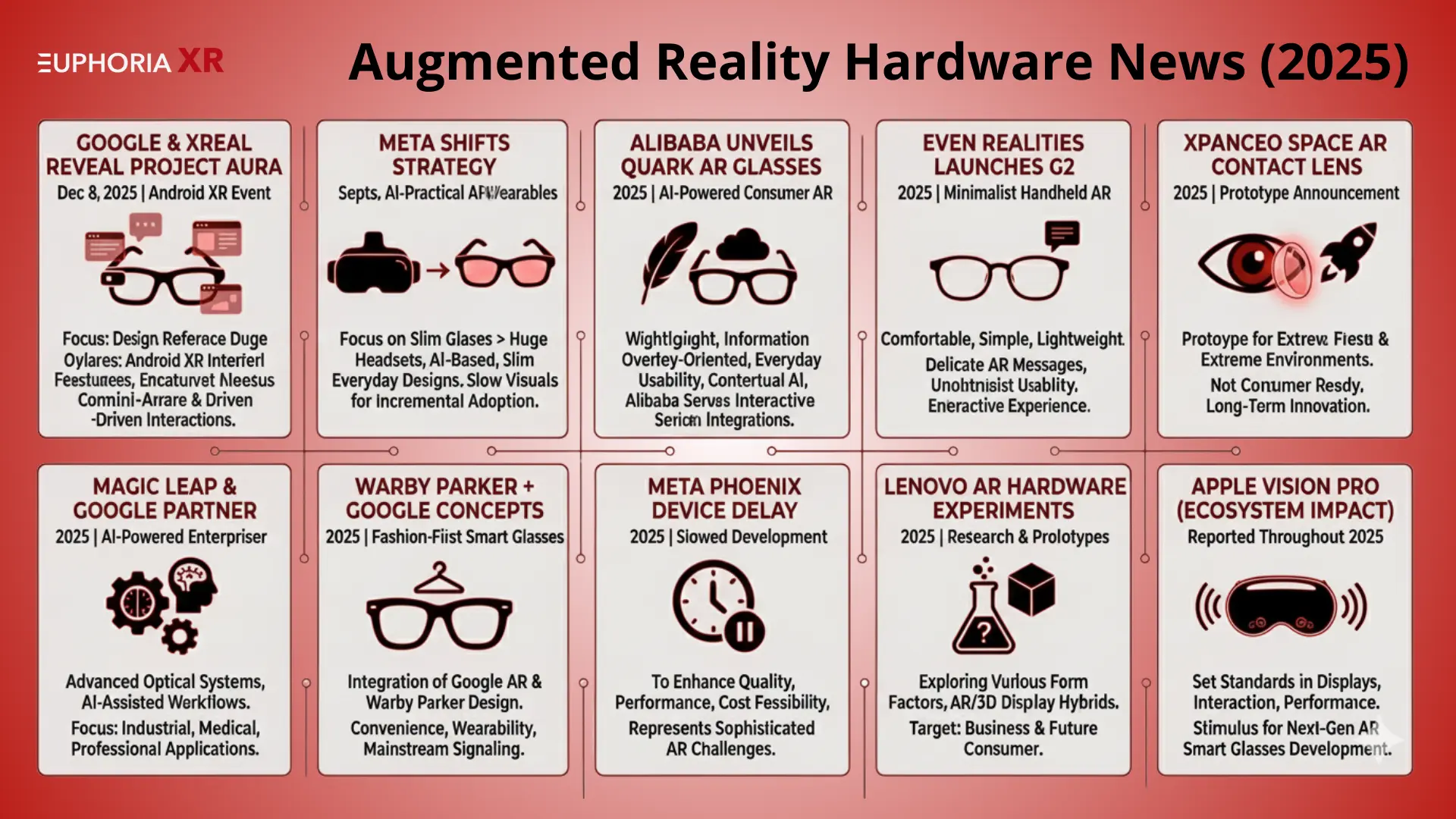
Google & XREAL Reveal Project Aura AR Smart Glasses
Announcing Date / Demo: December 8, 2025.
On December 8, 2025, at an Android XR special event hosted by Google in collaboration with XREAL, Project Aura was announced. Project Aura came out as a reference smart glasses product, which aimed to demonstrate how lightweight augmented reality glasses can be made to work on the Android XR platform.
The reveal demonstrated:
Android glasses have an interface called Android XR.
Floating virtual displays
Context-aware overlays
Human-assisted interactions with the help of AI that is driven by Gemini.
Upon uncovering the news, Google made it clear that Project Aura is not a commercial product. Rather, it is a developer/hardware-partner reference design, with consumer AR glasses planned to succeed in 2026.
Meta Shifts Strategy Toward Practical AR Wearables
Strategy Shift Committed: September 2025.
In September 2025, Meta indicated its strategic pivot to the younger and more utilitarian AR wearables publicly. This guidance was conveyed through product briefings of Meta 2025 and Founding, devoted to Meta continued in 2025 during the 2025 Meta Connect product briefing.
The new shift of strategy focuses on:
Smart glasses instead of huge headsets.
Artificial intelligence-based wearables.
Slim designs that can be used in everyday life.
Using slow presentations of visuals.
Meta realized that the adoption of full AR glasses was going to be incremental, and such advanced visions as immunoblotting should be practiced before an impressive scale of use.
Alibaba Unveils Quark AR Glasses
In 2025, Alibaba announced its Quark AR Glasses as one of its wider efforts to enter consumer hardware powered by AI. The launch made the glasses weightless, information overlay-oriented AR devices that used AI support.
The Quark AR Glasses feature:
Everyday usability
Contextual information that is driven by AI.
Connections with the digital services of Alibaba.
Though Alibaba did not present the exact consumer release date, the 2025 release proves the willingness of the company to venture into the AR wearable arena.
Even Realities Launches G2 Smart Glasses
As early as 2025, Even Realities released the G2 Smart Glasses, an AR wearable, a minimalistic handheld device that can be used every day. The G2 Smart Glasses are comfortable and simple, instead of immersive.
The launch highlighted:
Lightweight design, day-to-day design.
Delicate AR messages and text messages.
Unobtrusive interactive experience.
A larger industry trend of 2025 is in the direction of practical consumer AR glasses, as seen in the G2 launch.
XPANCEO Introduces Space-Focused AR Contact Lens
Prototype Announcement: 2025
In 2025, XPANCEO launched its prototype AR contact lens, which is related to space. The announcement presented a future-facing AR form factor that was to be used by astronauts and extreme environments.
Highlights that were heard during the announcement:
The lens is under research and development.
It is neither a consumer-ready product.
It symbolizes long-term AR innovation out of glasses.
The 2025 disclosure makes XPANCEO a leader in the development of experimental AR hardware.
Magic Leap and Google Partner on AI-Powered AR Glasses
In the year 2025, Magic Leap and Google made their announcement of working on AI-powered AR without leaving out enterprise-based augmented reality solutions.
The partnership centers on:
Advanced optical systems
AI-assisted workflows
The industrial, medical, and professional AR applications.
This 2025 declaration gave more strength to the ongoing relevance of enterprise AR and consumer wearables.
Warby Parker + Google Smart Glasses
In 2025, the news and announcements indicated collaboration between Warby Parker and Google on the concepts of smart glasses. The emphasis was on the integration of the AR technology of Google and the eyewear design skills of Warby Parker.
Fashion first smart glasses.
Pay attention to convenience and the ability to wear.
AR and AI features may be potentially integrated.
Greater signals are stretched towards mainstreaming.
Meta Phoenix Device Delay
In the year 2025, Meta stated that its Phoenix AR gadget had slowed product development. According to the company, the delay was done to enhance the quality of design, performance, and cost feasibility.
The timeline was beyond previous expectations.
Pay attention to the hardware and user experience development.
Represents issues of sophisticated AR hardware.
Absolute change towards a more implementable wearable strategy.
Lenovo AR Hardware Experiments
In 2025, Lenovo announced it was working on AR devices, noting that it had explored various AR and spatial computing form factors. These were announcements made on research and prototypes, and not on finished products for the consumer.
Development of AR and 3D display hybrids.
Experimental form factors
Target business and future consumer consumption.
Refers to long-term AR investment.
Apple Vision Pro (treated as hardware-driving AR ecosystem impact)
Reported Throughout 2025
Being sold not as a pair of AR glasses, Apple Vision Pro still had an impact on the way of development of hardware in augmented reality in 2025. The Vision Pro, being a spatial computing device, established new standards regarding the quality of displays, models of interaction, and performance of wearable computing.
In 2025, 3D vision, comfort, seamlessness, and usability were competitive issues in the industry that Vision Pro led to jump-starting the next-gen AR smart glasses and mixed-reality gear development. Its popularity supported the significance of advanced hardware as a stimulus to the wider use of AR.
Augmented Reality Software, Platforms & Ecosystem News (2025)
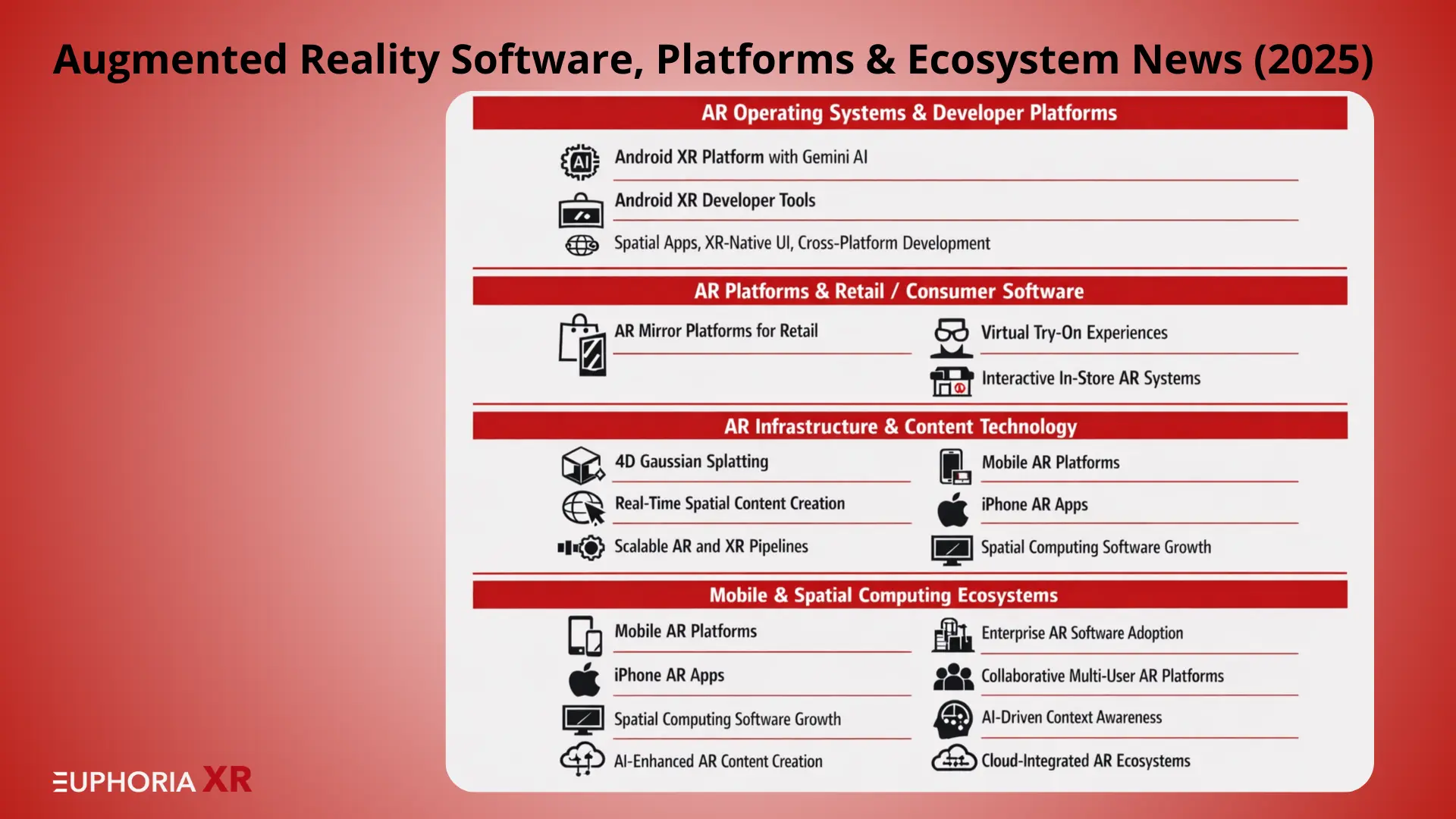
Google Announces Android XR Platform with Gemini AI
Formal announcement: 8 December 2025.
On December 8, 2025, Android XR was officially launched by Google; it is viewed as an operating system focused on the field of augmented reality glasses and mixed-reality headsets.
Google pointed out in the announcement:
Extensive penetration of Gemini AI.
Android applications in the form of space.
XR-native Notifications, Maps, and Assistant.
Bluetooth Headset and Glass support.
Google asserted that Android XR will be used to establish an open ecosystem, which will enable various hardware providers to use a common platform to develop AR and XR devices.
Official Reference:
Google officially described the Android XR and Gemini AI integration in its product press release, which includes plans for AI to give XR experiences to both glasses and headsets.
Android XR Developer Tools Released by Google
In 2025, Google declared a fresh Android XR developer tools that will enable the development of applications on AR glasses, AR headsets. These tools are directed at assisting developers in porting existing Android applications to the spatial experience.
SpatialUI adaptation tools.
Cross-platform XR-applications.
Gemini AI’s development of intelligent AR.
Long-range ecosystem growth orientation.
XREAL Aura Hardware Demos
In 2025, XREAL demonstrated the demos of Aura hardware to demonstrate Android XR-based practical AR glasses. These prototypes were to demonstrate a real-world use and not an experimental prototype.
Form factor of lightweight glasses.
Web-based formative clinics.
Usability and the use situations.
Priority to portability as opposed to immersion.
LOOOK.AI Launches AR Mirror Platform for Retail
LOOOK.AI announced the release of its AR mirror platform in the retail and e-commerce sectors in 2025.
The platform enables:
Virtual try-ons
In-store AR mirrors are of an interactive nature.
Improved interaction with the customers.
Emerging use of AR in real-world and online shopping places indicates the presence of the 2025 launch.
Scentient Launches Digital Scent Device for AR/VR
Product Announcement: 2025
In 2025, Scentient declared that it was working on a scent digital device, which would allow adding the smell of things to the AR and VR worlds.
The announcement focused on:
Multisensory immersion
Affective and emotional involvement.
AR and VR applications of this type of experiment.
This project of 2025 points to exploration beyond the visual-only immersive technology.
Gracia AI Raises Funding for 4D Gaussian Splatting
Funding Announcement: 2025
In 2025, Gracia AI said it was raising funds to develop its 4D Gaussian Splatting technology and allow better real-time spatial content creation.
The funding supports:
Faster real-time 3D rendering
Better spatial visual vision.
Scalable AR and XR flow of content.
This source of funding, carried out in 2025, highlights the attention of investors to AR infrastructure technologies.
Snap Advances Mobile Augmented Reality Experiences
Reported in 2025
In 2025, Next Reality reported that Snap maintained its lead in mobile augmented reality through large-scale Lens Ecosystems provided by Snapchat. AR strategy of Snap continued to be centered on scale, accessibility, and creativity.
Critical spheres of improvement were:
Improved Lens Studio tools
AR content production with the help of AI.
AR experiences outside of entertainment.
The decision of Snap to be mobile first preserved the notion that AR, which is supported by smartphones, is the most popular in 2025.
Apple Vision Pro Fuels Next Phase of AR Development
Ongoing Coverage in 2025
Next Reality (2025) reported on how the Apple Vision Pro would keep on shaping the future of augmented reality and spatial computing. Although Vision Pro is not a pure AR glasses, but a spatial computing device, it has had a big influence on the AR ecosystem.
Coverage emphasized:
Spatial app development growth.
There is a greater interest among developers and enterprises.
Shaping user expectations of AR and mixed reality.
The additional launch of Apple Vision Pro and the development of the AR ecosystem in the year 2025 pushed the discussion of AR further, as it was no longer experimental, but platform-mature.
Meta’s AR Glasses Move Closer to Mainstream
Reported Throughout 2025
In the course of 2025, the Augmented.Reality.News (Next Reality) clashed widely following the achievements made by Meta in making AR glasses more mainstream. Reporting emphasized the shift of Meta that is based not on experiments but on prototypes that are makeshift and have a practical application.
Among the major developments that have been noted are:
The areas of smart glasses are under incremental development.
Artificial intelligence-reading is built into eyewear.
Slow adoption of the display components as opposed to complete holographic AR.
Instead of highlighting AR glasses as an innovation (futuristic), the 2025 strategy by Meta prioritized usability, price, and real-life application, which is an indication of wider consumer adoption.
AR Smart Glasses Adoption Accelerates
Industry Trend Observed in 2025
In 2025, Next Reality recorded growth in the use of AR smart glasses, especially in consumer and corporate markets. This was not a movement that was linked to a particular product introduction, but it was based on the movements in the market.
Reported drivers included:
Lighter hardware designs
Increased battery efficiency.
Real-life examples, including navigation, alerts, and beats.
In the coverage, 2025 was posed as a transitional year in which AR glasses were closer to becoming more of an ordinary product than a niche technology.
Apple Vision Pro Redefines Spatial Computing
Analysis Published in 2025
In 2025, several analyses were published in AI Magazine, which has positioned Apple Vision Pro as a spatial computing redefiner. Instead of covering AR visuals, the emphasis was on the manner in which Vision Pro reinvents interaction models.
Key points discussed:
Flat screens will be substituted by spatial interfaces.
Professional and enterprise applications.
AR/VR convergence implications in the long term.
Vision Pro, an acceleration of innovation in the immersive technology realm, was positioned in a way to bring AI Magazine to view innovation as an emergent force within the industry.
Top Augmented Reality Apps for iPhone
Published in 2025
In 2025, AI Magazine added AI-based content and reviewed the most popular augmented reality apps for the iPhone, which explains the constant evolution of mobile AR along with hardware.
Coverage focused on:
Applications of AR that are utility-based.
Innovation and performance applications.
Smartphone adoption by consumers.
This report solidified the position of iOS as one of the key platforms of mainstream AR experiences.
AR and VR Market Growth Driven by Enterprise Adoption
Market Analysis Released in 2025
According to the article in AI Magazine (2025), enterprise adoption is one of the most powerful contributors towards the market AR and VR growth. Instead of the sole use of consumer gaming, the businesses took more operational experience with immersive technologies.
Key sectors highlighted:
Manufacturing
Healthcare
Training and simulation
Remote collaboration
The analysis aligned the enterprise use as a stabilizing factor of the AR and VR markets.
AI and AR Convergence Reshapes Immersive Tech
Trend Analysis Published in 2025
The discussion of artificial intelligence and augmented reality as a turning point in immersive technology, which was highlighted in the scope of AI Magazine in 2025, sees the merging of both technologies as a defining development of the latter.
The convergence themes comprised;
Experiences in an AR context-aware.
The recognition of objects through AI.
Spatially intelligent interactions.
The article realized the convergence between AI and AR as the basis of the next generation of the immersive platform, not a trend.
Enterprise AR Software Adoption Expansion
Reported Across 2025
The introduction of AR software applications that are enterprise-oriented increased in both regulated and operational features in 2025. Instead of using experimental pilots, organizations used more production-ready AR software systems in the real world.
Some of the important enterprise software applications were:
Preparation of work instructions and quality control.
Telehealth in surgery and healthcare.
Training, onboarding, and simulation of their workforce.
Technical and operating support by remote experts.
This growth made enterprise software a stabilizing influence on the AR business, with high ROI and long-term commitment to the platform.
Collaborative and AI-Driven AR Platform Maturation
Observed Throughout 2025
By 2025, AR systems will become collaborative and artificially-enhanced systems as opposed to solitary visual overlays. The software development allowed multiple users to communicate in a common AR environment in real-time, which is facilitated by cloud synchronization and AI-enabled context-understanding.
Developments in platforms that have been highlighted include:
AR shared sessions among several users.
Object recognition and spatial cognition (AI).
Context-initiated overlays line with the intent of the user.
Enterprise system integration and cloud integration.
This period of maturity meant a transition to AR as a permanent, smart platform, which will become the basis of the next generation of spatial computing ecosystems.
Augmented Reality Trends (2025)
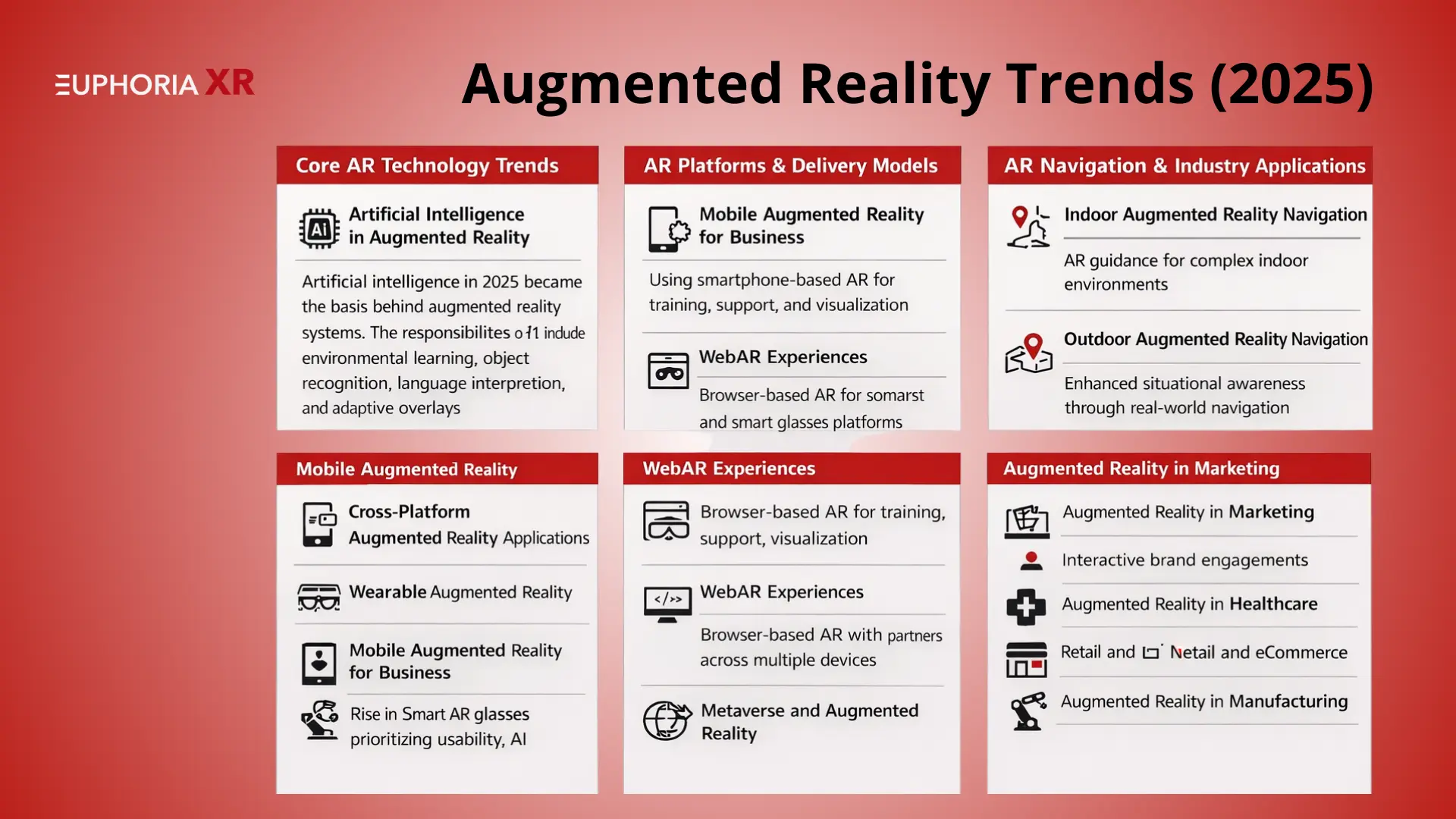
Artificial Intelligence in Augmented Reality
Artificial intelligence in 2025 became the basis behind augmented reality systems. The responsibilities of AI include environmental learning, object recognition, language interpretation, and providing context-based overlay. Dynamically-adaptive AR experiences are made possible by the combination of computer vision and large language models, as opposed to fixed content.
Mobile Augmented Reality for Business
Another dimension that grew immensely in 2025 was mobile augmented reality; businesses started using smartphone-based AR in training, remote support, field, and product visualization. Since smartphones have already become highly ubiquitous, mobile AR is the most scalable and low-cost method through which organizations can implement AR solutions.
WebAR Experiences
By introducing the use of augmented reality via web browsers without having to download applications, WebAR only increased in 2025. This open access propelled WebAR to be highly favored in marketing, previewing of certain products, and short-term campaigns, in which individuals could access AR immediately on several devices.
Cross-Platform Augmented Reality Applications
The development of cross-platform AR was made a priority in 2025 when firms tried to provide universal experiences on smartphones, headsets, and smart glasses. Combined frameworks and content that were hosted in the cloud were utilised to ensure that one AR experience could be sustained across a variety of hardware ecosystems.
Wearable Augmented Reality
In 2025, wearable augmented reality will be driven by smart glasses as an everyday product. Rather than the immersive visuals, these gadgets were oriented towards the lightweight design and glanceable content like notifications, navigation, and AI support, which makes AR more realistic and socially acceptable.
Indoor Augmented Reality Navigation
In 2025, indoor AR navigation saw improvement with organizations bringing forward a visual guidance system, which would offer directions to places where GPS does not work. AR overlays allow people to navigate their complex indoor spaces, like in an airport, hospital, warehouses, and shopping centers, by overlaying directions directly in their line of sight.
Outdoor Augmented Reality Navigation
In 2025, the outdoor AR navigation was developed further by integrating the GPS, mapping, and computer vision to reveal real-time directional overlays. The solution enhances situational awareness of pedestrians, tourists, and navigation in the city by integrating digital directions with the real physical world.
Augmented Reality in Marketing
AR was a common marketing resource through which brand experiences were made interactive in 2025. AR campaigns enabled customers to interact with products virtually, which enhanced the engagement, brand recall, and time during which customers communicated with the marketing content.
Augmented Reality in Healthcare
The use of AR in healthcare increased in 2025 to train, observe internal organs during surgery, and collaborate remotely. AR helps medical practitioners to overlay important data in making critical information during the procedure and facilitates more efficient education and simulation settings.
Augmented Reality in Retail and eCommerce
AR became an essential tool in the retail and e-commerce industry in 2025 to enhance customer trust and minimize returns. Online trial-ons, 3D display cases, and store AR mirrors served as a solution and bridged the divide between online and offline shopping.
Augmented Reality in Manufacturing
Enhancing manufacturing was still among the most active areas of AR implementations in 2025. AR is applied to provide work instructions, maintenance instructions, and quality control, overlaid and enhance the efficiency and minimise errors on the production floor.
Augmented Reality in Automotive
In 2025, automotive firms extended the use of AR in the form of sophisticated head-up displays and driving assistance systems. AR overlays are designed to display navigation signals and safety data right on the driver’s view, increasing the level of awareness and keeping distractions to a minimum.
Metaverse and Augmented Reality
Augmented reality was the interface that became the most sensible in larger metaverse strategies in the year 2025. Instead of committing to fully virtual worlds, firms positioned AR as a concept of a linkage between the physical world and the digital life, which rested on a real-life usefulness instead of hype.
Augmented Reality Technology Updates
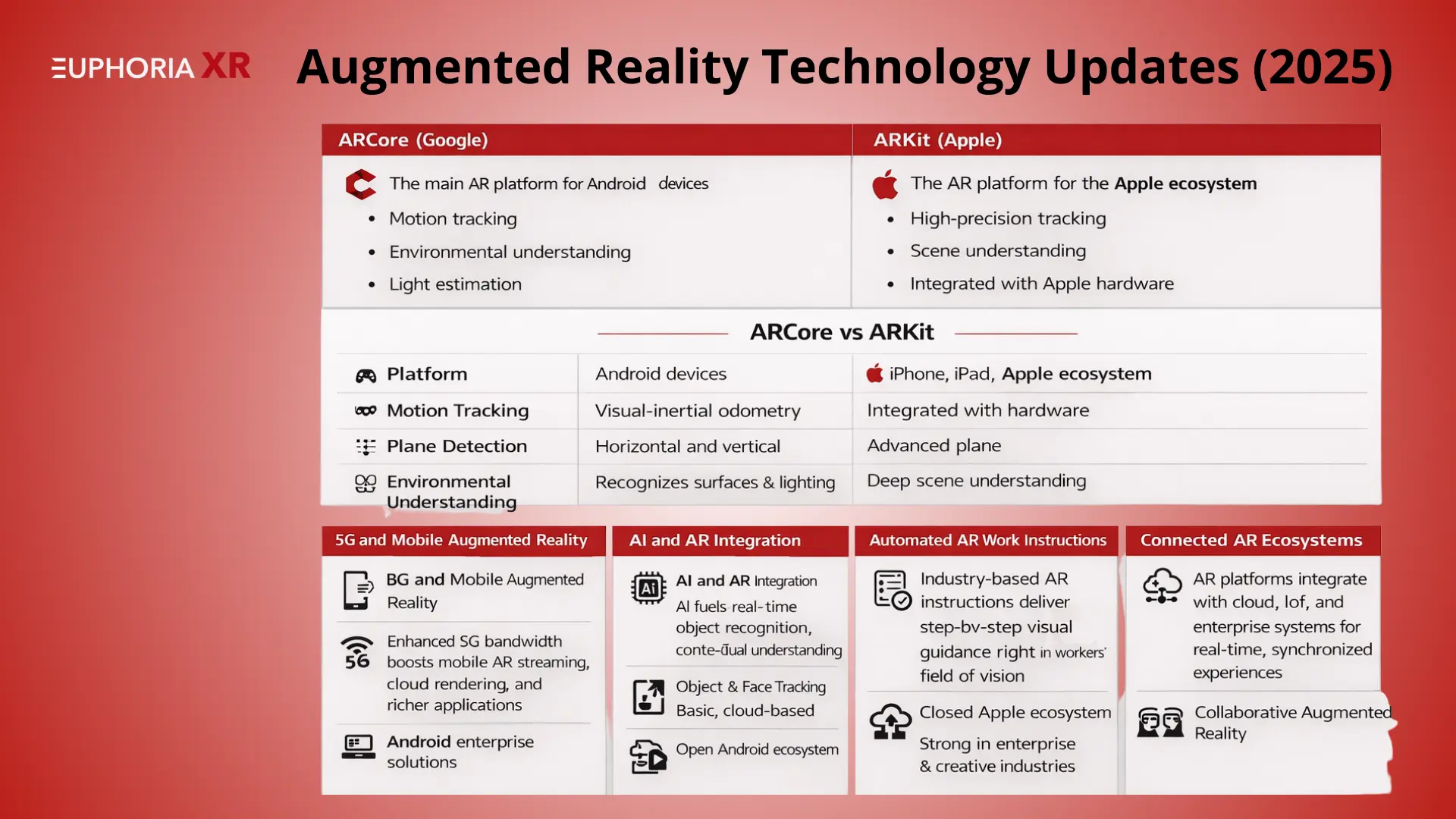
ARCore
ARCore remained a developing platform in 2025 as the main platform on Android devices created by Google. It allows tracking movements, understanding the environment, and estimating light, so the interaction of digital objects with real-world spaces can be more natural with the help of smartphones and supported AR wearables.
ARKit
ARKit continued to be the fundamental augmented reality system of Apple in 2025, driving the experiences of AR on iPhone, iPad, and on the spatial computing platform of Apple. It specializes in tracking with high precision, understanding the scenes, and integrating with Apple hardware, and it is used in consumer and professional AR.