

AI news, trends, updates, and announcements continue to transform the business, society, and global infrastructure at a rate never experienced before. Whether it is large-scale companies integrating Generative AI into their business processes or the scale of data centers hurrying to meet global energy needs, the current artificial intelligence environment is transforming at an unparalleled speed. This is an overview of the most significant AI news and official AI launches, which identify the influential trends in AI influencing industries across the world as of December 2025.
Artificial Intelligence News
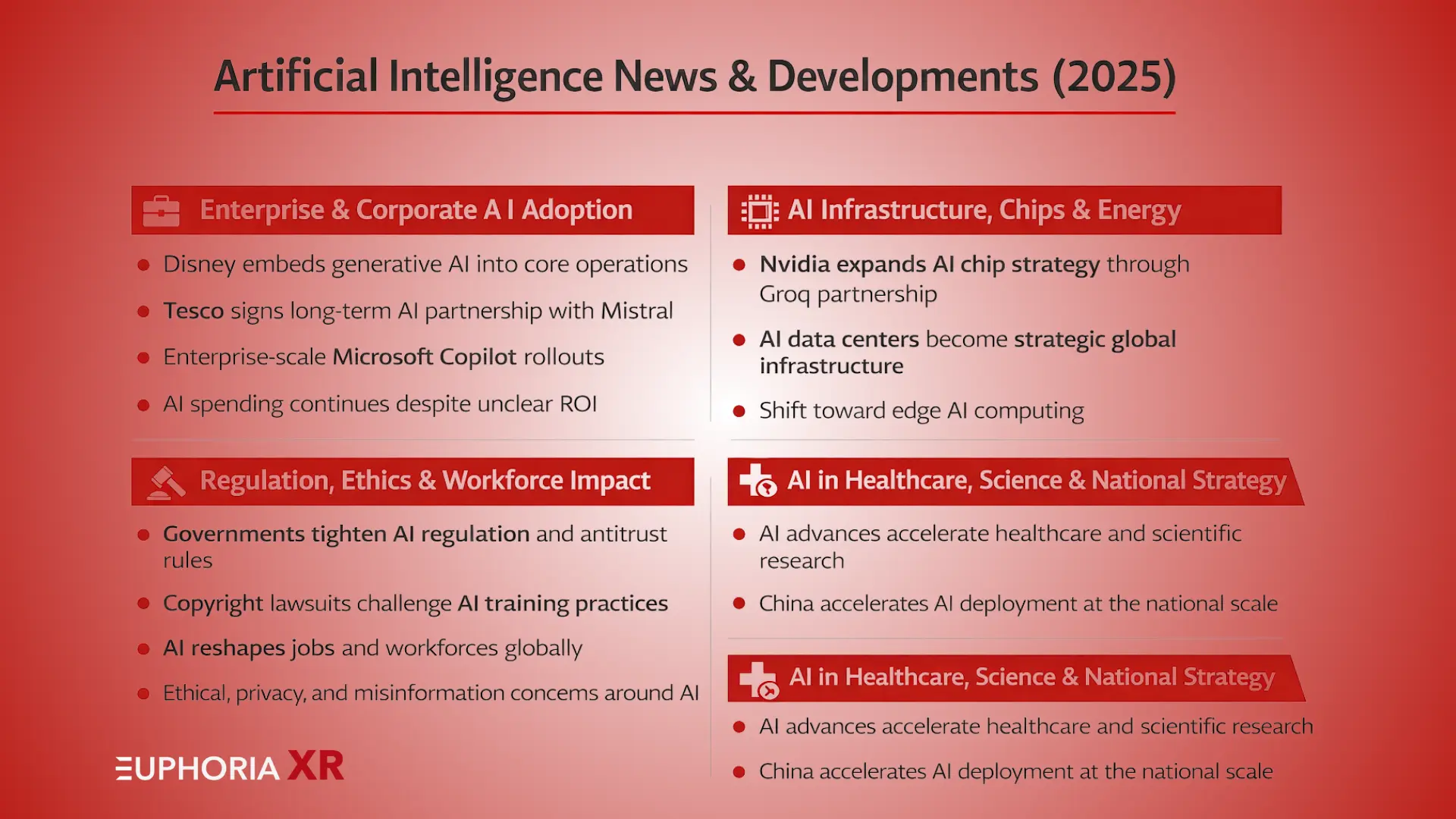
Disney embeds generative AI into core operations
Date: December 26-27, 2025
The Walt Disney Company has switched from generative AI in experimental projects to an organization-wide application in creative, marketing, and operating departments, and has put it under very strict IP guardrails. Disney is also collaborating with AI vendors such as OpenAI to integrate them into its processes instead of viewing them as conceptual side projects.
Associated: Disney had also agreed to invest over 1 billion dollars, and a 3-year character licensing contract with OpenAI, which means Sora and ChatGPT users will be allowed to use over 200 Disney, Pixar, Marvel, and Star Wars characters by the beginning of 2026.
Nvidia expands AI chip strategy through Groq partnership
Date: December 24-25, 2025
Nvidia has just made its biggest acquisition of all, reaching/buying a strategic licensing deal and partnership with an AI chip company called Groq, worth 20 billion. The technology of Groq’s low-latency processor will be incorporated by the chipmaker into its AI data-centre design architecture and acquire key executives, such as the CEO of Groq, whilst Groq as an entity stands alone. This is an indication of the growing fight over inference-focused AI hardware.
AI data centers become strategic global infrastructure
Date: Reported December 23, 2025
The insatiable electricity demands of AI are altering the methods of electricity production and consumption: ageing power generating plants formerly called a peaker power plant, are now kept online or reactivated to produce electricity to feed AI data centers, especially in the United States, where the need to generate electricity has become suddenly profitable again, and the older generation of plants were less efficient than in historical use.
This highlights the fact that the strategy of AI expansion is not only digital but also physical infrastructure, and new items in the equation are energy grids, capital markets, and urban development.
AI spending continues despite unclear ROI
Date: Throughout 2025
The leaders of corporations are enhancing AI capital spending across industries, with direct financial benefits remaining unclear. Companies are betting more on AI infrastructure, data-center construction, and internalization than on the immediate profits, with a long-term investment bet on the productivity effect of AI, but it also casts concerns on the efficiency of investments in 2026.
Tesco signs long-term AI partnership with Mistral
Date: December 23-22, 2025
Mistral AI, a French-based AI company, and Tesco, a retail giant in the UK, signed a three-year generative AI contract. The acquisition opens Tesco up to the commercial models of Mistral, and it also has a shared AI lab in which they can create a better AI to meet the needs of customers, analytics, and internal processes.
Enterprise-scale Microsoft Copilot rollouts
Date: December 2025 (ongoing)
India and years of Consulting, software development, and enterprise operations, Microsoft Copilot is being deployed to tens of thousands of licenses by major service firms around the world. This is the end of small-scale pilots to organization-wide. It would be wise to mention that, though there exists no universal rollout date that companies can be said to have been implementing, this trend was announced in several business news sources throughout the month of December.
AI reshapes jobs and workforces globally
Date: Reported up to December 5, 2025.
The role of AI in the employment market continues to be the key story: analysts at the Reuters NEXT conference at the beginning of December highlighted that AI can boost the number of jobs and offer them out, it can replace a job, especially an office job, and senior management declares reduced growth rates in headcount and increased work priorities.
Copyright lawsuits challenge AI training practices
Date: Cumulative through 2025
There are several cases of lawsuits that claim that AI models have been trained on copyrighted content without permission, compelling courts to find answers to the fair use and copyright nexus. These court cases can impact future norms of data-training and regulatory regimes.
Governments tighten AI regulation and antitrust rules
Date: December 27–28, 2025
The new draft rules issued by China to regulate AI systems, which replicate human interaction, require safety, the prevention of addiction, and the control of ethical content. This action represents an increasing trend in the international direction of AI governance.
In other countries, regulators (such as the EU and Italy) have acted by imposing the need for modification in the deployment of AI chatbots, especially in the areas where they influence competition and user reach.
AI advances accelerate healthcare and scientific research
Date: December 18, 2025
Research groups in China have recently introduced novel AI-based models, which can quickly generalize clinical data and enhance evidence-based medicine, and promote better diagnosis and treatment recommendations. This demonstrates how AI is moving beyond the productivity tools to act as an accelerator in research.
Shift toward edge AI computing
Date: Trend that will be seen during 2025.
Edge AI, where data is processed on devices as opposed to cloud server-based servers, is becoming a trend that aims to minimize latency, reduce costs, and improve privacy. This change is indicative of maturity in AI infrastructure models. (Blazed throughout the tech news of the world).
China accelerates AI deployment at the national scale
Issue date: Draft regulations, December 27, 2025.
The AI control mechanism of China is intended to guide its high-speed implementation, but provide safety, ethical, and national security restrictions to the use of AI services that are emotionally interactive, which emphasizes the purpose of Beijing to be the first to implement AI worldwide and control its influence on society.
Ethical, privacy, and misinformation concerns around AI
Date: Ongoing in 2025
The lack of regulations regarding AI safety measures, ethical utilization, and misinformation control is still under the focus of governments, watchdogs, and independent studies, proving that the trust and regulation of people is as important as the power. The reason is that the figures have been reported through numerous sources, such as industry indexes, industry safety reviews, etc.
Artificial Intelligence Trends (2025)
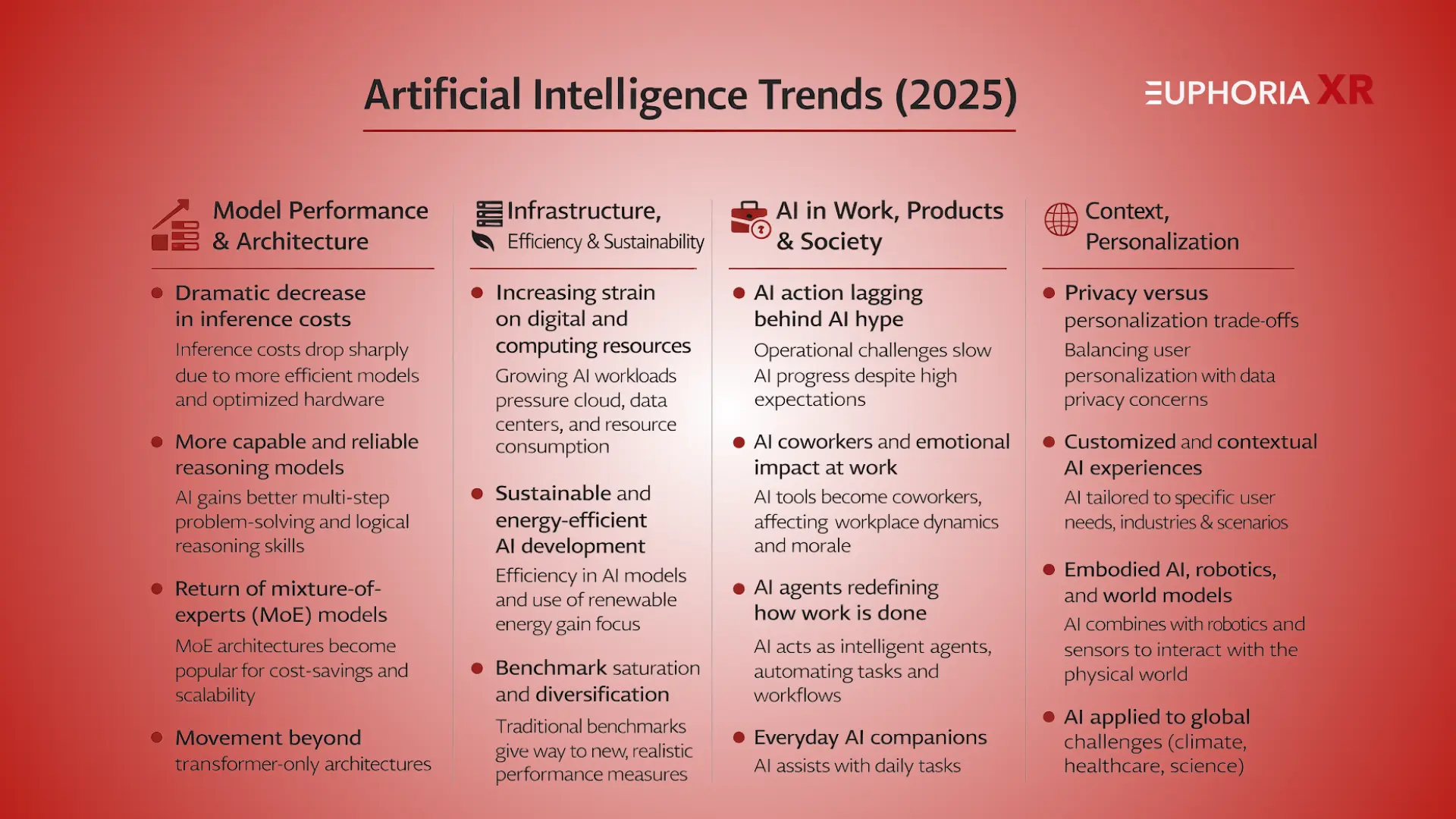
Dramatic decrease in inference costs
The term AI inference describes the cost incurred when executing a trained AI model. By 2025, the inference cost is declining at an accelerated pace by using more efficient model architectures, improved hardware acceleration implementation, chip optimization, and smart deployment processes. Such a rapid decrease is what makes the AI deployment cost-effective on scale, enabling companies to incorporate AI into daily workflows like customer care, analytics, and automation without having to spend too much money on infrastructure.
More capable and reliable reasoning models
Multi-step problem solving, long-context understanding, and decision-making are also some of the complex reasoning tasks that AI models can increasingly deal with. Modern reasoning models can assess the situation, execute steps logically, and minimize hallucinations, as opposed to generating superficial or shallow answers. This advancement renders AI more credible in the application of enterprises, research, and mission-critical applications.
Increasing strain on digital and computing resources
The accelerated development of AI is exerting a significant burden on cloud providers, data centres, GPUs, power systems, and water supplies to cool them down. With the increasing AI workload, organizations have to deal with the escalating costs and maintain sustainability and capacity constraints. This pressure is transforming the way governments, utilities, and technology companies design infrastructure investments.
Return of mixture-of-experts (MoE) models
Mixture-of-Experts models do not perform the whole network, but rather deactivate a sub-network of model components within each task. Such a solution here maximizes efficiency and saves costs, and is more scalable. Architectures of MoE will lead to a resurgence among current solutions in 2025 to enable trade-off of performance and compute-related limitations, particularly regarding very large enterprise and cloud-based AI systems.
AI action lagging behind AI hype
AI is top of the news and on PowerPoint presentations, but its actual execution falls short of the hype. Organizations face much difficulty in replicating pilot projects into production systems because of data quality problems, integration problems, regulatory issues, and skills gaps. This trend identifies the difference between AI promises and operational reality.
Benchmark saturation and diversification
Conventional AI benchmarks can no longer be used as a metric of real model ability, since many of them already rank at the top. Because of this, new standards are coming up that are based on real-world work, the level of reasoning, safety, robustness, and performance at the domain level. The latter shift can be seen as a more developed consideration of AI systems.
Movement beyond transformer-only architectures
Although the transformer models still prevail, researchers are developing other architectures that are more efficient, more reasonable, and more memory-effective. These are hybrid approaches, recurring systems, and novel neural architectures that are aimed at reducing the constraints of transformers, like high computational complexity and restrictions in context length.
Embodied AI, robotics, and world models
Embodied AI is a combination of perception, reasoning, and action. The use of AI systems to reason and communicate with the physical world is becoming more common in 2025 in the form of robotics, simulation, and world models. This allows use in the industry, logistics, health, self-driving, and intelligent environments.
Privacy versus personalization trade-offs
The more AI systems are personal, the more they need access to user data, and this brings privacy, consent, and data security concerns. Regulatory compliance and ethical responsibility present a trade-off where organizations should walk a fine line between providing personalized AI experiences, compliance, and responsibility. Such a trade-off is influencing the design of products, data control, and predetermination of AI.
AI coworkers and the emotional impact of AI at work
There is a trend of placing AI tools as computing partners as opposed to inactive tools. It changes the work relations, trust among the employees, motivation, and identity of the job. Management, Organizational collaboration, accountability, and mental well-being need to be handled in such a manner that they maintain a positive human-AI interaction.
AI models are becoming more capable and useful
In addition to technical advancement, AI models are becoming closer to actual business requirements. They perform more, particularly in following instructions and integrating with software systems, and give actionable output. The trend indicates the shift of AI, as an experimental technology, to a productive, reliable engine.
AI agents redefining how work is done
AI agents can plan, perform, communicate with the tools, and coordinate with human beings independently. These types of agents are changing the workflow in software development, customer service, operations, and research in 2025. They decrease handwork and make it possible for other kinds of automation, other than mere scripts.
Everyday AI companions
The AIs help users manage schedules, find information, learn skills, as well as make decisions, which is becoming a part of their everyday life. These friends are more conversational, context-specific, and personal, and take AI out of the workplace, into the personal and consumer experiences.
Sustainable and energy-efficient AI development
Now, AI has become a significant issue regarding its impact on the environment. Organizations are focusing on energy-efficient models, streamlined hardware, the use of renewable energy, and responsible scaling. The evolution of sustainable AI is not only a competitive and regulatory requirement but an option as well.
Customized and contextual AI experiences
Artificial Intelligence is becoming devised in a manner that is sensitive to the user situation, sector, job, and purpose. These are domain-specific models, fine-tuning, and contextual memory. Personalized AI enhances the relevance, accuracy, and user experience and minimizes non-specific results.
AI applied to global challenges (climate, healthcare, science)
Some of the effects of AI on solving large-scale issues include climate modeling, healthcare diagnostics, drug discovery, disaster response, and scientific research. Such applications show the possibility of AI resulting in societal value beyond the commercial types of applications and are an important strategic asset in world development.
Artificial Intelligence Announcements
Meta Announces Acquisition of AI Startup Manus
Meta declared the purchase of AI startup Manus as it plans to build robust AI capabilities, in particular, AI agents and autonomous systems. This relates to the shift that Meta is making toward incorporating smarter and more goal-focused AI into its products, such as social media, messaging apps, and business tools. Such an acquisition is the beginning of increased competition among large tech companies to end up with proprietary AI talent and technology.
Microsoft Announces $17.5 Billion AI Investment in India
Microsoft announced it had plans to invest 17.5 billion dollars in India to develop AI and cloud infrastructure. The statement revolves around developing data centers, assisting AI studies, and educating millions of individuals in AI skills. This makes India a key center of AI development at the global level and a long-term goal of Microsoft in order to make AI implementation on a population-wide level.
U.S. Department of Defense Launches GenAI.mil Platform
For the U.S military and defense personnel, the U.S Department of Defense unveiled a safe generative AI site dubbed GenAI.mil. The platform permits the restricted application of generative AI to plan, document, and internal processes, and protects strong security standards. It is one of the first enormous government applications of generative AI.
Google Announces Gemini 3 and Major AI Platform Updates
Google declared significant changes to the ecosystem of AI, which included the introduction of the Gemini 3 models and further enhancement of AI integration into Search, Workspace, and developer tools. The updates concentrate on enhanced reason, enhanced speed, and multimodal features. The announcement further confirms the desire of Google to be a competitor in the highest level of generative AI innovation.
U.S. Health Department Launches AI Innovation Prize Program
The U.S. Department of Health and Human Services declared a program called AI innovation prizes to stimulate the development of AI applications to address challenges of healthcare and caregiving. The program aims to fast-track useful AI tools to enhance patient care, lessen the workload on caregivers, and impact efficiency in healthcare due to responsible use of AI.
U.S. Department of Health and Human Services Unveils AI Strategy
HHS also released an all-inclusive AI plan that covers the manner in which the artificial intelligence will be incorporated into federal health activities. The plan focuses on responsible use, privacy of data, transparency, and better health outcomes among people in society. Such an announcement creates a structured path to AI adoption in the healthcare systems of the U.S.
Amazon Announces Large-Scale AI and Supercomputing Investment
Amazon declared that it would invest tens of billions of dollars in AI and supercomputer systems, mainly through AWS. The investment provides government cloud services, inference, and the big scale AI training. This action underscores the increasing significance of the dominance of infrastructure during the AI race.
European Union Announces Plan to Build AI Gigafactories
The European Union proposed the concept of creating AI gigafactories to aid in high-performance computing and sovereign AI development. The purpose of such facilities is to lessen the reliance of Europe on overseas AI infrastructure and the competitive edge of the region in terms of more advanced AI studies and deployments.
Cisco Launches Unified Edge Platform for Agentic AI Workloads
Cisco proposed a single platform in Edge United, which can accommodate distributed and agent-based AI loads. The platform allows processing AI nearer to the data sources, which lowers the latency and bandwidth consumption. This declaration is in line with the general trend of edge AI and decentralized computing.
Florida Proposes Citizen Bill of Rights for Artificial Intelligence
Florida introduced a Citizen Bill of Rights on Artificial Intelligence, which was meant to ensure the privacy of consumers, their transparency, and ethical AI. The proposal indicates the growing role of states in governing AI and the relevance of politics in perceiving the impact of AI in society.
Samsung Teases AI-Focused “First Look 2026” Event
Samsung launched its next event, part of the First Look 2026 series, which indicated that the company is going to pay significant attention to AI-powered consumer technology. The news item suggests the use of AI in Smart Homes, customized devices, and the future of home ecosystems, with AI playing an increasing part in consumer electronics.
Microsoft Signals 2026 as Key Year for AI Diffusion
According to Microsoft leadership, 2026 will be the year of AI, where the current trend of experimentation will end, and there will be massive adoption in industries. The announcement highlights how AI is being diffused into daily business processes, government services, and productivity systems all over the world.
What Artificial Intelligence Development Services Does EuphoriaXR Offer?
EuphoriaXR provides practical AI development solutions for real-world businesses that are scalable and practical. The services provided assist companies in deploying AI in software, automation, and conversational infrastructures with a high degree of reliability, performance, and long-term value.
AI Development Company
EuphoriaXR is a full-stack AI Development Company that offers personalized artificial intelligence applications that are tailored in accordance with practical business requirements. It is concerned with scaling, production-ready, and reliable AI systems, but not experimental ones.
AI Software Development
EuphoriaXR does AI Software Development that can integrate into existing systems and processes. These applications and systems involve data applications, systems of automation, prediction, and smart tools designed to suit the enterprise and industrial needs.
AI Chatbot Development Services
EuphoriaXR offers AI Chatbot Development Services to allow intelligent and context-sensitive conversations in customer support, internal operations, and digital products. These chatbots are accuracy-scaling punched at real-life applications, with customer applications addressing both enterprise and customer needs.
Conclusion
The AI news, trends, updates, and announcements in 2025 make one thing clear: artificial intelligence is no longer a matter of innovation; it has become a matter of infrastructure. Businesses, government, and technology officials are no longer experimenting with AI; they are integrating it into their business processes, rules, and long-term strategic planning. Given the rate at which AI is being adopted, the current emphasis is placed on scalability, governance, sustainability, and workforce impact.
To become informed about the newest news of artificial intelligence and official AI announcements, it is crucial to keep up to how artificial intelligence will continue to impact business, society, and the world systems in the future.


![Top 50 (CTA) Call to Action Synonyms That Drive ROI & Conversions [+ Examples] - Euphoria XR](https://euphoriaxr.com/wp-content/uploads/2026/02/Top-50-CTA-Call-to-Action-Synonyms-That-Drive-ROI-Conversions-Examples-Euphoria-XR-1024x576.webp)