Have you observed how people disregard ads nowadays?
They scroll fast. They skip videos. They block banners. Now imagine this. Customers do not look at your brand; they go into it.
Such a change is the reason why people are seeking an immersive experience agency to establish deeper connections with AR and VR.
PwC argues that the effectiveness of immersive training in enhancing retention of learning is four times higher than that of classroom training. Shopify states that the conversion rates can rise by 94 percent with 3D and AR product content. These numbers show one thing. Immersive technology works.
We should disaggregate the way agencies utilize it and the significance of the same.
What is an Immersive Experience Agency?
An immersive experience agency is a business establishment that designs brand experiences that are interactive on the basis of technologies such as 3D design, Augmented Reality, Virtual Reality, and spatial computing.
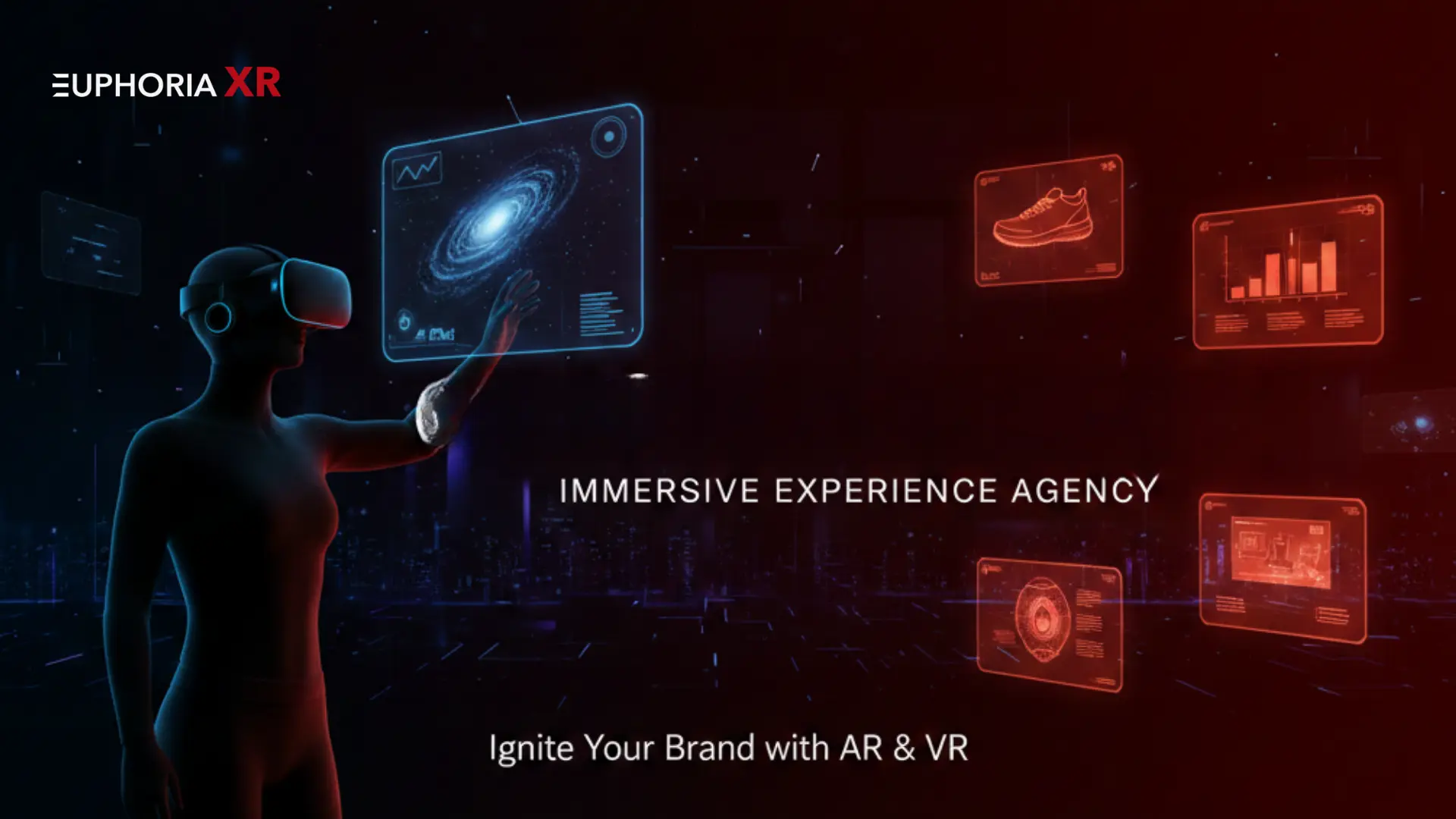
They are not displaying a message, but creating experiences that one can visit and experience.
These agencies are a combination of strategy, creative design, and technology to assist a brand:
As an example, a brand experience agency can create a virtual showroom in which customers can walk around and play with the product. AR-powered experiences of live events could be developed by an immersive events agency. An immersive experience design agency is centered on creating a follow-through of the user experience, concept to deployment.
In straightforward terms, an immersive experience agency assists brands in shifting from the ad to the interaction.
What Does Immersive Experience Mean?
An immersive experience refers to a complete involvement in an environment that is perceived as real and interesting.
The user is no longer an outsider, and instead, he is integrated into the experience.
Immersion can include:
Seeing products in 3D
Strolling in an imaginary world.
Playing with computerized objects.
Demonstrating information overlay in real space using AR.
Gamification of brand campaigns.
It has also been determined that immersive experiences enhance memory and interest. PwC studies revealed that VR learners are four times more concentrated than traditional learners. The same rule can be applied in marketing. People retaliate better when they are involved.
Put simply, an immersive experience implies that the audience does not simply see the brand. They experience it.
How Agencies Use AR VR for Immersive Brand Experiences?
Most brands are invisible.
Not because they are bad.
But they are memorable.
People scroll. They skip. They ignore.
Now here is the shift.
You do not need to ask customers to pay attention to your brand…
What, should they be able to enter it?
It is precisely what an immersive experience agency provides in terms of AR and VR.
A report by Statista estimates that the AR and VR market in the world will exceed 100 billion dollars in the coming years. PwC studies indicate that levels of uneasiness and confidence are much better with immersive experiences than with classic formats.
This is not a new technology that is still in the experimental stage.
It is a tactical marketing infrastructure.
Let us deconstruct the way the agencies actually utilize AR and VR to create brand experiences that are immersive.
Creating Immersive Brand Storytelling
The old method of telling stories is linear.
Its immersive narration is spatial.
Users navigate a branded environment as opposed to viewing a 30-second advertisement. They move through it. They interact with it. They make choices.
A typical immersive experience design agency would have the following format:
Define the brand narrative
Move it into a virtual world.
Also added engaging touchpoints.
Showcase users a predetermined path.
Example use cases include:
This leads to increased emotional involvement. The emotional involvement enhances the brand recall. Harvard Business Review validates Emotional connection as an important factor in Long term Customer value.
Stories are memorable when they are immersed.
Enhancing Product Visualization and Understanding
Uncertainty is one of the greatest causes of friction in the marketing sphere.
Customers drag their feet in the absence of visualised value.
AR removes that friction.
Through the assistance of a brand experience agency, the companies are now enabling the customers to:
Store goods in the real world using the mobile AR.
3D view machineries before acquisition.
Turn, zoom, and scan product details.
Test features virtually
According to Deloitte, 71 percent of shoppers reveal that they would have shopped more frequently had there been AR experiences.
This is not just engagement.
This is the conversion optimization.
An immersive experience agency US is oriented towards the development of intuitively visualized tools that reduce hesitation and enhance confidence in buying.
Driving Customer Engagement Through Interactive Campaigns
It is not just a matter of impressions to engage.
It is about interaction.
Some of the campaigns designed by an immersive events agency or a Los Angeles experiential marketing agency can include:
AR-based retail activations
VR simulation in trade shows.
Interactive installations that are gamified.
Captivating product launch experiences.
Here is the difference:
Traditional marketing
Audience watches
Immersive marketing
Audience participates
Involvement raises the dwell time.
The longer the dwell time, the higher the memory retention.
Brands’ preference happens because of memory retention.
Brand experiences agency models are the reason why their rapid growth occurs in competitive industries.
Creating Immersive Video Experiences
Video still matters.
But passive video is becoming ineffective.
Agencies now create:
360-degree interactive videos
VR guided tours
Select your brand path narratives.
Real-world product showcasing.
According to Think with Google data, interactive formats are always at the top in terms of engagement indicators.
Immersive video makes the audience explorers.
Such a change enhances the attention capacity and absorption of the message.
How Companies Leverage AR and VR in Marketing?
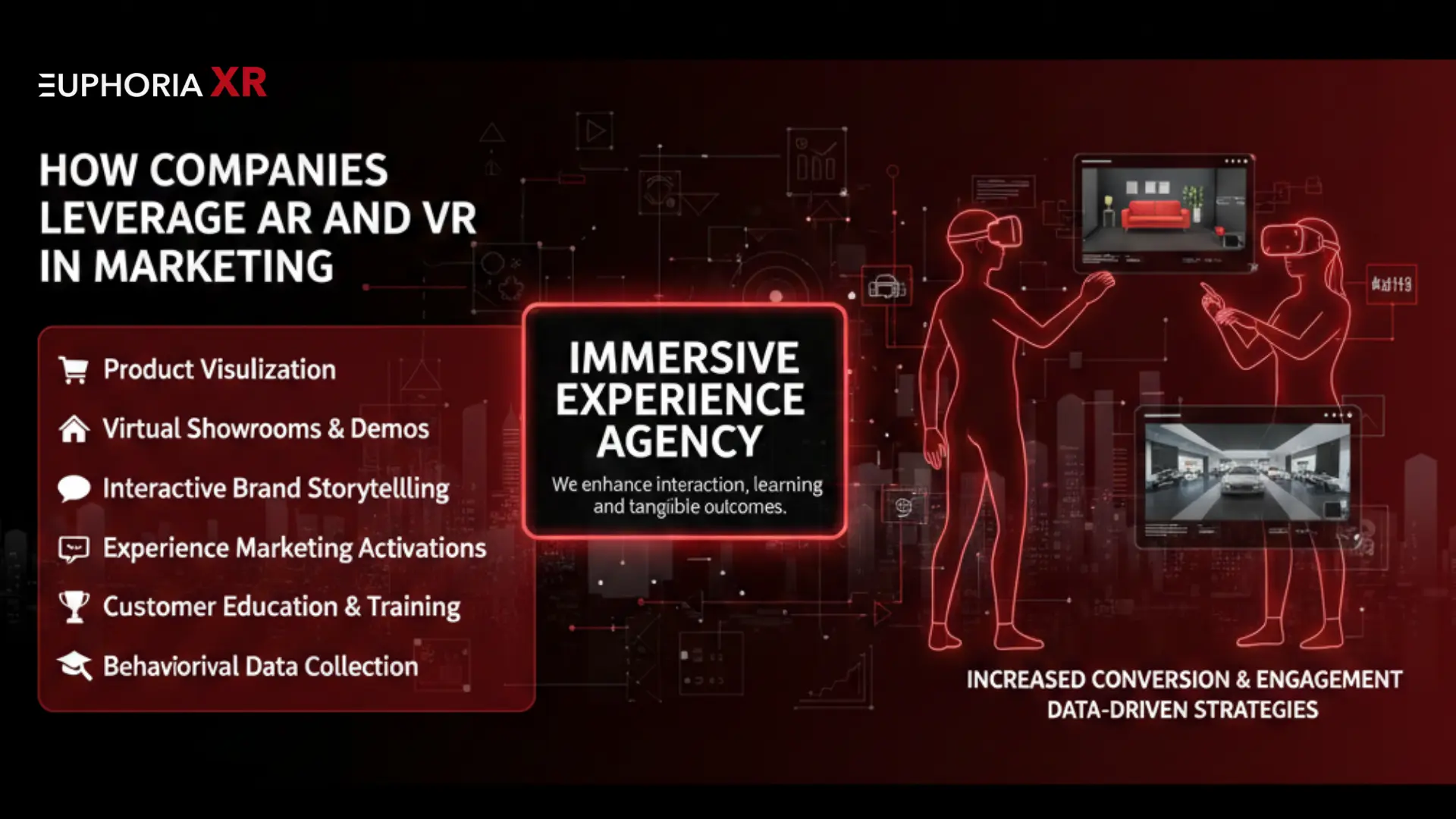
AR and VR allow companies to enhance interaction and learning and achieve tangible outcomes. The immersive experience agency assists the brands in strategically using these technologies, not only by being creative.
Product Visualization
AR enables customers to view the products in a real-life setting before making purchases. This enhances confidence and increases the purchase level. Research indicates that AR experiences can drastically boost the rate of conversion as opposed to a two-dimensional image.
Virtual Showrooms and Demos
VR allows customers to visit goods, homes, or equipment within simulated environments. It best applies to the complex or high-value products.
Interactive Brand Storytelling
Narratives are experiences through which brands guide users rather than display linear advertising. The involvement enhances memory and emotional attachment.
Experience Marketing Activations
AR and VR will be implemented in trade shows, retail spaces, and live events. A physical and digital layer in an immersive events agency is used to raise the dwell time and interactivity with the audience.
Customer Education and Training
Immersive simulation is used to explain technical services and products in a clear manner. There is greater decision-making with increased knowledge.
Behavioral Data Collection
AR and VR platforms can monitor interaction time, have interaction features, and navigation behaviors. An immersive experience agency US links this information to the campaign performance measures.
7 Things Immersive Experience Companies Do
Immersive experience companies offer end-to-end solutions that consist of strategy, technology, and measurement. Their involvement is more than development.
Brand strategy and immersive concept development
They establish goals, audience behavior, crucial messages, and measures of success. The brand positioning and marketing objectives are aligned with the immersive idea before the development.
AR and VR app development
They create tailor-made mobile AR applications, web-based immersive applications, and VR applications. The main priority is stability in performance, usability, and scalability.
3D modeling and interactive design
They develop three-dimensional art assets that are realistic and interactive systems. Clear navigation and user-friendly interfaces will make it strongly engaged.
Experiential event integration
They incorporate immersive technology in the live activations, which are organized with production teams and venues to be seamlessly executed.
Hardware deployment
They handle headset administration, sensors, interactive kiosks, and infrastructure either on an individual basis or a multi-location basis in order to have a uniform experience delivery.
Compliance and accessibility planning
They use data privacy standards, safe storage procedures, and universal design principles that provide standards to address regulatory and accessibility laws.
Analytics and performance tracking
They also track engagement, user conduct, and the impact of conversion to find out the effect of climate-guiding optimization.
How Tech Agencies Ensure Regulatory Compliance in Immersive Experiences?
Tech agencies incorporate compliance in the design and deployment. They implement immersive systems in compliance with the rules of data protection, including GDPR and CCPA, by transparent consent and by working with encrypted information.
Security-based infrastructure encompasses restricted access control, secure host environments, and periodical vulnerability testing. Transparency and accountability are supported with documentation.
The standards of accessibility are considered so that the immersive platforms can be accessible to a variety of audiences. Inclusive design minimizes the risks and reinforces the brand.
Hiring an approved immersive experience agency in the US, the companies can be sure that immersive campaigns are not only interesting, but also safe, proper, and planned.
How to Select an Immersive Experience Agency?
The choice of the immersive experience agency does not include the most inventive demo. It is a matter of selecting a partner that can bridge strategy, technology, compliance, and quantifiable outcomes.
The AR and VR projects are concerned with the complexity of development, the coordination of hardware, user experience design, and the protection of data. A systematic assessment approach causes fewer risks and improves long-term performance.
The following are the major considerations:
Proven Portfolio
Look at actual case studies and not concept reels. Find quantifiable objectives, like engagement, conversion lift, or event participation.
Technical Capability
Check with the agency on whether they develop AR and VR applications internally. The US should have a firm immersive experience agency that does not outsource development, 3D design, and integration heavily.
Strategic Alignment
The agency has to start with brand goals and viewer habits. Technology is not supposed to substitute marketing objectives.
Scalability
Determine whether they are able to grow out of a small prototype to a national or global implementation. The planning of infrastructure is important.
Compliance Readiness
Make sure that they have data privacy, data security, and access protocols in place initially.
Performance Measurement
The agency must also relate immersive engagement measurements to business KPI, like leads, sales, or retention.
An organized partner minimizes the risk of operations and enhances the profitability of investments.
5 Questions to Ask Immersive Experience Agencies
What immersive technologies do you specialize in?
Know whether the agency is mobile AR-oriented, WebAR, VR headset, mixed reality, or spatial computing. Specialization has an influence on platform compatibility and scalability.
How do you measure engagement and ROI?
Ask them about their way of monitoring engagement time, level of interaction, impact of conversion, and behavioral analytics. A developed immersive experience agency US is supposed to offer structured reporting that is related to business goals.
Can you scale from prototype to deployment?
Most agencies develop impressive demos but can not manage them on a large scale. Affirm their multi-location rollout experience, hardware logistics, and stability of infrastructure.
How do you handle compliance and user data security?
The immersive platforms can gather behavioral or device data. GDPR and CCPA-compliant agency frameworks, reliable hosting, encoded data processing, and-organized consent processes should be adopted by the agencies.
What post-launch support do you provide?
Immersive systems must have updates, optimization, and technical monitoring. Make sure that the agency provides service, monitoring of performance, and post-implementation cyclical improvement.
Best Full-Service Branding Agencies for Immersive Brand Experiences (2025)
By 2025, immersive marketing will not be experimental anymore. It is organized, fact-based, and results-oriented. The most ideal full-service branding agencies that provide immersive solutions are those ones that incorporate brand strategy, the ability to tell stories, and technical achievements into one unified approach.
The US providers of the leading immersive experience agencies usually provide:
End-to-End Brand Integration: Immersive campaigns will help support positioning, messaging, and long-term brand architecture, and not as stand-alone activations.
The AR and VR can be developed in-house: Specialized engineering teams provide stability of the application, interoperability across the devices, and shorter release cycles.
Experiential Event Capabilities: A good infrastructure of immersive events agencies will provide an opportunity to mix the real world with virtual through a digital layer.
Performance Analytics: The engagement time, behavioral interaction, and conversion impact are monitored by the advanced dashboards to bridge the gap between the immersive experience and measurable ROI.
Accessibility and Compliance Systems: Aggressive agencies incorporate privacy policy, protection of hosting, and universal design principles in each release.
Scalable Deployment Systems: They are able to transition from a prototype to either a national or global rollout without a reduction in quality.
The agency of a brand experience in 2025 will be based on finding the common ground of strategy, design, engineering, and governance.
Best Practices in Immersive Marketing
Immersive marketing works effectively when it is organized and planned. The performance and risk reduction best practices are described below.
First, begin with a strategy. Establish specific goals, how the audience acts, and quantifiable results before implementing AR or VR technology.
Secondly, make it easy to use. Simulated environments should be interactive. Explicit direction gets the time invested.
Third, combine information measurement at the very beginning. Monitor the depth of interaction, dwell time, and feature consumption so that features are continuously optimized.
Fourth, associate immersive technology and brand identity. The visual design, the tone, and the message should be consistent across the channels.
Fifth, make sure there is obedience and safety. Open data management fosters confidence and helps develop the credibility of a brand in the long term.
Sixth, scaling design. It is through the infrastructure planning that the immersive initiatives can extend past pilot phases.
Immersive campaigns create long-term effects on marketing when these principles are observed.
Why Choose EuphoriaXR As Your Immersive Experience Agency for AR VR Experiences?
EuphoriaXR provides strategy-based brand experiences, incorporating design and technology to provide high-performance AR and VR brand experiences. Each project will have a set of objective business objectives and quantifiable KPIs that are used to guarantee immersive campaigns to facilitate actual interactions and conversion.
It offers scalable, secure, and results-driven immersion solutions with the in-house development of AR and VR, sophisticated 3D design, and seamless integration and compliance frameworks. It is not only about innovation. It is concerning quantifiable development and brand effect in the long run.
Wrapping Up!
Immersive marketing is no longer a luxury of brands seeking attention, engagement, and quantifiable growth. AR and VR enable businesses to get beyond passive advertising and develop participatory spaces where customers explore, learn, and engage. These experiences have real business impact associated with them, and this is achieved by a qualified immersive experience agency that integrates brand strategy, immersive design, development expertise, compliance planning, and performance tracking. With heightened competition across sectors, the company investing in more organized immersive ecosystems acquires a stronger differentiation, a stronger connection with customers, and long-term marketing benefit.
Frequently Asked Questions (FAQs)




![Top 50 (CTA) Call to Action Synonyms That Drive ROI & Conversions [+ Examples] - Euphoria XR](https://euphoriaxr.com/wp-content/uploads/2026/02/Top-50-CTA-Call-to-Action-Synonyms-That-Drive-ROI-Conversions-Examples-Euphoria-XR-1024x576.webp)