Ever taken out your phone to look at one thing and then lost focus for 10 minutes?
AI-powered smart glasses are a solution to that problem.
Nowadays, a significant number of people are online for a large amount of time. Adults on the internet spend an average of 6 hours and 38 minutes online a day, according to DataReportal’s Digital 2025 report. That is digital support is already integrated into everyday life. The only issue is that the majority of them still reside on a phone display.
Smart glasses are the latest tool to help, with the help of artificial intelligence.
They can respond to queries, interpret conversations, take photos, play sounds, display private notes, read text, provide directions, and keep users connected without constantly keeping their eyes on a phone.
Hence, the market is surging rapidly. According to Grand View Research, the global smart glasses market will reach USD 14.38 billion by 2033 at a CAGR of 24.2 percent from 2026 to 2033 and will be estimated at USD 2.46 billion in 2025.
In layman’s terms, AI-powered smart glasses aren’t merely another gadget. They’re now a new way to utilize digital support in the real world.
What Are AI Power Smart Glasses?
AI-powered smart glasses are smart glasses that are empowered by artificial intelligence to listen, see, understand, and respond. They can assist users to obtain answers, listen to text while reading, take photos, handle calls, read text, follow instructions, or access information without using their hands.
They could be regular-looking glasses. In the interior: microphones, speakers, cameras, small displays, sensors, touch control, apps, and AI assistants.
The more popular term for them is the AI-powered smart glasses. However, some look for AI-powered smart glasses, and at an extensive level, both are practically interchangeable.
There are AI glasses out there that are geared towards the lifestyle.
Some focus on work.
Some concentrate on privacy.
Some concentrate on the ease with which people can use it.
Others are related to travel and translation.
Hence, this class can be confusing initially. AI smart glasses aren’t all created equally.
How Do AI-Powered Smart Glasses Work?
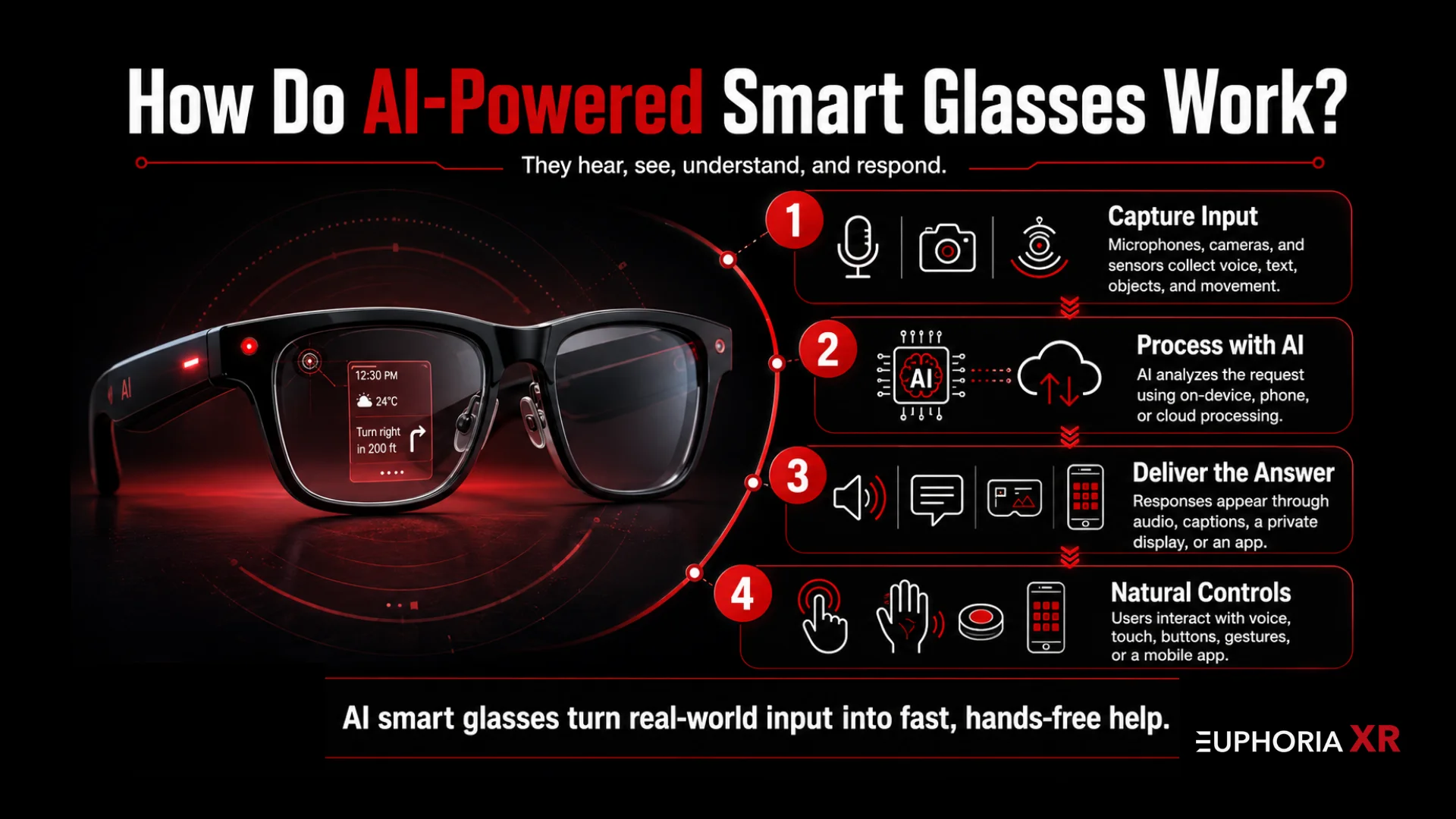
The concept behind AI-powered smart glasses is to capture data from the surroundings, apply AI algorithms to analyze it, and provide useful responses through speech, screen, or a mobile application. The procedure can be easily performed. The glasses hear, see, comprehend, and interact.
They Capture Input
It is the first step is INPUT. This means that the glasses are able to gather data about the user or the environment.
They can receive input through microphones, cameras, sensors, touchpads, buttons, or apps on their mobile devices that connect to them. For instance, when a voice command is given, microphones can pick it up. Text, objects, signs, or scenes can be seen on a camera. Sensors can be used to sense movement or position.
A user may ask, “What is the meaning of this sign?” and “Translate this sentence. The glasses then grab this request and process it with AI.
They Process Information With AI
The glasses then take in the input data and relay it to the AI system. This AI can function using the glasses, a wireless device, or cloud processing.
The AI analyzes the request and comprehends the need of the user. Can listen, understand, and translate languages, identify objects, read text, summarize conversations, or answer questions.
That’s why AI-enriched smart glasses are unique from regular Bluetooth-ready glasses. Basic Bluetooth glasses can play music or receive calls. The AI-powered smart glasses can then “get the context” and give a useful answer.
They Deliver the Answer
The answer is then sent back to the user via the glasses once the AI has processed it.
The response could be delivered through open-ear speakers, in a small private exhibit, via live captioning, translation, voice, or a companion app. If a user asks for directions, for instance, the glasses could announce the next turn or display it on the glasses. The user can request a translation, which then can be displayed or spoken by the glasses.
To offer helpful assistance without having to reach for a telephone.
Users Control Them Naturally
Smart AR Glasses with AI technology should be controlled easily. They are easily controlled by voice controls, touch controls, frame buttons, gestures, smart rings, or mobile apps.
This makes it feel like it is natural. The user can speak to, tap, or gesture to an object, as opposed to unlocking the phone, opening an app, and typing a question.
The most effective AI smart glasses render digital assistance effortless, hassle-free, and hands-free.
Main Types of AI-Powered Smart Glasses
AI-powered smart glasses come in many varieties. There are some that are designed to be used to take photos. Some are designed to be used in the workplace. Others are designed to be used for privacy. Others are designed for ease of operation or simple operation by hand.
Everyday AI Camera Glasses
Every day, AI camera glasses are designed for everyday use. Some of the features they come with are cameras, microphones, speakers, artificial intelligence assistants, calling, texting, and capturing photos and videos.
People who want to take photos from their perspective will be able to use these glasses to do so. They can also answer phones, ask questions, listen to music, and communicate, while keeping their hands free.
They’re ideal for travelers, creators, busy professionals, students, and common users who value ease of use with their hands free.
Display-Based Productivity Glasses
These are display-based productivity glasses, with a small display within the user’s line of sight. This display can be used to represent notes, captions, translations, reminders, directions, or AI prompts.
These glasses are great for meetings, presentations, travel, learning, and work. A speaker is able to view the talking points. Translucent words can be viewed by a traveler. Reminders can be seen by a professional while in conversation.
The primary use of their is private support. The user receives useful information without bending down to a cell phone!
Camera-Free Privacy Glasses
Camera-free privacy glasses are intended for those who wish to reap the advantages of “smart” glasses without the recording capability.
Some of these glasses could still provide AI support, private viewing, translation, alerts, and reminders, and hands-free controls. But they don’t want to deal with the cameras, so as to minimise privacy issues.
They can be a great option for workplaces, schools, meetings, and crowded areas where camera glasses might be cumbersome. They’re also great for those who wish to utilize AI assistance without appearing under surveillance or being recorded.
Accessibility AI Glasses
AI glasses that improve the usability of the device for blind and low vision users. They can read text, describe scenes, identify objects, recognize people, detect colors, and give audio guidance.
These users are not just looking for convenience with AI smart glasses; they are seeking a transformative experience. They can enable day-to-day independence.
The glasses could, for instance, read a menu, identify a product label, describe a room, or give the user an understanding of what is in front of them.
Budget Bluetooth AI Glasses
Budget Bluetooth AI glasses are not as complex or expensive. These are also frequently equipped with speakers or microphones, playback of music, calling, voice assistant functions, UV protection, or even basic translation.
The glasses may lack advanced displays and have limited AI capabilities. However, they can still be useful for those who would like smart functions at a cheaper cost.
They’re ideal for casual users, budget shoppers, and those who are new to smart glasses.
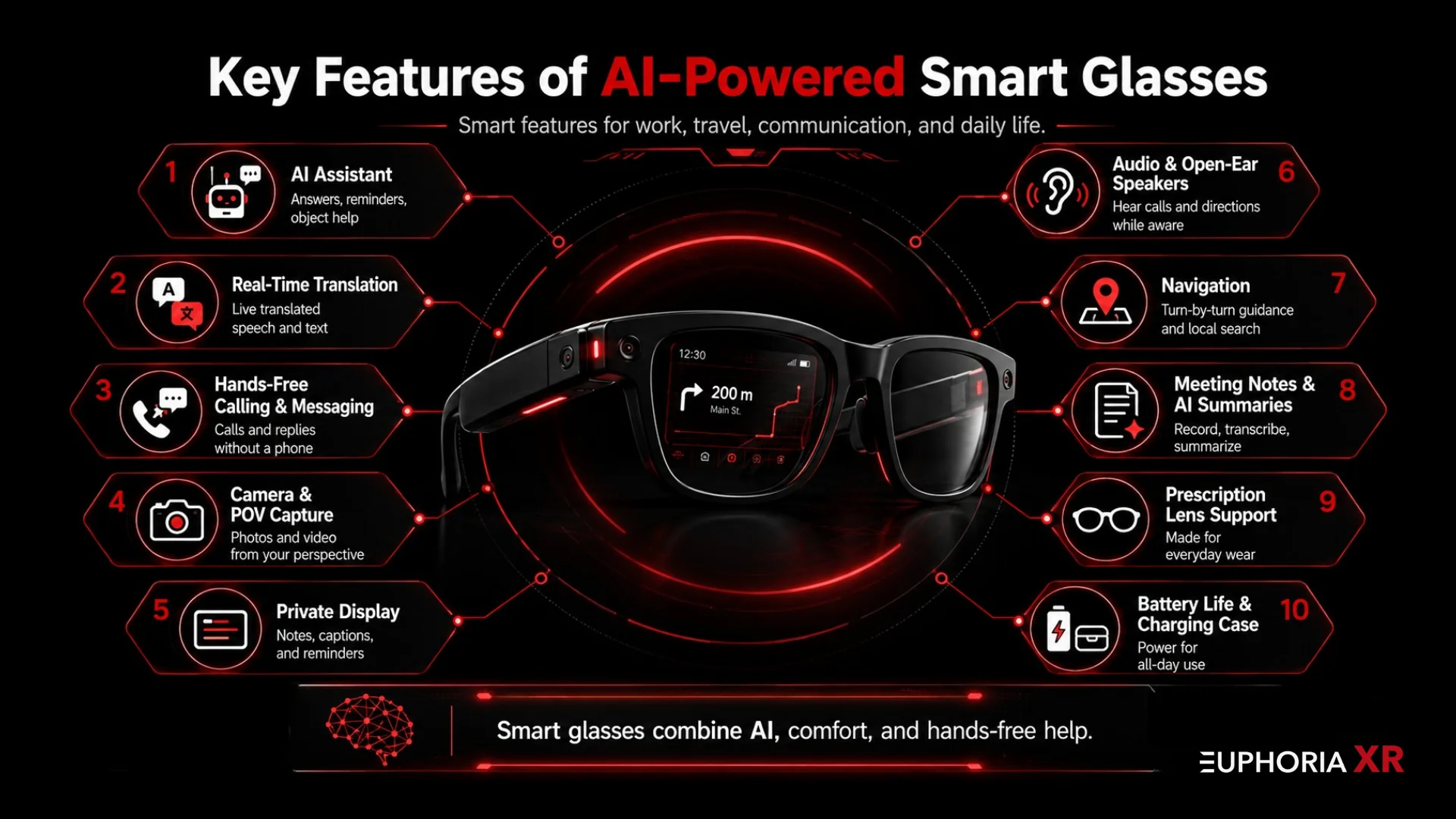
Key Features of AI-Powered Smart Glasses
Smart Glasses with AI capabilities can be equipped with numerous features. The most important features vary depending on the user’s predominant need.
AI Assistant
An AI assistant enables users to query it and receive an immediate reply to their queries. It can be used to remind, identify objects, translate, summarize, give directions, and for general information.
For instance, the user can say, “What am I looking at? or “Remind me to call later”. Then the glasses communicate back via audio, display, or app.
Real-Time Translation
Real-time translation feature allows the understanding of another language in conversations. The text on some glasses is translated onto an e-text display. Others give speeches on the translation via audio.
This helps travel, conduct business meetings, provide customer service, study, and have multilingual conversations.
Hands-Free Calling and Messaging
Lots of AI smart glasses enable users to place and take calls, hear messages, and send replies without needing to hold a telephone.
Useful for walking, cooking, working, when walking is safe and legal, or while carrying objects.
Camera and Point-of-View Capture
Some smart glasses that are powered by AI have a camera to take photos and videos. This enables the user to get a picture of what he/she sees from his/her own perspective.
This feature will be beneficial to content makers, travellers, parents, sports users, and field professionals.
Private Display
A private display is able to display information only to the wearer. It can display notes, captions, translations, reminders, steps to navigate, or AI suggestions.
This is helpful as important information will be visible to the user without requiring a laptop or phone.
Audio and Open-Ear Speakers
Open ear speakers enable users to listen to calls, music, voice replies, and directions without losing their sense of hearing.
Unlike earbuds, where there is complete blockage of the ears, these kinds of earplugs do not completely seal the ears. It assists users in remaining connected while being attuned to the surrounding world.
Navigation
Navigation options enable users to go from one point to another. The glasses can offer walking instructions, a local search, map directions, or voice-based turn-by-turn directions.
This is helpful for travelers, commuters, and those looking to explore new destinations.
Meeting Notes and AI Summaries
A few smart glasses with AI capabilities have the ability to record, transcribe, or summarize conversations. This way, users can concentrate on what they’re saying rather than on making notes.
This can be helpful when you’re running a meeting, a job interview, a lecture, a visit to a doctor, a sales call, or a training session.
Prescription Lens Support
Those who wear glasses on a daily basis should have some Prescription Lenses Support. For many people, smart glasses that do not accommodate prescription glasses may not be worn regularly.
The best pair of AI glasses should feel like your real pair of glasses rather than your smart equipment.
Battery Life and Charging Case
Among the top criteria is battery life. AI smart glasses require electricity for microphones, speakers, cameras, monitors, sensors, Bluetooth, Wi-Fi, and AI.
There are also glasses that have charging cases to increase the time of using the glasses all day long. The battery’s actual operating time, as opposed to standby time, should be checked by buyers.
Benefits of AI-Powered Smart Glasses
AI-enhanced smart glasses are helpful in that they help to bring digital assistance into real life. Users can access assistance via voice, audio, display, or artificial intelligence rather than removing a cell phone from their pockets for every little thing.
Key benefits include:
Less reliance on a phone: AI smart glasses eliminate the need to repeatedly go back to a phone. Users can ask questions, listen to messages, receive directions, or receive calls without having to take their eyes off a screen.
Improved information access: Users have quick access to information when they need it. They can request a translation, read a sign, recognize an object, or read a reminder in seconds, for instance.
Enhanced hands-free communication: AI-enabled smart glasses enable you to call, send messages, and perform voice commands without using your hands while walking, cooking, working, traveling, or holding items.
Enhanced content capture: AI glasses with cameras can take pictures and videos from the user’s perspective. Better to hold up this than a phone.
Enhanced travel and language capabilities: Real-time translation, navigation, local search, and sign reading capabilities can make travel easier, particularly in areas where the user is not fluent in the local language.
Increase meeting confidence: AI glasses can display notes, captions, reminders, or AI cues during meetings. They can also make a summary afterwards of the meeting, allowing the user to focus more on listening during the meeting.
Users with accessibility needs will gain greater independence: AI glasses for accessibility can read the text, describe the object, detect colors, and describe the surroundings of blind and low vision people, so that they can have a more confident experience.
Privacy Concerns With AI-Powered Smart Glasses
While AI-powered smart glasses are helpful, they also pose privacy issues. This is due to several models containing cameras, microphones, AI processing, app permissions, and cloud features.
The most important thing is that the person wearing them might not be aware of what the glasses are doing all the time.
Typical concerns about privacy are:
Camera recording: A few AI smart glasses have camera recording capabilities. This can cause discomfort in public, office, school, or private settings.
Microphones are always available to use: Voice commands require microphones. Users should verify that the glasses will only listen when they provide a wake command or that the glasses will listen in the background.
Bystander privacy: Bystanders are not aware that their image is being recorded by smart glasses. That’s why many brands now employ some sort of recording light or camera-free designs.
Cloud data processing: Cloud-based AI capabilities share voice, image, or text data with cloud servers for processing. The users should check the method in which the company stores, uses, and deletes that data.
App permissions: There are applications that require most AI glasses. The app can ask for permission to use Location, contacts, camera, microphone, notifications, or media files.
Confidential data/ customer privacy: Camera glasses may be prohibited in some workplaces due to the protection of confidential data, customer privacy, or security regulations.
Social comfort: If the glasses are legal to wear, then people may feel uncomfortable if they believe that they are being recorded.
The easy way to minimise risk is to ensure you review the privacy features before purchase. Check the app permission settings, data deletion options, clear privacy policies, microphone controls, and camera indicators. In cases where privacy is crucial, the camera-less AI glasses could be more suitable.
Are AI Power Smart Glasses Worth It?
While AI-powered smart glasses are potential game-changers, they require to address a problem that most people encounter daily. They don’t need to be for everybody. The value will vary based on the frequency of use of hands-free assistance, translation, calls, content capture, productivity assistance, or accessibility features.
They Are Worth It If
Here are some reasons why purchasing AI-powered smart glasses might be worthwhile:
You’d like to spend less time on your phone throughout the day.
While out and about, working, cooking, or traveling, you receive calls or messages.
Frequent travel & require translation/navigation assistance.
You make videos, photos, tutorials, or point-of-view pieces.
Attends meetings and desires notes, captions, or summaries.
You need reminders, prompts, or instructions in your line of sight.
Need assistance in reading text, identifying objects, or understanding surroundings.
You’re already a glass wearer and desire smart glasses that can be worn with your prescription glasses.
You enjoy wearable technology that is a part of your everyday life.
They May Not Be Worth It If
AI smart glasses may not be suitable when:
Normal glasses are all that is necessary.
You don’t want to add a device to the charge.
Uncomfortable with the use of camera/ microphone technology.
You would think that they would do everything to replace your cell phone.
For all-day use, a long battery life is necessary.
You’re looking for a more immersive AR or VR experience.
You’re purchasing merely because the item is well-known.
The basic music and calls are primarily required, and lower-priced Bluetooth glasses are capable of handling that.
The easiest method to come to a conclusion is simple. If glasses help to make a task easier that you do every day, they might be worthwhile. They might not need all the additional features if you don’t use them often.
How to Choose the Best AI-Powered Smart Glasses?
Your primary use case should be the first place to start when looking for the best AI-powered smart glasses. Don’t just make a selection based on the list of features. Select according to what the glasses are required to aid in the betterment of a person.
Start With the Main Use Case
The first thing you need to do is to know the reasons behind acquiring AI smart glasses.
Ask yourself:
Would I like to capture photographs and videos?
Is it necessary to have real-time translation?
Would I like to receive hands-free calls and messages?
Do I need to have notes or reminders for meetings?
Would you like to have navigation assist?
Should there be any accessibility features?
Are privacy and not taking pictures important to me?
Would I like to have a big screen for watching movies or playing games?
This step helps in making the decision easier. Each of these users, a traveler, a creator, an office worker, a student, a low-vision user, might require a different kind of AI Glasses.
Check Comfort and Weight
Comfort is crucial as smart glasses are worn on the face.
Check:
The comfort and feel of the glasses are paramount, and even the best AI features will not help if they are uncomfortable or heavy.
Compare Battery Life
Depending on the battery, you may get a lot of usage.
Don’t just consider standby time. Test the actual usage battery life of what you want.
Compare:
Call time
Music playback time
Camera recording time
Display usage time
Translation usage time
AI assistant usage time
Charging case suppor
Long standby time does not necessarily mean that the battery life will last for a long time when the product is in use.
Look at AI Features
Many products incorporating the word “AI” don’t necessarily have powerful AI capabilities.
Test to see if the glasses can:
Consider Camera vs Camera-Free Design
One of the most significant decisions.